Honda has begun producing storage batteries for AI data centers in the United States. Behind this are two major environmental changes: the enormous power demand in the rapidly expanding generative AI market and the slowdown of the EV market in North America.
- Production conversion to storage systems at joint venture factories
- Overview and Schedule of the New Ohio Plant
- Demonstration of Hydrogen Fuel Cell Technology for Data Center Conversion
- The North American EV Market Slows Down and Honda’s Cautious Stance
- Explosive surge in electricity demand due to the spread of generative AI
- The Ministry of Economy, Trade and Industry’s Vision of the 5 Trillion Yen Market and Japan’s Chances to Win
- Mass production start and contribution to revenue from 2025 onward
Production conversion to storage systems at joint venture factories
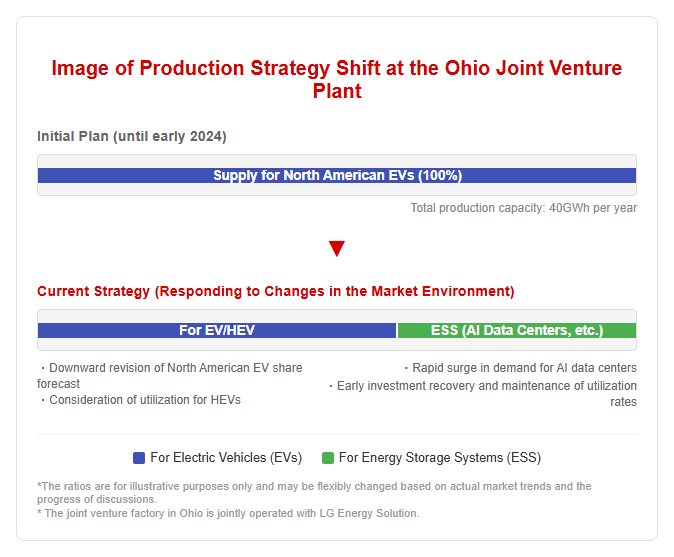
Honda has partially reviewed its production plan for electric vehicle (EV) batteries in the United States and has decided to start producing batteries for energy storage systems (ESS) for AI data centers. Specifically, discussions are underway to redirect part of the originally planned EV production capacity for energy storage applications such as data centers at a large-scale battery factory being built in Jeffersonville, Ohio, in collaboration with South Korea’s LG Energy Solution. This decision comes in response to a sharp slowdown in EV demand in the North American market and serves as a strategic steering to avoid the risk of excess invested production capacity. Honda’s management aims to achieve early monetization and stable operation by meeting the rapidly growing power demand for generative AI without wasting the large capital investments already made. Please refer to the diagram below.
Overview and Schedule of the New Ohio Plant
The new factory under construction in Ohio is operated by a joint venture between Honda and LG Energy Solution, with construction entering its final stages aiming for completion within 2024. Mass production of lithium-ion batteries is scheduled to begin within 2025, with an annual production capacity expected to reach up to 40 GWh. Initially, all batteries produced at this factory were supplied to Honda’s North American plant and planned to be installed in EVs sold in North America. However, considering the current market environment, flexible utilization, including conversion to stationary storage batteries, is being considered. Since the investment in this factory amounts to several hundred billion yen, securing a new high-growth market for data centers will play a crucial role in maintaining profitability in Honda’s North American operations.
Demonstration of Hydrogen Fuel Cell Technology for Data Center Conversion
Alongside mass production of lithium-ion batteries, Honda is also accelerating the development and demonstration of stationary power supplies for data centers utilizing hydrogen fuel cells (FC). At the American Honda Motor facility in California, a demonstration operation of a stationary power supply reusing the FC system of the fuel cell vehicle “Clarity” began in March 2023. This system has an output of approximately 500kW, demonstrating its practicality as a clean emergency power source for data centers. In recent years, the expansion of cloud and big data utilization has led to a rapid increase in the power requirements of data centers, creating a growing demand for high-quality emergency power sources that can provide stable power even during disasters. Honda aims to contribute to the realization of a carbon-neutral society by expanding its hydrogen technology, which it has cultivated over more than 30 years, not only for automotive applications but also into infrastructure fields.
Dramatic changes in the market environment that prompted strategic shifts
The North American EV Market Slows Down and Honda’s Cautious Stance
The biggest factor forcing Honda to review its production plans is the sharp slowdown in EV demand in the United States. At the financial results briefing for the fiscal year ending March 2026, Honda’s management expressed a forecast that the U.S. EV share could fall from the conventional forecast of 8–9% to around 5%. This includes the end of the $7,500 subsidy that had been in effect until last year, as well as rising selling prices due to tariff effects. While Honda will not change its ultimate goal of achieving carbon neutrality by 2050, it will adjust its path to achieve that goal according to the current situation. For the time being, in North America, the company plans to focus resources on gasoline vehicles (ICE) and hybrid vehicles (HEV), where demand remains strong, to minimize losses from excessive EV investment.
Explosive surge in electricity demand due to the spread of generative AI
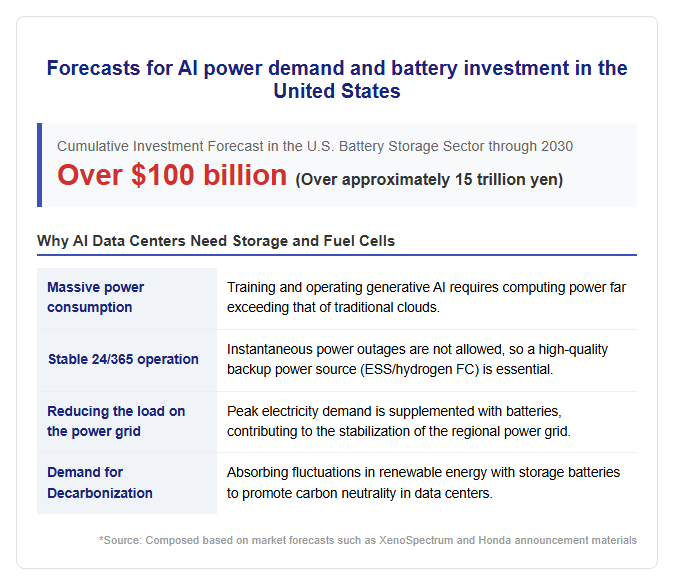
While the EV market is slowing, electricity demand for AI data centers is increasing at an explosive pace. In the United States, it is predicted that more than $100 billion (about 15 trillion yen) will be invested in the battery sector by 2030 to meet electricity demand driven by AI. Training and operating generative AI requires massive computational processing, and data centers demand stable power at an unprecedented scale. In particular, in data centers where 24/7 operation is essential, the presence of large storage batteries and fuel cells to reduce grid load and provide backup during outages has become indispensable. Honda is capturing this massive wave of demand and is adopting a strategy to slide high-performance battery technology developed for EVs into the high value-added infrastructure market of data centers. Please refer to the diagram below.
Future Developments and Outlook for the Battery Industry
The Ministry of Economy, Trade and Industry’s Vision of the 5 Trillion Yen Market and Japan’s Chances to Win
Honda’s move aligns with Japan’s Ministry of Economy, Trade and Industry’s new “Battery and Power Supply Industry Strategy.” The government has set a goal to increase the sales of related Japanese companies to 5 trillion yen by 2035, about three times the current amount. This means moving away from the “numbers game” of mass production of EV batteries that Chinese companies excel at, and instead competing in high value-added markets for AI data centers and critical infrastructure. Not only Honda, but also GS Yuasa and others are positioning AI data centers as new growth drivers and are accelerating investments to start new factory operations in the latter half of fiscal 2028. Redefining high-quality automotive-grade batteries as energy infrastructure for the AI era is becoming a new way for Japanese companies to leverage their strengths.
Mass production start and contribution to revenue from 2025 onward
The key future focus will be on the concrete product lineup and customer acquisition aimed at starting mass production in 2025. Honda plans to flexibly switch production at its joint venture plant in Ohio to ESS while carefully assessing the EV market situation. By the fiscal year ending March 2026, GM is expected to complete the settlement of one-off EV-related expenses, and the key to seeing how much this new battery strategy contributes to revenue will be key. Additionally, building a circular model that reuses used batteries as infrastructure power sources, such as the recycling demonstration of hydrogen fuel cells jointly advanced with Mitsubishi Corporation and Tokuyama, is an important step. Honda’s challenge to transform from an automaker into an “energy solutions provider” is expected to become the foundation supporting AI infrastructure in the United States.
[#ホンダ #AIデータセンター #蓄電池 #再生可能エネルギー #水素燃料電池 #経済ニュース #ビジネス戦略 #北米市場]

コメント