OpenRouter, a hub for AI models, has released a new feature called “OpenRouter MCP Server” that autonomously selects the best models for AI agents. This frees developers from the hassle of manually selecting the best model from hundreds of options, enabling dynamic model selection based on the latest market data.
The Emergence of OpenRouter MCP Server
On June 25, 2026, OpenRouter, which operates an integrated AI model platform, announced the “OpenRouter MCP Server,” which gives AI agents autonomous model sorting capabilities. OpenRouter currently functions as an “AI relay hub,” making over 400 AI models worldwide available with a single API key, and its enterprise value is expected to reach $1.3 billion as of May 2026. The newly introduced MCP server is a tool that allows agents such as “Claude Code” to write programs or the code editor “Cursor CLI” to determine the best model for tasks rather than users directly selecting models. This enables agents to autonomously execute complex instructions, such as “find and run the best-performing model within $2 per 1 million tokens input.” As the cost of selecting the optimal AI models from an overly diverse range of AI models rises rapidly, this feature holds the potential to revolutionize productivity in development sites beyond mere convenience improvements.
Why is “AI selection through AI” necessary?
The reason this new feature is being valued lies in the fatal weakness of “knowledge freshness” that AI agents have faced. Traditional AI agents made guesses based on “old information from about six months ago” contained in their own training data when deciding which model to use. However, the pace of AI evolution is extremely fast, with the emergence of new high-performance models, price revisions occurring every few days, and fluctuations in response times between providers occurring frequently. Relying on old knowledge risked missing out on high-performance but cheap latest models or continuing to use models that overconsumed the budget. OpenRouter MCP Server provides agents with “catalogs and price tags for the present moment” in real time. This allows agents to compare model prices, performance, and latency based on the latest information available in response to questions, enabling them to make truly optimal choices. In fact, the world of AI is undergoing a change like handing the latest flyers to clerks.
Technical Foundation and Specific Tools
The Role of the Common Protocol “MCP”
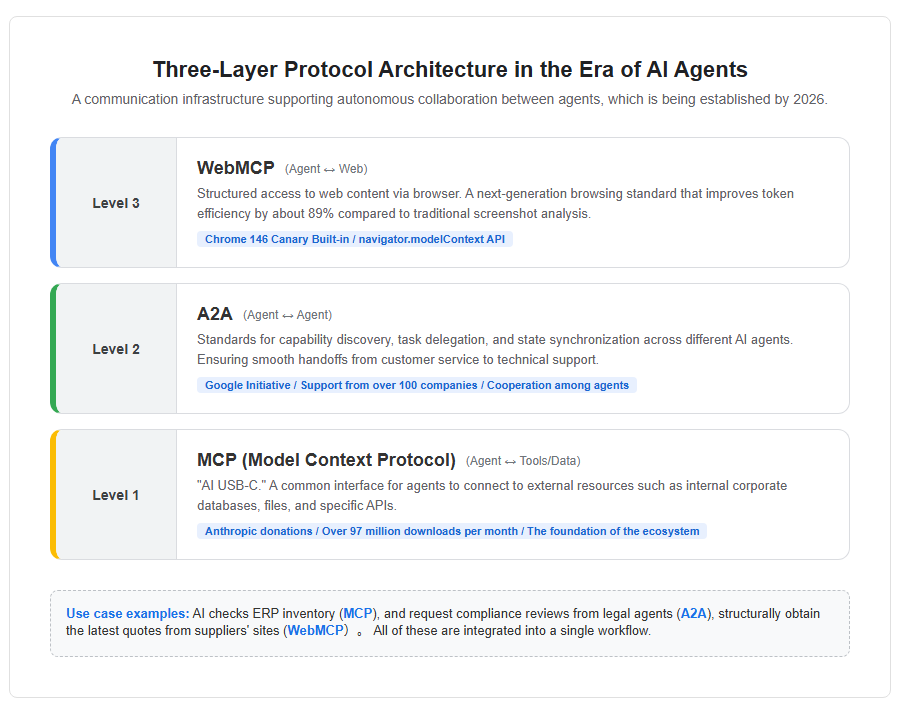
The foundation of OpenRouter MCP Server is the Open Standard Model Context Protocol (MCP), proposed by Anthropic in November 2024 and now donated to the Agentic AI Foundation. MCP is a common standard for connecting AI agents with external tools and data, often referred to as the “USB-C of AI.” Previously, it was necessary to write separate connection programs for each tool, but by adopting a unified standard called MCP, AI from different companies can now access external information in the same way. Now, with OpenRouter serving as the MCP server, agents can now directly query the vast model information held by OpenRouter using standardized procedures. Thus, protocols that started as grassroots open source have grown into industry standards with the support of major tech giants, underpinning an ecosystem of “co-competition” where AI cooperates.
Five Search Abilities Given to Agents
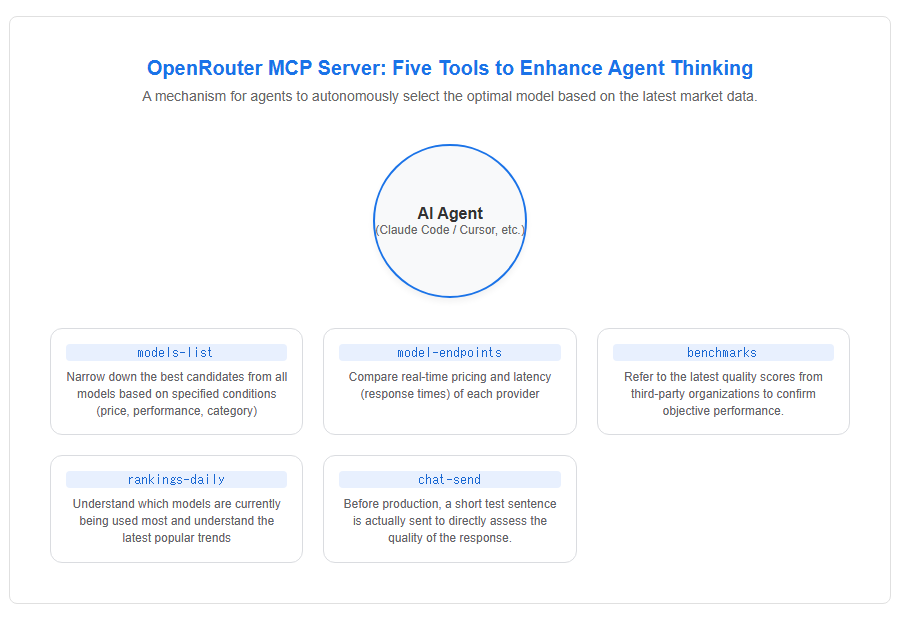
Agents who implement this MCP server will be able to master five powerful capabilities (tools).
-
models-list: Search models by specific criteria
-
model-endpoints: Check prices and speeds by provider
-
Benchmarks: Check quality scores from third-party organizations
-
rankings-daily: Keeping up with the current popular models
-
chat-send: Actually send test statements to test performance
These tools are integrated as part of the agent’s thought process, as shown in the diagram below.
It also features a “docs-search” feature for full-text official document searches, allowing developers to check the latest specifications without leaving the editor. Previously, the “15-minute task” of searching websites for the best model can now be completed with a single question in the editor, dramatically improving the development workflow. This frees humans from the routine task of detailed model comparisons, creating an environment where they can focus on more essential design and strategy.
Risk Management and Future Outlook
Security considerations and limitations
While convenience improvements are remarkable, careful risk management is also required for implementation. From a security perspective, a new attack method known as “tool poisoning” is on high alert. This method involves inserting malicious instructions invisible to humans into MCP instructions, tricking AI into sending confidential information or SSH keys externally. Additionally, due to OpenRouter’s structure, where all communications pass through relay servers, there is an inherent risk that personal information contained in prompts and confidential corporate data may be managed by third parties. In fact, there have been cases where vulnerabilities in remote code execution were discovered in Anthropic’s server implementations, so caution is needed against excessive reliance during the technology’s immature stage. As a countermeasure, strict implementation of guidelines such as sandboxing—using only reliable official sources and limiting AI operations to certain folders—and continuous monitoring of execution logs are essential conditions for enterprise use.
The Future of AI Shaped by Layer 3 Protocols
The communication standards for AI agents are evolving into a ‘three-tier structure’ including MCP, forming the foundation of the future digital society. In addition to MCP that connects models and tools, the three layers of “A2A” (agents collaborate) and “WebMCP” (structured access to web content) complement each other to realize an advanced autonomous system as shown in the diagram below.
NIST is urgently building governance at the national level, with the launch of the AI Agent Standardization Initiative in February 2026. In the market, inference prices are falling and model performance is converging, and AI is transforming from a “brand” into a “comparable commodity.” Amid this major trend, OpenRouter’s initiative can be seen as the first step toward an “autonomous economy” where AI autonomously selects and continuously optimizes AI. We are now witnessing a historic moment when the infrastructure of the AI agent era is established, much like the protocol wars of the 1980s that gave birth to the internet.
[#AIエージェント #OpenRouter #MCP #LLM #開発効率化]
コメント