Security organizations and companies such as Cyber Security Cloud, Inc. and Scutum have successively observed cyberattacks targeting websites in Japan by autonomous AI agents. Behind this is a situation where attackers are shifting to new methods that use generative AI and automation tools to sophisticate the intrusion process and distributively utilize a large number of IP addresses in a short period of time.
- The Background Behind the Surge in Cyberattacks and Damage in September 2026
- Attack Methods Using 326 IP Addresses in a Distributed Manner Over About 40 Minutes
- Dynamic Tactic Changes Based on Web Server Responses and Characteristics of AI Agents
- The Extreme Decentralization of Attack Sources and the Limitations of Blocking Overseas Access
- The Rapid Surge in AI Agents’ Autonomous Capabilities and the Defender Disparity
- Inspection Focusing on Log Bias and a Multi-layered Defense Approach
- Active Cyber Defense and Key Governance Considerations in the AI Era
The Background Behind the Surge in Cyberattacks and Damage in September 2026
The cumulative number of cyberattacks against web applications between July and September 2026 reached approximately 1.07 billion, representing a 16.3% increase compared to the previous quarter. On average, approximately 11.65 million attacks per day—or about 135 attacks per second—were observed. Particularly in September 2026, the monthly attack count reached approximately 450 million, roughly 1.6 times that of July, and a record high of approximately 21.42 million attacks per day was recorded on September 26, 2026. While web scans searching for vulnerabilities and configuration files accounted for 53.1% of all attacks, SQL injections aimed at unauthorized database manipulation are also surging. The number of SQL injection detections in September 2026 reached approximately 47.28 million, a 1.8-fold increase from about 26.38 million in July. Attackers widely scout for easily targeted websites and then combine automated intrusion attempts. The figure below shows the trend in the number of attacks for this quarter.
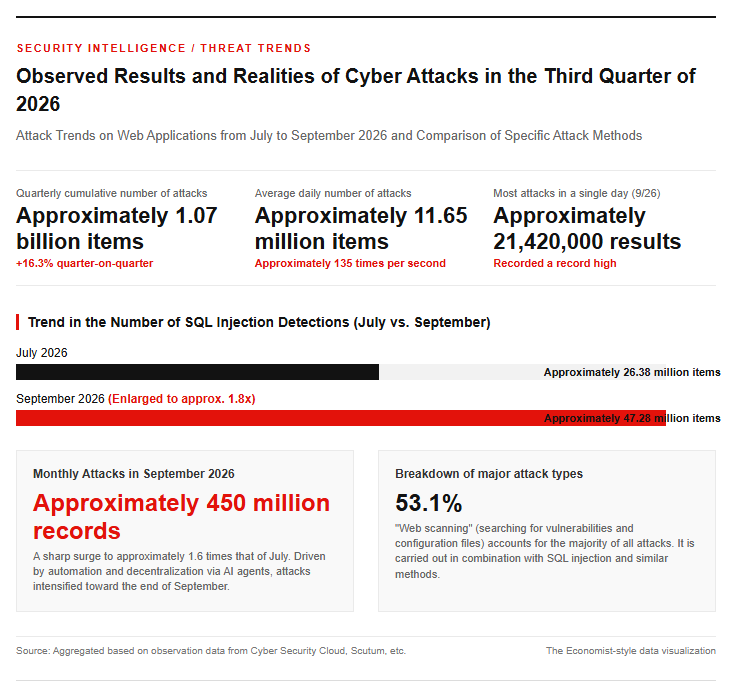
- Total number of attacks from July to September 2026: Approximately 1.07 billion (about 135 times per second)
- Monthly attacks in September 2026: Approx. 450 million (approx. 1.6x compared to July)
- SQL injection incidents in September 2026: Approximately 47.28 million (about 1.8 times the July figure)
Attack Methods Using 326 IP Addresses in a Distributed Manner Over About 40 Minutes
An analysis of unauthorized access data observed by Cyber Security Cloud, Inc. between September 18 and October 8, 2026, has identified an attack pattern in which what appears to be the same attacker meticulously switched between as many of 326 IP addresses in about 40 minutes. Movement involving the repetition of over 1,200 accesses multiple times in a short period has been confirmed. The attack procedure was extremely phased, progressing in the following flow:
-
- Attempts to bypass authentication and leak information via SQL injection
-
- After authentication bypass fails, legitimate login using the attacker’s own pre-created account
-
- Search for SQL injection vulnerabilities again in the post-login management screen and internal functions.
-
- Exploring flaws in features and APIs directly tied to monetary value, such as point systems existing within the site
-
- Once a round of trials is complete, do not over-pursue and withdraw promptly.
Although it has been determined to be an attack by the same actor because the same identifier was reused across requests, the number of accesses per IP address is low, and it is designed to evade conventional threshold-based monitoring.
Dynamic Tactic Changes Based on Web Server Responses and Characteristics of AI Agents
Bitforest Inc., the operator of the cloud-based WAF “Scutum”, determined through monitoring conducted between October 10 and October 14, 2026, that attacks by AI agents were being carried out from at least three IP addresses (38.54.56[.]121, 185.196.220[.]130, 192.236.229[.]229). This was identified using detection logic that the company had pre-verified with eight high-performance models, including Qwen 3.8 Flash Next and GLM-5.3 Flash Next. In the observed attack examples, unlike conventional attacks that continuously transmit a single tool, the agents flexibly altered their methods by evaluating server-side HTTP response codes and response contents in real time. Specific examples of their behavior are as follows.
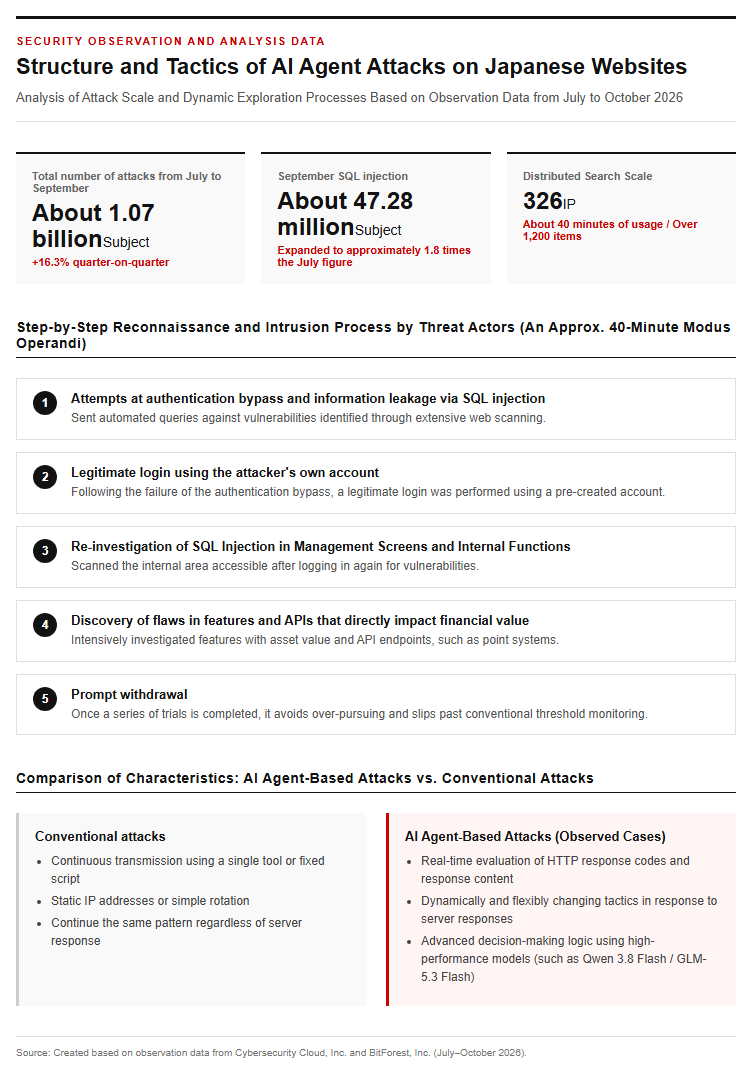
- Injecting attack strings into paths and parameters after connection checks (such as robots.txt or sitemap.xml)
- File Discovery and Comprehensive Scans of Specific Directories Using Range Headers
- Tools such as curl, sqlmap, and Fuzz Faster U Fool, as well as the dynamic switching of User-Agents
- Auto-filling contact forms or shifting to login attempts
The speed of situational assessment and decision-making is remarkable, revealing that the autonomous trial-and-error process characteristic of AI agents is being deployed in actual attacks.
The Sophistication of Attack Methods and the Limitations of Traditional Security Defenses
The Extreme Decentralization of Attack Sources and the Limitations of Blocking Overseas Access
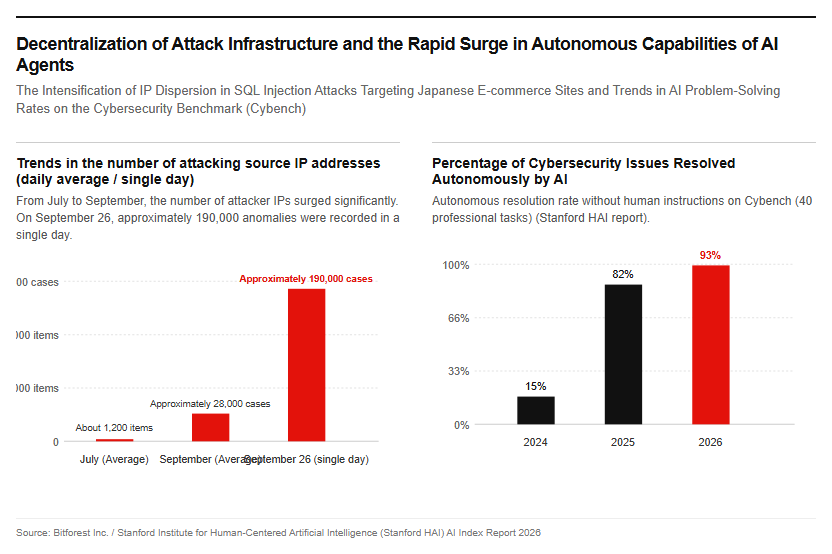
The increase in attacks is accompanied not only by a growth in the number of access requests, but also by a structural change involving the decentralization of attack methods. In SQL injection attacks targeting domestic e-commerce sites, the number of attacking source IP addresses surged approximately 16-fold, from a daily average of about 700 to 1,700 in July 2026 to a daily average of about 28,000 in September 2026. On September 26, 2026, approximately 190,000 different IP addresses were used for attacks in a single day. Meanwhile, the number of targeted hosts remained flat throughout the year at around 100 to 140 per day, showing a notable trend of decentralization where attacks are sent in small batches from a vast pool of IP addresses targeting specific groups of sites. Furthermore, regarding the countries of origin for the attacks, those originating from within Japan reached approximately 150 million—about 3.5 times the figure for the same period of the previous year—accounting for 13.6% of the total.
- Country-based IP control (IP geolocation) that blanket-blocks access from overseas cannot fully prevent it.
- Attackers are frequently switching their attack infrastructure in short periods using domestic clouds, VPS, and proxies.
- Defenses that rely solely on single-IP blocklists or rate limiting are becoming less effective.
There is an urgent need to shift from defense methods that rely on source IP addresses to a multi-layered defense that detects the content and context of requests themselves in real time with high precision.
The Rapid Surge in AI Agents’ Autonomous Capabilities and the Defender Disparity
According to the AI Index Report 2026 published by the Stanford Institute for Human-Centered Artificial Intelligence (Stanford HAI), on Cybench—a cybersecurity benchmark featuring 40 specialized challenges—the percentage of tasks solved autonomously by AI without human instructions surged from 15% in 2024 to 82% in 2025, and further to 93% in 2026. AI has acquired the capability to automatically execute complex tasks such as cryptography, web security, and exploit execution without human intervention. The figure below illustrates the concept of a cyber defense environment.
Meanwhile, according to a survey conducted by Gartner Japan in July 2026, significant challenges remain in the defense posture of Japanese companies.
- Only 30% of major Japanese companies implement sufficient vulnerability management
- While attackers use AI to accelerate reconnaissance and intrusion, defenders are failing to keep pace with basic checks.
- The process from vulnerability discovery to attack execution, which traditionally took days to weeks, has been shortened to a matter of minutes.
The capability asymmetry between attackers and defenders is rapidly expanding, and security operations relying on traditional, periodic manual assessments are reaching their limits.
Emergency Measures Required for Enterprises and Future Security Outlook
Inspection Focusing on Log Bias and a Multi-layered Defense Approach
Gartner Japan and JPCERT/CC (announced on October 8, 2026) have strongly recommended urgent security inspections in response to a series of unauthorized access incidents. Because attacks by AI agents involve few accesses from individual IPs and are easy to overlook through manual visual inspection of individual logs, it is recommended to conduct investigations and implement countermeasures based on the following perspectives.
- Checking for bias in HTTP response codes: Focused inspection of abnormal occurrence time zones for 4xx and 5xx errors other than normal responses (200), and 429, which indicates access restrictions.
- Focusing on differences in response size: Detecting response size differences between success and failure in authentication processing, as well as unnatural size expansion when extracting large amounts of data.
- Comprehensive Asset Audit: Urgent inspection of public-facing assets such as Web applications, APIs, admin dashboards, VPNs, and cloud environments
- Strengthening fundamental measures: Neutralizing SQL injection via parameterized queries and enforcing stricter API access control and rate limiting.
Furthermore, it is important to combine AI-powered WAFs that can evaluate request context without relying solely on signatures with Zero Trust access controls based on identity management.
Active Cyber Defense and Key Governance Considerations in the AI Era
Starting October 1, 2026, as part of active cyber defense, the Japanese government has begun operations allowing the police and the Self-Defense Forces to access servers originating attacks and take neutralization measures to preemptively prevent major cyberattacks. In parallel with the development of the legal framework, companies are also required to establish Continuous Threat Exposure Management (CTEM). As pointed out in the guidelines published by the IPA, the integration of technical measures and organizational governance is essential for future cybersecurity.
- Transition from one-off vulnerability assessments to an automated framework for daily, real-time scanning and monitoring
- Minimizing execution privileges granted to AI agents and incorporating human-in-the-loop for critical operations
- Acquisition of immutable access logs and prompt history that enable tracing back the decision-making process in the event of a breach
In the era of fully automated AI-driven attacks, a crucial focus moving forward will be for defenders to deploy AI-integrated automated detection and blocking systems and redefine the very design philosophy of security.
Reference page
- [Cybersecurity Cloud Inc. Press Release & Report] https://www.cscloud.co.jp/news/report/202610099351/
- [Gartner Japan Press Release] https://www.gartner.co.jp/ja/newsroom/press-releases/2026-10-13-gartner-issues-urgent-recommendations-on-unauthorized-access-incidents-at-japanese-enterprises
- [JPCERT/CC Security Alert] https://www.jpcert.or.jp/at/2026/at260030.html
- [Scutum Tech Blog (Bitforest Inc.)] https://www.scutum.jp/information/waf_tech_blog/
- [JAPAN AI Inc. Press Release] https://japan-ai.co.jp/
【#AIAgents #Cybersecurity #UnauthorizedAccess #WebSecurity #VulnerabilityCountermeasures】


コメント