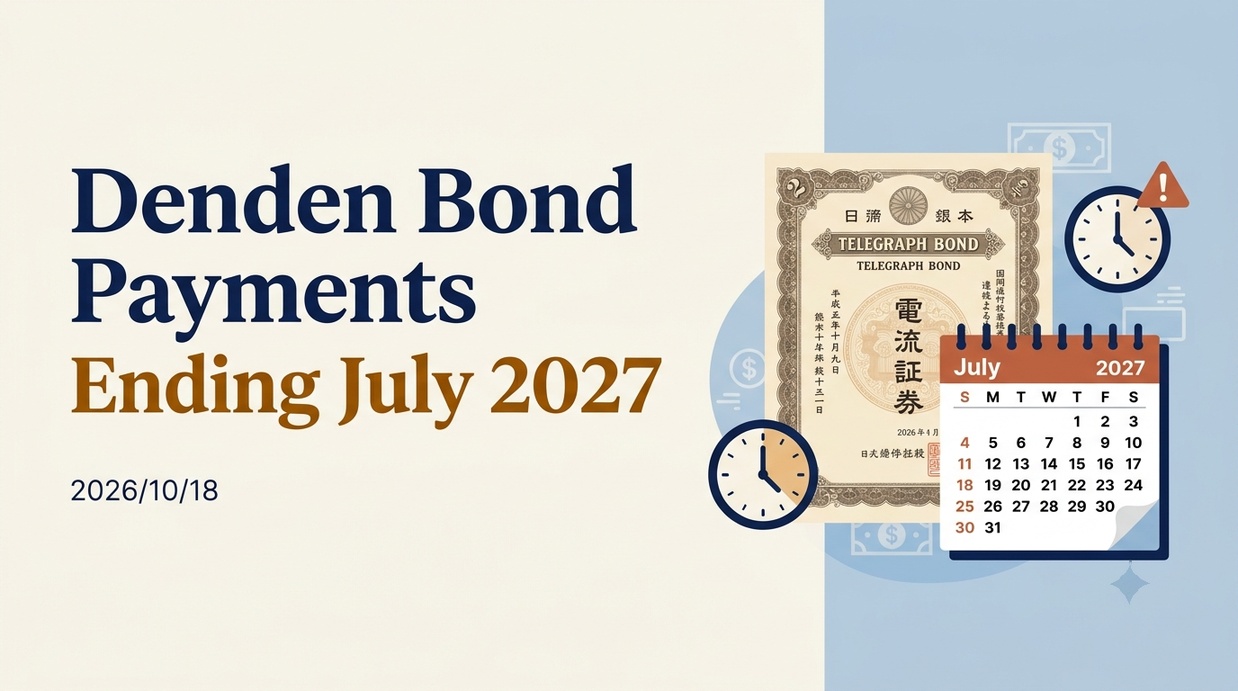
Nippon Telegraph and Telephone Corporation (NTT) will end the payment of principal and interest on “Subscriber Telephone and Telegraph Bonds (Denden-sai)” issued during the era of the former Nippon Telegraph and Telephone Public Corporation on July 5, 2027. Behind the end of these payment measures, which have been continued as a special exception for many years, is the reality that more than 30 years have passed since the maturity of all such bonds.
- The approaching end of Denden bond payments on July 5, 2027
- The Mechanism of Denden Bonds (Subscriber Bonds) and the Historical Background of Their Issuance
- Misconceptions About “Telephone Subscription Rights” and “Subscriber Bonds” and the Truth Behind the “72,000-Yen Refund Hoax”
- History of Rights Extinction and Statute of Limitations Exceptions, and the Background of NTT’s Payment Response
- How to Find Bonds Hidden in Your Parents’ Home or Safe and Prepare Necessary Documents
- Window Redemption Flow, Future Points to Keep in Mind, and Key Highlights
The approaching end of Denden bond payments on July 5, 2027
Nippon Telegraph and Telephone Corporation (NTT) has announced that it will terminate the payment of principal and interest on “Subscriber-Underwritten Telegraph and Telephone Bonds” (commonly known as “Denden bonds” or “subscriber bonds”) formerly issued by the former Nippon Telegraph and Telephone Public Corporation, effective July 5, 2027. From July 6, 2027, the statute of limitations based on laws and regulations will be formally invoked, and all refund procedures will no longer be available. With this decision, there is now very little time left to cash in old bonds that were acquired by households that installed landlines during the Showa era, or that have been kept for many years deep inside safes or drawers at their parents’ homes.
Payments of principal and interest are not accepted at NTT counters or by mail; procedures must be conducted directly at the designated handling financial institution counters printed on the back of the bond. Although there are many cases where they are accidentally discovered due to unknown ownership or while sorting through a deceased person’s belongings, the rights will completely expire after the final deadline of July 5, 2027, making early confirmation and response strongly urged.
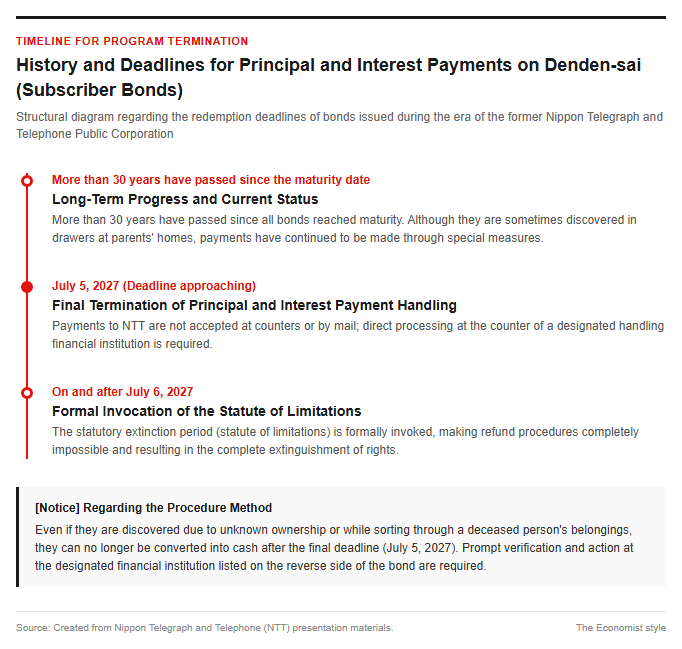
As we approach the conclusion of the refund system that has been maintained as a special measure for a long period, public awareness and outreach efforts through financial institutions and local governments are once again becoming increasingly important.
The Mechanism of Denden Bonds (Subscriber Bonds) and the Historical Background of Their Issuance
“Dendensai” (Subscriber-Underwritten Telegraph and Telephone Bonds) refers to bearer securities issued by the Nippon Telegraph and Telephone Public Corporation (Denden Kosha) over a 30-year period from January 1953 to March 1983 to raise the construction funds necessary for the installation of landline telephones and the rapid expansion of communication networks. At the time, when applying for a telephone service, prospective subscribers were legally required to purchase these bonds as a way to partially cover the facility installation costs.
There are two types of issued bonds: interest-bearing bonds and discount bonds. Interest-bearing bonds were set with a holding period of approximately 10 years and were structured to pay interest every six months. Meanwhile, discount bonds were sold at a price discounted in advance for the interest amount at the time of issuance, designed to reach maturity in about 8 to 12 years. As of 2025, both types of bonds have already passed all of their maturity dates, and they remain in existence long after their original redemption periods. They are iconic financial products that quietly supported the development of telecommunications infrastructure during the post-war period of high economic growth, spreading widely throughout Japan alongside the telephone installation boom of that time.
The Definitive Difference from Telephone Subscription Rights and Warnings Against Confusion and Misinformation
Misconceptions About “Telephone Subscription Rights” and “Subscriber Bonds” and the Truth Behind the “72,000-Yen Refund Hoax”
In recent years, inaccurate information has been rapidly spreading—primarily on social media and short-form video platforms—claiming that “with the elimination of fixed-line copper networks, if you cancel your service, the 72,000 yen paid in the past for telephone subscriber rights will be fully refunded if you complete the procedures by July 5, 2027.” However, this is a completely baseless and utter hoax (misinformation). The facility installation fee for telephone subscriber rights is positioned as an advance payment for the equipment construction costs required to provide the service, and it is under no circumstances refunded, even upon cancellation or line termination.
The true identity of the money that is mistakenly thought to be refunded upon cancellation is the “Subscriber Bonds (Denden Bonds)” issued in the past. While telephone subscription rights are “contractual rights” to use NTT’s landline telephone lines, subscriber bonds have a completely different nature as “promissory notes (financial instruments)” issued by the public corporation to borrow funds from investors and subscribers.
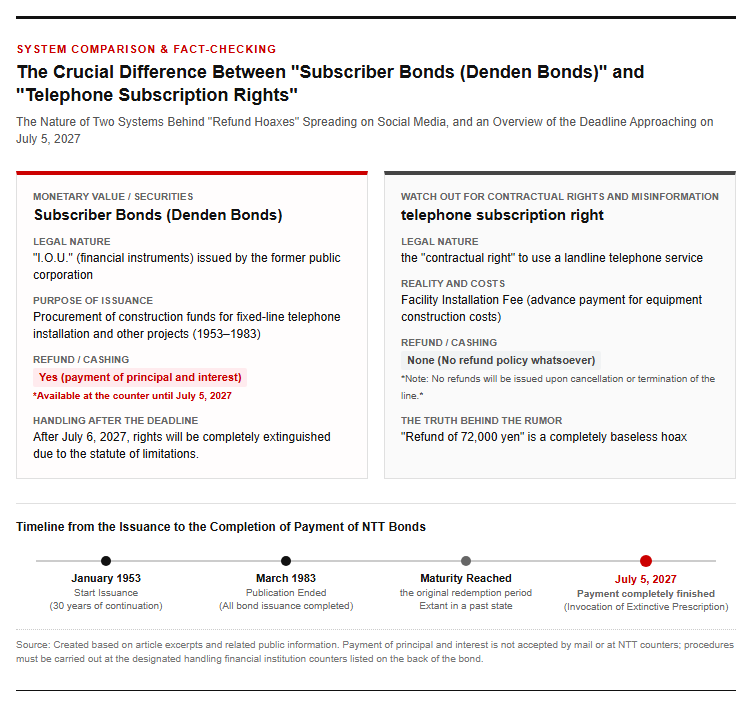
Misled by false information, it is extremely important to accurately identify the nature of the rights and what is eligible for a refund, in order to avoid falling victim to malicious businesses that charge exorbitant proxy fees or to special scams.
History of Rights Extinction and Statute of Limitations Exceptions, and the Background of NTT’s Payment Response
Under legal regulations, the statute of limitations for public and corporate bonds is stipulated based on the Nippon Telegraph and Telephone Public Corporation Act and other laws to be 10 years from the maturity date for the principal and 5 years from the payment date for interest. In light of this provision, even for the bonds issued last in March 1983, the statute of limitations for all subscriber bonds had already expired by March 2003 (Heisei 15), 10 years after their maturity date (March 1993). Strictly speaking, under the law, NTT has no obligation to pay the principal and interest.
However, from the standpoint of customer protection and social responsibility, the NTT Group has long maintained a special measure under which it has not invoked the statute of limitations even after it has taken effect, and has paid principal and interest upon the presentation of physical bonds. However, now—more than 40 years after the final issuance and over 30 years since the maturity of all bonds—maintaining the dedicated systems and verification structures required for payment operations has become extremely difficult. Therefore, after providing a sufficient public notification period in advance, a decision has been made to completely terminate this special handling on July 5, 2027.
Specific procedures and verification steps for cashing out
How to Find Bonds Hidden in Your Parents’ Home or Safe and Prepare Necessary Documents
If a piece of paper found while cleaning out your parents’ home, sorting through a deceased person’s belongings, or searching deep inside a chest of drawers or safe bears the words “Telegraph and Telephone Bonds” or “Discount Telegraph and Telephone Bonds,” it is highly likely to be a marketable security that can be converted into cash. If the physical certificate is found, first check the name on the front and the “handling financial institution (principal and interest payment location)” listed on the back. If the bank name listed on the back has changed due to reorganization or consolidation, it is necessary to refer to a financial institution conversion table or the like to identify the current applicable counter.
When completing the procedure, you are required to prepare the following items and bring them to the designated counter.
- Physical Telegraph and Telephone Bonds (the actual certificates)
- Identification documents of the person performing the procedure (such as a driver’s license or My Number card)
- Seal (registered seal or personal seal)
- Bank account information for the transfer of principal and interest
In addition, since bonds are bearer securities, presenting the physical certificates is an absolute requirement, and refunds cannot be obtained with past sales reports, purchase statements, or safekeeping certificates alone. Furthermore, when cashing out bonds inherited from a deceased relative, advance confirmation is recommended because additional documents, such as a family register proving the familial relationship with the registered holder, may be required.
Window Redemption Flow, Future Points to Keep in Mind, and Key Highlights
When carrying out the procedure, it is necessary to visit the counter of a financial institution listed on the back of the bond (such as Mizuho Bank, which succeeded the lead managing underwriter former The Industrial Bank of Japan, major city banks, regional banks, etc.). When you inform the counter staff that it is for “NTT bond redemption procedures,” the financial institution will perform a physical verification of the bond, as well as inquiries to NTT regarding reported bonds and confirmation of unredeemed status. Since the verification process often takes time, and it is general practice for funds to be transferred to a designated account at a later date rather than handed over in cash on the same day, it is advisable to visit with plenty of time to spare in your schedule.
As for future developments, a rush of last-minute procedures for similarly unredeemed bonds is expected ahead of the July 5, 2027 deadline. Furthermore, heightened vigilance against fraud targeting the elderly, such as “fraudulent approaches related to landline cancellations and bond redemption,” will become even more crucial. Amidst a growing trend to reassess landlines themselves due to declining usage rates and crime prevention perspectives, correctly identifying “valuable pieces of paper” left in the home and securely exercising rights before the deadline will be an extremely important point in protecting personal assets.
Reference page
- 【To Customers Holding Telephone and Telegraph Bonds (Subscriber Bonds) | Topics | NTT】https://group.ntt/jp/topics/saiken/
【#NTT #DendenBonds #SubscriberBonds #AssetUtilization #AssetBuilding #Landline #Procedures #SpecialMeasures】

コメント