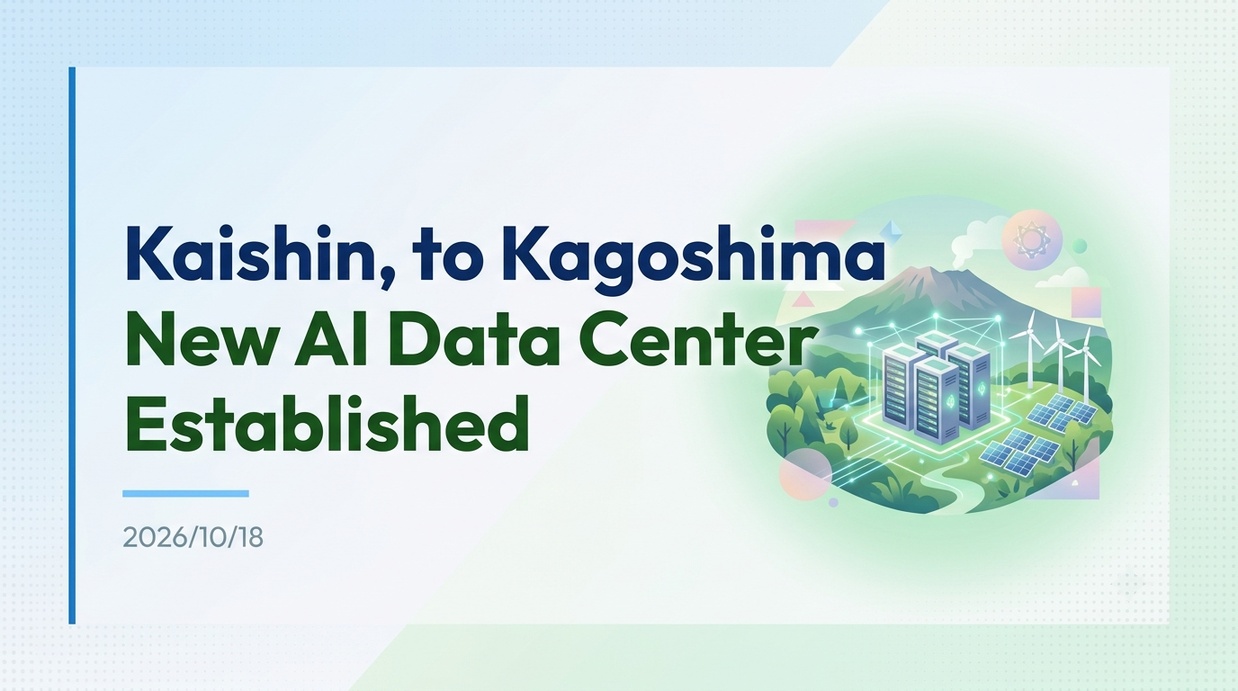
Kaishin Digital Infrastructure has announced plans to construct a new AI data center in Satsumasendai City, Kagoshima Prefecture, with an investment scale of 850 billion yen, making it one of the largest in Japan. This development is driven by the soaring demand for generative AI and the growing momentum toward developing renewable energy and community-cocreation-based infrastructure utilizing the site of a former thermal power plant.
- Key point of the event: An investment of 850 billion yen and a 350MW-scale construction plan
- Operating Entity and Target: CDIB Capital-backed new company and overseas hyperscalers
- Background for Selection: Effective Use of Former Thermal Power Plant Sites and Strengths in Power and Environmental Infrastructure
- Industry-Academia-Government Collaboration Agreement: Regional Co-Creation with Kyushu Electric Power, Kagoshima University, Sony Network, and Others
- The Decentralization of Data Centers to Rural Areas and Nationwide Challenges Concerning the Environment and Regional Conflicts
- Future Outlook and Key Focus: Community Contribution and the Establishment of a Sustainable Infrastructure Model
Key point of the event: An investment of 850 billion yen and a 350MW-scale construction plan
In Satsumasendai City, Kagoshima Prefecture, construction plans for a data center dedicated to artificial intelligence, boasting one of the largest scales in Japan, have gone into full swing. On July 18, 2026, Satsumasendai City and the business entity Kaishin Digital Infrastructure Co., Ltd. held a signing ceremony for a location agreement concerning the construction of the AI data center.
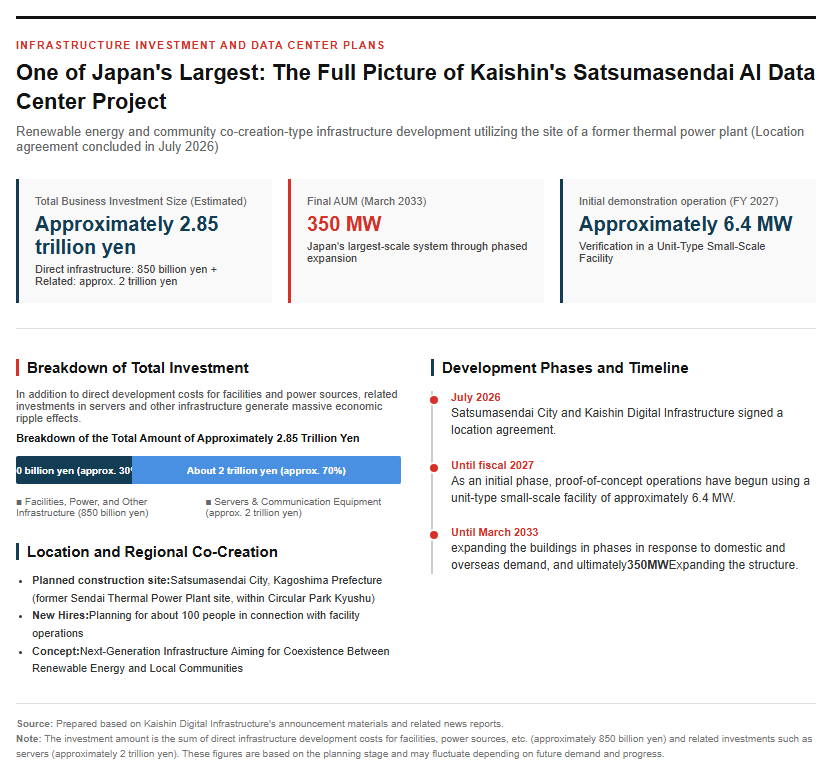
The planned investment for this project is expected to be approximately 850 billion yen for direct infrastructure development costs, such as facilities and power supplies. Furthermore, including related investments in servers and network equipment, approximately 2 trillion yen in additional investment will be generated across the entire site, making it projected to be a historic, large-scale project totaling approximately 2.85 trillion yen.
The planned construction site is located within Circular Park Kyushu, which utilizes the former site where Kyushu Electric Power’s Sendai Thermal Power Plant was once located. Under this plan, phased expansions will be carried out by March 2033, with the ultimate goal of operating a 350-megawatt (MW) system.
As an initial initiative, we will construct a unit-type small-scale facility integrating power supply, cooling, communication, and server equipment, and begin proof-of-concept operations at a scale of approximately 6.4 megawatts by fiscal 2027. Thereafter, we plan to expand the buildings to match domestic and overseas demand. In addition, approximately 100 new jobs are planned with the operation of the facility.
The overview of the project site’s location and the concept for the phased development steps are as follows:
This project is expected not only to serve as the foundation for cutting-edge AI technologies that require massive computational resources, but also to contribute significantly to job creation and economic revitalization in the region.
Operating Entity and Target: CDIB Capital-backed new company and overseas hyperscalers
Kaishin Digital Infrastructure Co., Ltd. (凱信数基), which plays a core role in this project, is a new company established on January 20, 2026, with the purpose of specializing in the construction, operation, and management of AI data centers. Its registered headquarters is located at 1-1 Circular Park, Satsumasendai City, Kagoshima Prefecture, the same location as the construction site, and Yi-Chun Nan has assumed the office of Representative Director.
The company is backed by investors such as CDIB Capital Management (中華開發資本管理顧問股份有限公司), which engages in investment and startup support in the Asia-Pacific region, and boasts an international financial and business network. Its anticipated primary target customers include overseas hyperscalers that deploy generative AI services and advanced cloud infrastructure and require massive computational resources.
In recent years, alongside the rapid adoption of generative AI, computational demand driven by high-performance graphics processing units (GPUs) has experienced explosive growth in advanced fields such as semiconductor design, autonomous driving technology, and robotics. Kaishin is addressing these data-processing needs—which demand high processing speeds and massive power capacity—by providing dedicated unit-based infrastructure equipped with cutting-edge cooling technologies and high-quality communication environments.
By attracting cutting-edge digital infrastructure, Satsumasendai City aims to establish its position as a cluster for the information services industry, while also leading to the attraction and development of peripheral industries such as related component manufacturing and server assembly and maintenance.
Why Satsumasendai City Was Chosen and the Regional Co-Creation Framework
Background for Selection: Effective Use of Former Thermal Power Plant Sites and Strengths in Power and Environmental Infrastructure
Behind the selection of Satsumasendai City as the site for a massive AI data center are the city’s unique land and power infrastructure, as well as its proactive environmental policies. Leading up to this site agreement, phased public-private collaboration had been advancing, and on February 12, 2026, a memorandum of understanding was concluded among five parties: Kaishin, Kagoshima Prefecture, Circular Park Kyushu Co., Ltd., Kyushu Electric Power Co., Inc., and Satsumasendai City.
The former Sendai Thermal Power Plant site, chosen as the project location, not only secures a vast expanse of land for the construction of large-scale facilities, but also boasts a strong infrastructural advantage in that, having previously functioned as a power plant, it offers easy access to a high-capacity power grid. Furthermore, as Kaishin Representative Minami noted at the site agreement ceremony, the city’s promotion of clean energy policies and decarbonization initiatives has made it an exceptionally attractive proposition for global companies that prioritize environmental considerations.
Additionally, Satsumasendai City has been selected under the government-promoted “GX (Green Transformation) Strategic Region System” as a promising region for the formation of a GX-type industrial cluster that includes the concentration of data centers and other facilities. The city has positioned the area, including surrounding protection forests, as the “(tentatively named) Karahama Industrial Site” and plans to advance its integrated development.
Conceptual diagrams regarding future expandability and area development visions are as follows.
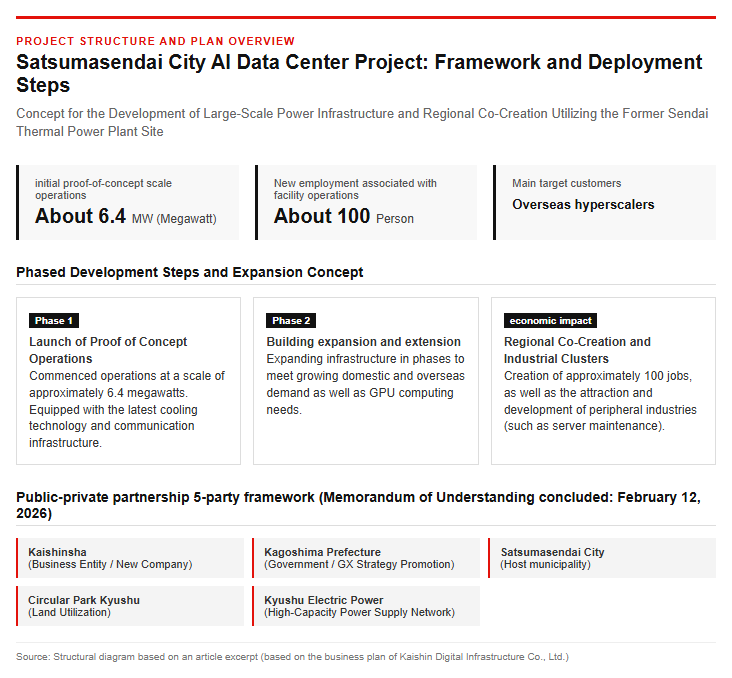
With future expansion to the 1-gigawatt (GW) class also in sight, it is attracting attention as a hub that balances a reduced environmental footprint with advanced digital infrastructure.
Industry-Academia-Government Collaboration Agreement: Regional Co-Creation with Kyushu Electric Power, Kagoshima University, Sony Network, and Others
In parallel with the trend of data center construction, industry-academia-government collaborative initiatives aimed at sustainable coexistence with local communities are also getting underway in earnest. On July 22, 2026, four parties—Satsumasendai City, the national university corporation Kagoshima University, Kyushu Electric Power Co., Inc., and Sony Network Communications Inc.—concluded a “Regional Co-creation Partnership Agreement.”
This agreement aims not simply to attract data centers, but to build a new regional development model that combines digital infrastructure with a circular economy. Under the partnership agreement, each of the four parties will assume a specialized role.
- Satsumasendai City: Promoting the provision of demonstration fields, infrastructure development such as road networks, regulatory design, and inter-governmental coordination.
- Kagoshima University: Based at the satellite lab within Circular Park Kyushu, it is responsible for research and development, technological evaluation, academic verification, and the development of digital human resources in the GX (Green Transformation) field.
- Kyushu Electric Power: Effective utilization of the former Sendai Power Plant site and the promotion of resource circulation through collaboration with its group company, Circular Park Kyushu Co., Ltd.
- Sony Network Communications: Leveraging its expertise in the digital domain and regional branding to lead the formulation of grand designs for regional models and the upgrading of communication and digital infrastructure.
By bringing together our respective strengths in various fields, we aim to establish a sustainable local industrial foundation that channels the energy and computational resources generated by data centers back into the community, achieving harmony between the environment and the economy.
Nationwide Challenges and Future Prospects of the Satsumasendai Model
The Decentralization of Data Centers to Rural Areas and Nationwide Challenges Concerning the Environment and Regional Conflicts
With the rapid expansion of generative AI, the domestic data center-related services market is projected to expand to approximately 5.6 trillion yen by 2030. Traditionally, about 90% of domestic data centers have been concentrated in the Tokyo and Osaka areas, but due to tight power supply and demand and land shortages, decentralizing hubs to regional areas has become a national challenge.
However, while the construction of large-scale data centers is progressing across the country, friction with local residents and disputes surrounding environmental impact are also becoming apparent. For example, in Inzai City, Chiba Prefecture, a dispute over construction in a commercial area in front of the station escalated into a lawsuit filed by residents in March 2026 seeking the revocation of the building confirmation. Furthermore, the increase in power consumption and CO2 emissions caused by data centers has been taken up in the National Diet, where discussions are underway regarding the application of the environmental impact assessment system.
The main background behind resident opposition movements and conflicts includes the following concerns:
- Strain on regional power grids due to massive power consumption and concerns over rising electricity rates
- Massive water consumption associated with server cooling, as well as the impact on the surrounding environment due to waste heat and noise.
- The disruption of the landscape and oppressive presence caused by massive, windowless, and sterile buildings, as well as the lack of a tangible sense of return to the local community.
As a series of cases emerge where cutting-edge infrastructure nevertheless ends up becoming a “facility rejected by the local community,” the selection of construction sites and development methods are facing stricter scrutiny than ever regarding their harmony with the surrounding environment and the lives of local residents.
Future Outlook and Key Focus: Community Contribution and the Establishment of a Sustainable Infrastructure Model
The ¥850 billion AI data center project that has begun moving forward in Satsumasendai City serves as an important leading model for the nationwide challenges of regional data center decentralization and environmental harmony. The greatest point of focus for future developments will be whether steady infrastructure preparation proceeds according to schedule, spanning from the demonstration operation through fiscal 2027 to full-scale operation at 350 megawatts in March 2033.
For the local economy and construction industry, this project presents an opportunity to generate tremendous ripple effects. Beyond the construction of buildings and the installation of power and cooling equipment, business opportunities will expand for local construction companies and equipment-related businesses across a wide range of fields, including the development of surrounding access roads and civil engineering infrastructure, as well as server maintenance and security operations after coming online. Mayor Ryoji Tanaka of Satsumasendai City has also clearly demonstrated his stance on broadly returning the economic benefits generated by the development to citizens and local businesses.
Furthermore, another key focus will be to see to what extent initiatives such as the utilization of data center waste heat, the local production and consumption of renewable energy, and the development of digital talent are materialized through co-creation agreements with partners including Kyushu Electric Power and Kagoshima University.
Can we transform massive digital infrastructure from a regional “burden” into an “asset” that drives resource circulation and economic growth? Deepening dialogue with local communities while achieving a balance between sustainable infrastructure development and economic returns will be the key to determining true future success.
Reference Page
- [Satsumasendai City Official Announcement] https://www.city.satsumasendai.lg.jp/shigoto_sangyo/sangyoricchi/3/20533.html
- [Kagoshima Prefecture Corporate Location Guide] https://kagoshima-kigyouricchi-guide.jp/company-information/%E3%82%AB%E3%82%A4%E3%82%B7%E3%83%B3%E3%83%87%E3%82%B8%E3%82%BF%E3%83%AB%E3%82%A4%E3%83%B3%E3%83%95%E3%83%A9%E3%82%B9%E3%83%88%E3%83%AC%E3%82%AF%E3%83%81%E3%83%A3%E3%83%BC%E6%A0%BC%E5%BC%8F%E4%BC%9A/
【#KaishinDigitalInfrastructure #SatsumasendaiCity #AIDataCenter #CircularParkKyushu #GXStrategicRegion】

コメント