The International Monetary Fund (IMF) has revised upward its 2026 economic growth forecasts for the Asia-Pacific region and major emerging economies. The backdrop is strong exports of semiconductors and IT hardware, driven by the expansion of global artificial intelligence (AI) demand.
- Key point of the event: IMF’s revision of growth forecasts
- Growth Gap Between Advanced and Emerging Economies: The Contrasting Fortunes of the Asian Market
- South Korea and Taiwan’s Prominence: The Core of AI Hardware Trade
- Circular Transactions and Financial Risk: The IMF’s Warning
- US Interest Rates and Energy Prices: The Threat of a Compound Shock
- Future Outlook and Key Points: Economic Maintenance and Policy Challenges
Key point of the event: IMF’s revision of growth forecasts
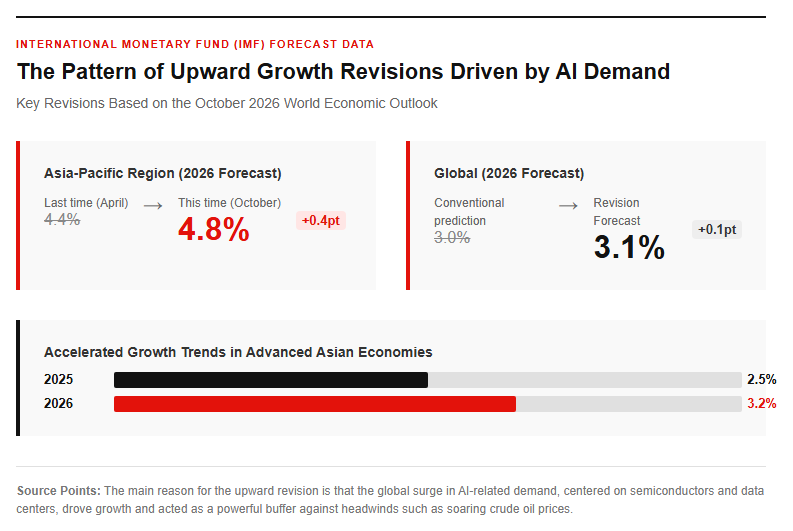
On October 13, 2026, the International Monetary Fund (IMF) released its latest World Economic Outlook and Regional Economic Outlook reports. In this report, the economic growth forecast for the Asia-Pacific region for 2026 was set at 4.8%, an upward revision of 0.4 percentage points from the 4.4% forecast in April 2026. The growth rate for advanced Asian economies is also projected to accelerate from 2.5% in 2025 to 3.2% in 2026. Furthermore, the global economic growth forecast for 2026 was slightly raised from the previous 3.0% to 3.1%.
The main points of this revision are as follows:
– The global surge in AI-related demand, centered on semiconductors and data centers, drove growth.
– Against headwinds such as soaring crude oil prices, technology investments functioned as a strong buffer.
– Significant upward revisions to economic forecasts have been confirmed in advanced economies and key supply chain participants.
During a press conference, IMF Deputy Managing Directors explained that AI investment is playing a crucial role in supporting the global economy. The figure below summarizes the key figures of the revision.
Manufacturing and infrastructure demand across various countries has demonstrated the resilience of the economy.
Growth Gap Between Advanced and Emerging Economies: The Contrasting Fortunes of the Asian Market
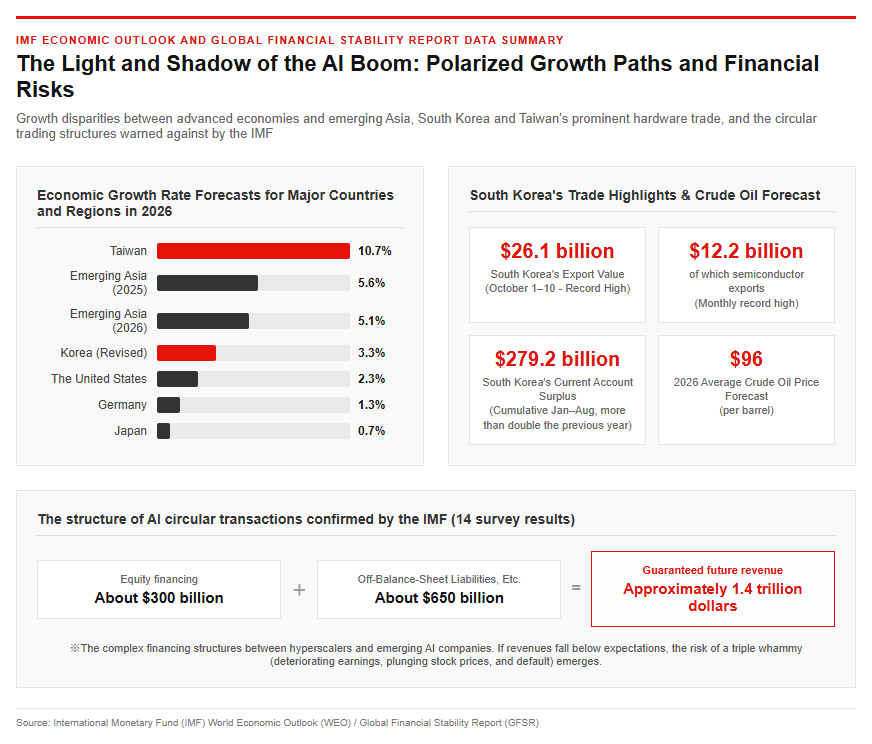
The economic benefits of the AI boom are not distributed evenly across all regions, with a clear divergence in market fortunes. While economies deeply integrated into the global technology supply chain are showing remarkable growth, the growth forecast for emerging Asia and developing economies is expected to slow from 5.6% in 2025 to 5.1% in 2026.
The main background factors driving this growth disparity are as follows.
– The Struggles of Oil-Importing Countries Lacking Direct Benefits from AI Demand, Such as Bangladesh and Cambodia
– Increase in import costs due to persistently high crude oil prices (projected to average $96 per barrel in 2026) driven by escalating tensions in the Middle East
– Shrinking Fiscal Buffers Across Countries and Persistent Inflationary Pressures
The IMF Research Department director and other officials pointed out that the global economy is following a “bipolarized growth path,” splitting into a group that benefits from AI demand and a group hit hard by high energy prices. In emerging Asian economies, rising exchange rate volatility and the risk of capital outflows are also surfacing, raising concerns about the impact on countries with fragile economic foundations.
South Korea and Taiwan’s Prominence: The Core of AI Hardware Trade
Among Asian regions, South Korea and Taiwan—global production hubs for semiconductors and electronic components—saw the most significant upward revisions. The IMF raised South Korea’s 2026 economic growth forecast by 0.7 percentage points, from the previous 2.6% to 3.3%. This revision margin significantly exceeds those of major developed nations such as the United States (2.3%), Japan (0.7%), and Germany (1.3%). A staggering growth forecast of 10.7% has also been projected for Taiwan.
The specific economic data and background for South Korea are as follows.
– Exports for October 1–10, 2026 reached $26.1 billion, setting a record high.
– Semiconductors accounted for $12.2 billion of exports, setting a new all-time high for a single month
– Current Account Surplus Reaches $279.2 Billion in Jan-Aug Cumulative Total, More Than Doubling Previous Year’s Figure
The IMF praised South Korea as a “core trading nation in AI hardware,” analyzing that robust demand for high-bandwidth memory (HBM) and other products is strongly boosting exports. Furthermore, Southeast Asian economies such as Malaysia, Thailand, and Vietnam are also benefiting from the spillover effects of AI demand as production hubs for data center construction and related equipment.
AIバブル懸念と世界金融市場のリスク要因
Circular Transactions and Financial Risk: The IMF’s Warning
While growth in the real economy continues to be driven higher, the IMF has expressed strong concern over excessive leverage and investment structures in the financial markets. The Global Financial Stability Report, published by the IMF’s Monetary and Capital Markets Department, examined the complex financing structures operating between major hyperscalers (giant cloud providers) and financially vulnerable emerging AI startups.
Here are the main figures from the 14 circular transactions confirmed by the IMF:
– Equity financing: approx. $300 billion
– Liabilities including off-balance-sheet vehicles: approx. $650 billion
– Future revenue promised in return: Approximately $1.4 trillion
IMF deputy managing directors warned that while price-to-earnings (P/E) ratios themselves do not immediately appear overheated, a severe market correction could occur if promised earnings fall short of expectations. This highlights the risk of a “triple blow” where worsening investment earnings, a sharp plunge in stock prices, and defaults occur simultaneously. An overview of the main transaction structure is shown below.
Preparation for sudden changes in the financial environment is required.
US Interest Rates and Energy Prices: The Threat of a Compound Shock
The risks facing the global economy and Asian markets extend beyond AI-related market corrections. The IMF cites “sharp rises in government bond yields” and “spikes in energy prices driven by geopolitical shocks” as major risk factors that threaten financial stability.
Compounding risk factors and anticipated impacts are as follows.
– Capital outflows from Asia against the backdrop of expectations for prolonged monetary tightening by the US Federal Reserve (FRB) and upward pressure on US interest rates
– Rise in oil prices due to the prolonged Middle East conflict (pushing down 2026 global growth by 0.2 percentage points if it reaches $130 per barrel)
– The increase in interest payment burdens for various governments and the squeeze on fiscal space, driven by the global rise in bond yields
In emerging Asian economies burdened with high levels of public debt, rising yields combined with a depreciation of local currencies pose the risk of rapidly inflating debt-servicing costs. In October 2026, the Nasdaq index fell 1.88% in response to accelerating inflation indicators, demonstrating that the market’s sensitivity to fluctuations in interest rates and crude oil prices is extremely high.
Future Outlook and Key Points: Economic Maintenance and Policy Challenges
When forecasting the future of the global economy and the growth trends of emerging Asian markets, the sustainability of AI demand and the policy responses of major nations will be the focal points. Whether massive investments in semiconductors and data centers will translate into sustained earnings or face a sharp correction holds the key to the market’s fate.
The main points to watch in terms of future market and policy developments are as follows.
– Major high-tech companies’ Q3 earnings and revenue outlook to be announced in late October 2026
– US Interest Rate Decisions and the Future of Monetary Tightening Policy at the December 2026 FOMC
– Implementation of Targeted Fiscal Support and Rebuilding of Policy Buffers Across Asian Economies
The IMF is urging central banks around the world to focus on price stability while carefully assessing persistent inflation risks. Avoiding blanket price controls and excessive subsidies, and instead advancing structural reforms to enhance resilience against shocks, are essential conditions for emerging Asian economies to maintain their growth momentum over the long term.
Reference page
- 【IMF Global Financial Stability Report October 2026】https://www.imf.org/en/publications/gfsr/issues/2026/10/13/global-financial-stability-report-october-2026
- 【IMF World Economic Outlook October 2026】https://www.imf.org/en/publications/weo/issues/2026/10/13/world-economic-outlook-october-2026
[#IMF #WorldEconomicOutlook #AsianEconomy #AIBubble #SemiconductorExports #EconomicNews]


コメント