
The Ministry of Agriculture, Forestry and Fisheries (MAFF) has announced that it will establish nine new item categories, including packaged cooked rice and instant miso soup, starting with the trade statistics for January 2027. This move is driven by the growing overseas demand for processed rice products and the need to gain a detailed understanding of export trends.
- Background and Overview of the Item Classification Revision Announced by the Ministry of Agriculture, Forestry and Fisheries
- The Policy Significance of Packaged Cooked Rice Becoming an Independent Item
- Changes in Domestic Dietary Habits and the Establishment of Demand Brought About by the Reiwa Rice Shortage
- Massive Capital Investment and Increased Production Systems by Major Processed Food Manufacturers
- Growing demand in overseas markets, centered around the United States, and the acquisition of FDA approval
- Future Export Strategies and Challenges Through Enhanced Statistical Data Accuracy
Background and Overview of the Item Classification Revision Announced by the Ministry of Agriculture, Forestry and Fisheries
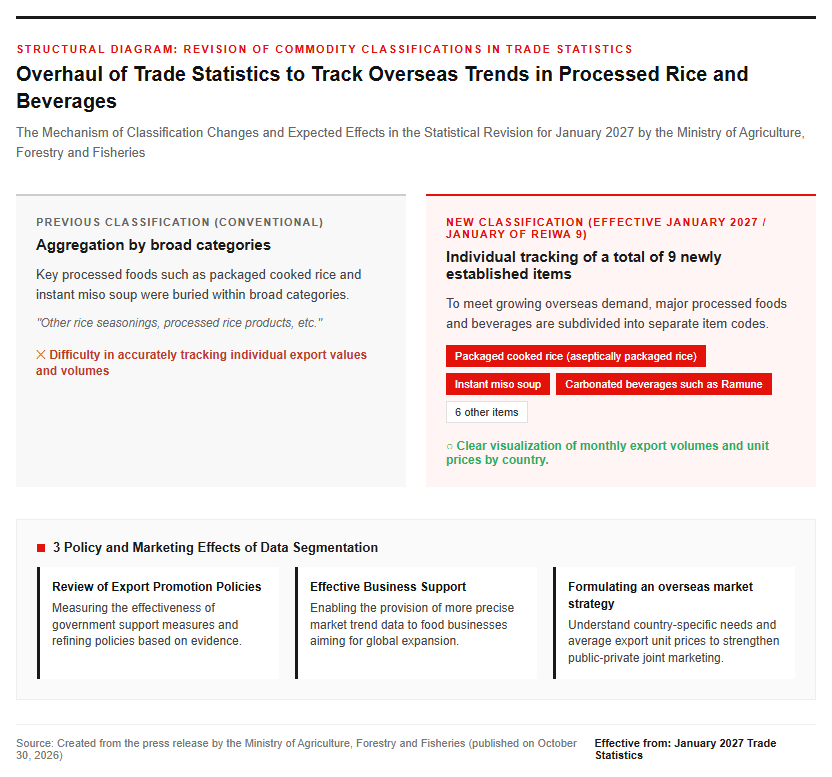
In a press release issued on October 30, 2026, the Ministry of Agriculture, Forestry and Fisheries announced that starting with the trade statistics for January 2027 (Reiwa 9), a total of 9 new categories—including “packaged cooked rice (aseptically packaged cooked rice),” “instant miso soup,” and “carbonated beverages such as ramune”—will be established to independently track export performance. Until now, packaged cooked rice and other such items were included under broad classification categories such as “other rice seasonings and processed rice products,” making it difficult to accurately track individual export values and volume trends with numerical data.
With the recent Japanese food boom and the promotion of global expansion by various manufacturers, overseas interest in Japanese processed foods has been rising rapidly. This classification revision is being implemented as part of the action strategy for expanding exports of agricultural, forestry, and fishery products and foods, with the objective of detailing and quantifying the export performance of targeted items. The nine newly established items include not only processed rice products but also regionally distinctive processed foods and beverages, and the policy is to utilize this data for collaborative public-private market analysis.
The finer subdivision of item codes in trade statistics will clearly visualize data such as monthly export volumes by country and average export unit prices. This will facilitate the evaluation of export promotion policies by the government, effective business support, and the formulation of marketing strategies for overseas markets. Please refer to the figure below.
The Policy Significance of Packaged Cooked Rice Becoming an Independent Item
Among the newly established categories, the one attracting the most attention is packaged rice, typically represented by aseptically packaged cooked rice. While domestic consumption of rice—Japan’s staple food—continues on a long-term downward trend, domestic production of packaged rice continues to break record highs, and it is also anticipated to be a strong growth driver in the export market. However, because there has been no independent HS code until now, it has been impossible to track to which countries and in what volumes packaged rice is being exported.
The establishment of packaged cooked rice as an independent statistical category holds immense significance for both government administration and food manufacturers. In the export expansion targets for agricultural, forestry, and fishery products and foods promoted by the Japanese government, rice and processed rice products are positioned as one of the top priority items. By clarifying export data for packaged cooked rice, it will become possible to instantly detect changes in demand in overseas countries and regions—such as North America and Asia—and reflect them in country-specific export promotion measures.
In addition, the accumulation of individual data will support operators in making capital investment decisions and in their efforts to acquire international certifications. Grasping overseas demand based on accurate figures serves as a foundation for strategically strengthening production capacity while curbing the risk of overinvestment. The establishment of packaged cooked rice as an independent product category can be described as a symbolic measure that represents a transition from a domestic industry dependent on internal demand to a globally growing industry.
The Rapidly Expanding Packaged Cooked Rice Market and Domestic Manufacturers’ Strategies
Changes in Domestic Dietary Habits and the Establishment of Demand Brought About by the Reiwa Rice Shortage
Behind the expansion of the packaged rice market lie changes in Japan’s social structure and lifestyles. With the increase in single-person and dual-income households, a “time-performance” (taipa) mindset—seeking convenience in cooking and preparing just the right amount—has taken root. The conventional negative image of emergency food has been dispelled, and its position as an everyday food where one can enjoy the taste of freshly cooked rice simply by heating it in the microwave has become fully established.
Furthermore, the Reiwa rice crisis that occurred in the summer of 2024 decisively shaped consumer purchasing behavior and stockpiling awareness. When uncooked rice vanished from supermarket shelves, packaged cooked rice served as a vital staple food source to support consumers’ tables. Through this experience, demand for “rolling stock”—stockpiling by routinely buying a little extra and consuming items in daily life—experienced explosive growth. The purchase frequency of multi-packs, such as 5-pack, 8-pack, and 10-pack options moving up from the conventional 3-pack, has risen, boosting sales volume in supermarkets and online retail. Please refer to the figure below.
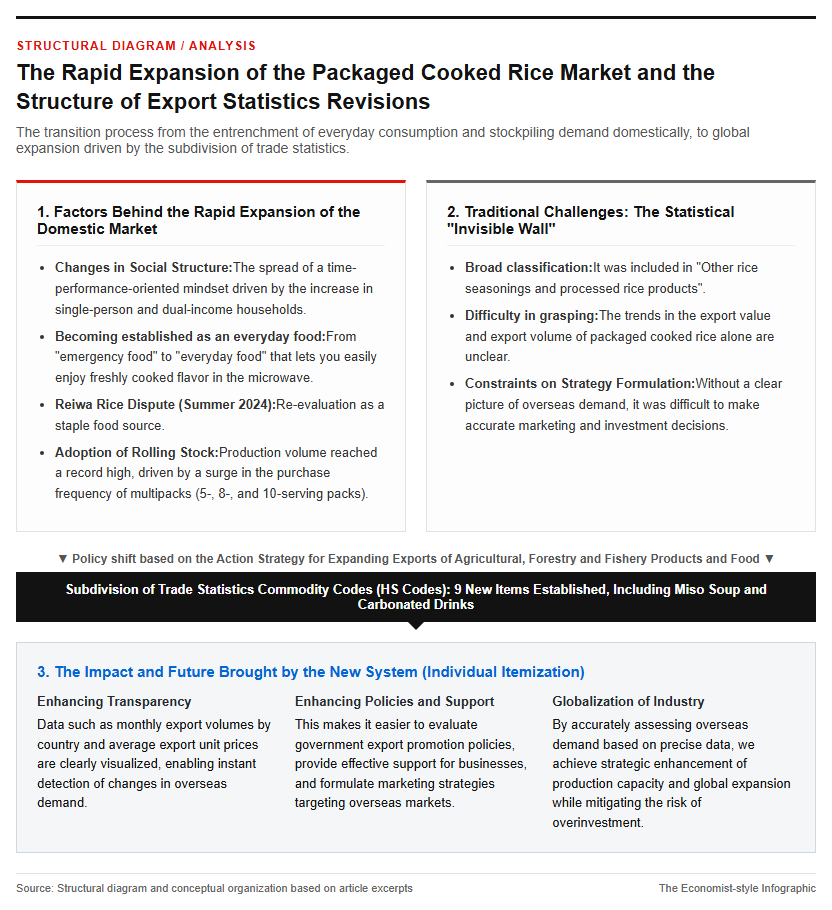
This surge in demand is showing remarkable growth amidst the ongoing decline in the annual consumption of staple rice. Product development catering to diversifying needs—such as high-functional rice, multi-grain blends, and low-carbohydrate products—has also emerged in rapid succession, with packaged cooked rice serving as a driving force to elevate the value of the entire rice industry.
Massive Capital Investment and Increased Production Systems by Major Processed Food Manufacturers
To meet surging demand, major domestic processed cooked rice manufacturers are successively making large-scale capital investments. Sato Foods Co., Ltd., a leading company in packaged cooked rice, is constructing a next-generation production line with a record-breaking total construction cost of over 8 billion yen, aiming to significantly boost its supply capacity. The company’s strength lies in differentiating its taste and quality through a thick-pot, direct gas-fired cooking method, and it aims to maintain its market share.
In addition, Hagoromo Foods Corporation has decided to make a capital investment of 4.5 billion yen at its main plant in Yaizu City, Shizuoka Prefecture, boosting the production capacity of its flagship “Papatto Rice” product by 30%. The company has adopted a unique small-portion tray design (100g × 2), capturing the demand for smaller portions from demographics such as the elderly and women, and is nurturing it into the second pillar of its business growth. Furthermore, Uuke Co., Ltd., under the Shinmei Group umbrella, and Iris Ohyama Inc. are also advancing the development of their own plants equipped with cutting-edge technology.
High productivity is being achieved through the creation of jobs in regional areas and the active introduction of automation and labor-saving technologies. This enhancement of production capacity is part of building a framework that not only ensures a stable supply for the domestic market but also anticipates future increases in overseas exports. The aggressive investments made by various companies are further strengthening the foundation of the packaged cooked rice industry.
Full-Scale Expansion into Overseas Markets and Future Prospects for Export Growth
Growing demand in overseas markets, centered around the United States, and the acquisition of FDA approval
Pack-cooked rice manufacturers that have solidified their domestic foundations are beginning full-scale expansion into overseas markets. In the United States, their largest export destination, demand for pack-cooked rice is surging alongside growing awareness of Japanese cuisine. Among overseas consumers, the convenience of being able to cook it in the microwave in just a few minutes, coupled with the high-quality taste unique to Japanese rice, has earned high praise, and it is steadily becoming established as an everyday staple food.
For a full-scale rollout into the U.S. market, obtaining certification from the U.S. Food and Drug Administration (FDA) is crucial. Iris Ohyama Inc. acquired FDA certification (FCE and SID registration) for manufacturing at its Kakuda Plant and began full-scale sales in the United States in January 2024. By leveraging its local subsidiary’s distribution network, the company aims to expand its market share nationwide through major supermarkets and online retail.
Furthermore, moves to obtain local government safety certifications are also spreading in Southeast Asian countries such as Thailand and Singapore. Amid the ongoing weak-yen trend, processed foods made with high-quality domestic rice are well-positioned to demonstrate strong price competitiveness. Capturing demand in global markets—going beyond merely satisfying domestic demand—has become an essential component of manufacturers’ growth strategies.
Future Export Strategies and Challenges Through Enhanced Statistical Data Accuracy
With the establishment of a new product category in trade statistics, export trends for packaged cooked rice will become visible starting in January 2027, enabling more sophisticated international strategies. Accurate tracking of export volumes will serve as a robust data foundation for country-by-country marketing and the development of local distribution networks. Through public-private collaboration in analyzing this data, it is expected that the rollout of strategic promotions in regions with surging demand and product development aligned with local needs will be accelerated.
However, challenges also exist regarding expansion into overseas markets. These include pricing against local currencies, compliance with export procedures and sanitary standards, and differentiation from competing local processed foods. In addition, maintaining stable procurement prices for raw rice and building a sustainable supply chain are also essential elements.
Triggered by the statistical development by the Ministry of Agriculture, Forestry and Fisheries, Japan’s rice industry is breaking away from its dependence on domestic demand and transitioning into a growth phase that captures global demand. The expansion of exports of high-value-added processed rice products, such as packaged cooked rice, is extremely important for maintaining and developing the domestic agricultural production base, and we cannot take our eyes off future trends.
Reference Page
- [Ministry of Agriculture, Forestry and Fisheries] Export values for packaged cooked rice, instant miso soup, carbonated beverages such as ramune, and more will be trackable starting from January 2027! https://www.maff.go.jp/j/press/yusyutu_kokusai/kikaku/261030.html
【#MinistryOfAgricultureForestryAndFisheries #PackagedRice #TradeStatistics #ExportExpansion #FoodIndustry #JapaneseFood #OverseasExpansion #SatouFoods】


コメント