Bank of Japan Governor Kazuo Ueda has stated that “further increases cannot be tolerated” as the underlying inflation rate—excluding temporary factors such as the government’s measures against high prices—approaches 2%, making clear his stance to continue implementing additional rate hikes with the aim of achieving stability at around 2%. In the background is a strong sense of vigilance against the risk of inflation overshooting due to high crude oil prices, foreign exchange fluctuations, and companies’ proactive wage- and price-setting behavior.
- Key takeaway: Approach of the 2% inflation target and clarification of the stance on rate hikes
- Shift in Policy Phase: From Upward Pressure on Prices to Stabilization Around 2%
- Financial Markets and Interest Rate Trends: Upward pressure on interest rates to 31-year highs
- Ripple Effects on Households and Businesses: The Stark Contrast Between Interest Payment Burdens and Profit Structures
- Government Finances and Political Situation: Increased Interest Payments Accompanying Rising Interest Rates and Moves to Keep Them in Check
- Future Outlook and Key Points: Timing of Additional Rate Hikes and Search for the Neutral Rate
Key takeaway: Approach of the 2% inflation target and clarification of the stance on rate hikes
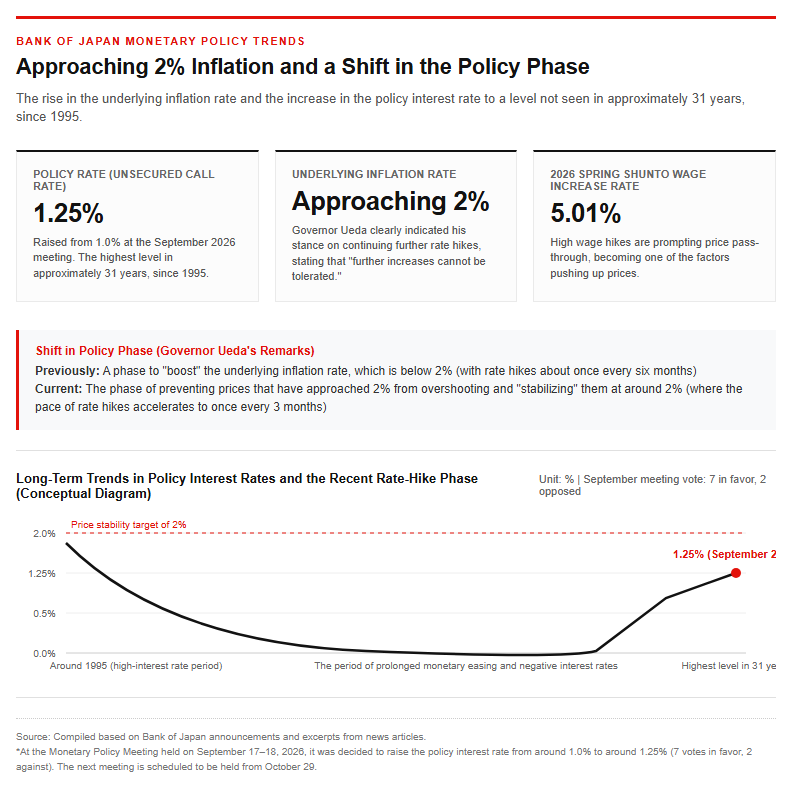
Bank of Japan Governor Kazuo Ueda stated that the underlying inflation rate, excluding temporary factors such as the government’s inflation relief measures, is approaching the 2% target, declaring that “further increases cannot be tolerated.” Up until now, the BOJ has tolerated upward momentum in order to gradually bring underlying inflation closer to 2%, but going forward, it has set establishing inflation at around 2% as a major policy goal, emphasizing its stance of continuing rate hikes to prevent excessive upward deviation in prices. At the Monetary Policy Meeting held from September 17 to 18, 2026, the BOJ decided to raise the policy interest rate—the uncollateralized overnight call rate—from the previous target of around 1.0% to around 1.25%. This rate hike comes three months after the June 2026 meeting, and the 1.25% policy rate level marks a high not seen in approximately 31 years, since 1995. With the BOJ’s next Monetary Policy Meeting scheduled for October 29, 2026, to determine near-term monetary policy, the bank has entered a critical phase of exploring the timing for the next additional rate hike while closely assessing the cumulative effects of the rate hike and trends in economic data.
Shift in Policy Phase: From Upward Pressure on Prices to Stabilization Around 2%
Governor Ueda used the concept of a “phase shift in policy” at a press conference to explain that the objective of monetary policy has shifted significantly. While the main focus of conventional policy was to push up the underlying inflation rate, which had been below 2%, it is now important to stabilize inflation at around the 2% level so that prices, which have approached 2%, do not overshoot further and adversely affect the economy. This phase shift is also the background behind the acceleration of the rate hike pace, which was previously viewed as roughly once every six months, to once every three months. Factors contributing to upside risks to prices include higher oil prices due to mounting tensions in the Middle East, the depreciation of the yen, the rapid expansion of artificial intelligence-related demand, and a high-level wage increase averaging 5.01% in the 2026 spring labor-management wage negotiations. These factors are prompting the passing on of costs from business-to-business transactions to the consumer stage. Meanwhile, at the September policy meeting, two board members, Toichiro Asada and Ayano Sato, cast dissenting votes on the grounds that “inflation is below 2% and the economy is also insufficient” and that the move was “premature,” resulting in a 7-2 vote in favor. The chart below shows the trends in the BOJ’s policy interest rate and price developments.
Spillover Effects on Financial Markets and Impact on Economic Agents
Financial Markets and Interest Rate Trends: Upward pressure on interest rates to 31-year highs
Following the Bank of Japan’s additional rate hike and hawkish stance, strong upward pressure has emerged on short- and long-term interest rates across the bond market. The yield on 2-year government bonds, considered particularly sensitive to the monetary policy outlook, temporarily rose to 1.975%, approaching the milestone 2% level for the first time since 1995. Furthermore, the 5-year government bond yield reached 2.43% to mark a record high, while the 10-year government bond yield (long-term interest rate) remains elevated above the key 3% threshold at 3.09%. Market views are growing that the BOJ may ultimately be forced to implement more aggressive rate hikes, driven by concerns that the central bank is falling behind the curve in tackling inflation and the persistence of the Japan-U.S. interest rate differential due to actions by overseas central banks such as the U.S. Federal Reserve. This rise in interest rates is also directly impacting personal asset management. The interest rates for retail JGBs and new over-the-counter JGBs for subscription in October 2026, announced by the Ministry of Finance, have been set at 2.07% for the 3-year fixed rate, 2.39% for the 5-year fixed rate, 2.05% for the 10-year variable rate, and 3.048% for the 10-year new over-the-counter JGBs, setting new record highs for all maturities in the Reiwa era.
Ripple Effects on Households and Businesses: The Stark Contrast Between Interest Payment Burdens and Profit Structures
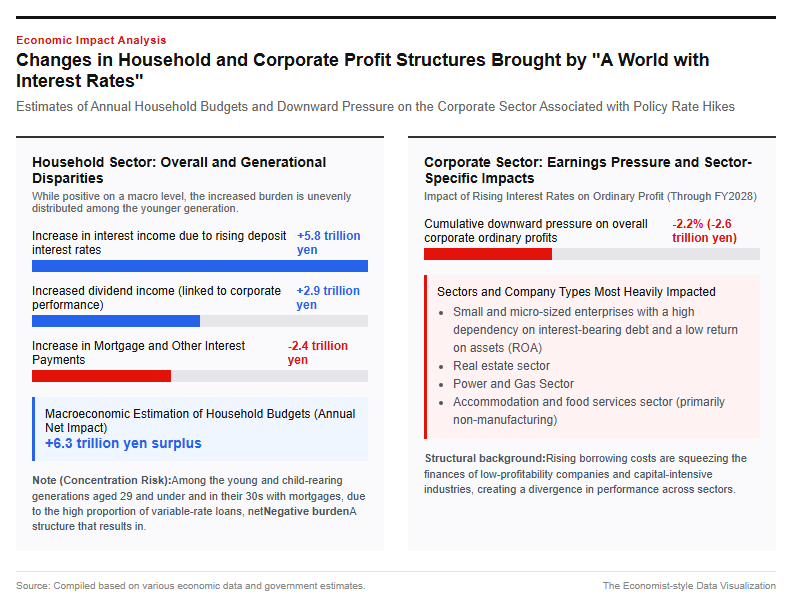
The full-scale transition to a “world with interest rates,” where the policy rate is raised to around 1.5%, will have a structural impact on both households and businesses. Looking at households as a whole, it is estimated that the increase in interest income due to higher deposit rates (approximately 5.8 trillion yen) and the increase in dividend income accompanying improved corporate performance (2.9 trillion yen) will significantly outweigh the increase in interest payments on mortgages and other loans (2.4 trillion yen), generating a positive effect of about 6.3 trillion yen annually. However, the distribution of benefits and burdens is heavily skewed among households. For young and child-rearing generations aged 29 and under or in their 30s with mortgages, repayment burdens will increase due to the high proportion of variable-rate loans and the large borrowing amounts, resulting in a net negative impact from rising interest rates. Meanwhile, in the corporate sector, interest rate hikes through fiscal 2028 are estimated to push down cumulative ordinary profits by 2.2% (about 2.6 trillion yen) overall. In particular, the drop in profits is projected to be significant for small and micro-sized enterprises with high dependence on interest-bearing debt and low return on total assets, as well as non-manufacturing industries such as real estate, electricity and gas, and accommodation and food services. The following graph illustrates the projected impact of interest rate fluctuations on each sector.
Fiscal and Political Situation and Outlook
Government Finances and Political Situation: Increased Interest Payments Accompanying Rising Interest Rates and Moves to Keep Them in Check
The negative impact of rising interest rates will appear most severely in the government sector. With the outstanding balance of government bonds exceeding 1,000 trillion yen, the government’s interest payment costs will skyrocket as refinancing progresses at high interest rates. According to government estimates, the interest payment burden is projected to swell from the current level of around 10 trillion yen to the 30-trillion-yen range by the mid-2030s, and it has been pointed out that if the fiscal balance does not improve, there is a risk that the government debt-to-GDP ratio will enter a divergent trajectory. Concerns over the increased issuance of government bonds under the “responsible aggressive fiscal policy” advocated by the Takaichi administration are also acting as a factor that widens the market’s risk premium and intensifies upward pressure on interest rates. On the political front, caution has been voiced from within the administration regarding BOJ Governor Ueda’s interest rate hike policy. Reports have also surfaced of unusual moves to keep rate hikes in check, such as Minoru Kiuchi, Minister for Economic and Fiscal Policy and a close aide to Prime Minister Takaichi, mentioning the potential exercise of the “right to request a postponement of a resolution” under the Bank of Japan Act during exchanges with senior Cabinet Office officials.
Future Outlook and Key Points: Timing of Additional Rate Hikes and Search for the Neutral Rate
The biggest focus regarding the future of monetary policy is the timing of the next additional rate hike and the level of the terminal rate, which is the endpoint of the rate hikes. In the financial market, there is a 20% to 40% probability priced in for consecutive rate hikes at two successive meetings by the October 2026 meeting, and approximately a 90% probability for an additional rate hike at the December 20th meeting [Wait, the text says 12月会合 (December meeting), let me translate accurately]. In the financial market, a probability of 20% to 40% is priced in for consecutive rate hikes at two successive meetings by the October 2026 meeting, and about 90% for an additional rate hike at the December meeting. Regarding the “neutral interest rate”—which neither overheats nor cools down the economy—Governor Ueda acknowledged the difficulty of measurement, stating, “There is no material that allows us to say definitively that it is around here,” while indicating a policy of making careful judgments while assessing the cumulative effects of past rate hikes as well as price and economic data. According to estimates by experts and research institutions, Japan’s neutral interest rate is seen to be around 1.5% to 2.0%, and a dominant scenario is that the BOJ will gradually raise the policy rate to around 1.5% to 1.75% from fiscal 2027 through fiscal 2028. Moving forward, the situation in the Middle East, U.S. policy trends, and the wage-hike momentum of the 2027 Shunto (spring labor-management wage negotiations) will be critical keys influencing policy decisions.
Reference Page
- [Bank of Japan Official Announcements & Materials] [suspicious link removed]
[#BOJ #GovernorUeda #InterestRateHike #Inflation #MonetaryPolicy #JapaneseEconomy]
コメント