Hitachi, Ltd. has developed a new framework called “Fix Before Attack” to prepare for cyberattack risks in critical infrastructure such as power and railways, supporting everything from vulnerability discovery to countermeasure decision-making in a matter of hours. Amid the ongoing automation of attacks, digital twin technology forms the backbone, enabling swift, proactive responses without shutting down systems.
- Key takeaway of the event: Announcement of “Fix Before Attack,” aiming to address vulnerabilities within hours.
- Social Background of Development: The Dilemma of Advancing AI Attacks and Infrastructure That Must Never Stop
- Proactive Detection for OT Devices Using Fuzzing and Component Analysis
- Visualizing the Scope of Impact Using Security Digital Twins and a Three-Tier Model
- Automated suggestion of countermeasures and operational automation via SSVC and ticket management integration
- Future Outlook and Key Points: PoC Promotion and Transition to Managed Security Services
Key takeaway of the event: Announcement of “Fix Before Attack,” aiming to address vulnerabilities within hours.
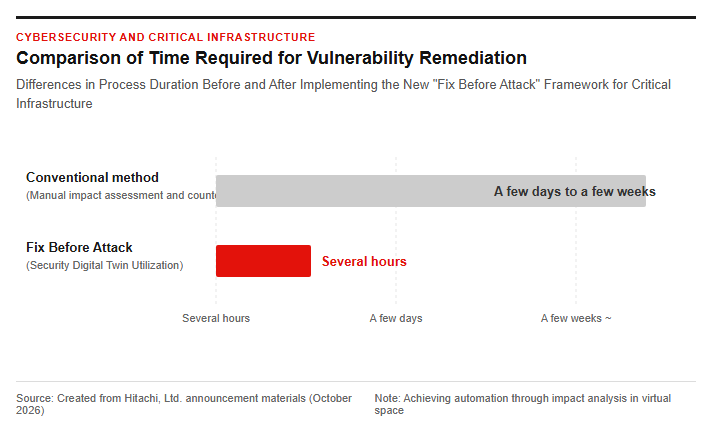
On October 19, 2026, Hitachi, Ltd. announced “Fix Before Attack,” a new framework designed for critical infrastructure systems such as power, railways, and large-scale factories, which seamlessly and rapidly accelerates the entire process from vulnerability discovery to impact analysis and countermeasure recommendation. In conventional operations, evaluating the risk of newly discovered vulnerabilities, investigating their impact on operational systems, and formulating mitigation strategies manually required a tremendous amount of time, ranging from several days to several weeks. However, by utilizing a security digital twin that replicates system configurations and business processes in a virtual space, this technology demonstrates an innovative operational model that completes this previously protracted series of evaluation and mitigation processes in just a few hours. Currently, the development of a prototype integrating core functions has been completed, and it has been demonstrated that the system can smoothly execute tasks ranging from importing external vulnerability information to automatically proposing optimal countermeasures. Moving forward, through verification experiments in internal systems and proofs of concept (PoCs) with customer enterprises, Hitachi aims to commercialize this as a managed security service that enhances the continuous operation and cyber resilience of social infrastructure. Please refer to the figure below.
Social Background of Development: The Dilemma of Advancing AI Attacks and Infrastructure That Must Never Stop
The development of this technology is rooted in the severe operational challenges unique to critical infrastructure—the foundation of social life—and the rapid evolution of cyberattacks. Operational technology (OT) systems, such as power grids, railway operations, and manufacturing plants, are premised on 24/7 continuous operation, making it difficult to casually implement software patches or network configuration changes that involve system downtime. As a result, they have faced a structural dilemma of having to leave dangerous vulnerabilities unaddressed for long periods despite being aware of their existence. Furthermore, in recent years, the malicious use of generative AI and AI agents has sophisticated and automated vulnerability scanning and exploit code creation by attackers, drastically shortening the time from vulnerability disclosure to the launch of actual exploits. Regulatory authorities in various countries, including the U.S. Cybersecurity and Infrastructure Security Agency (CISA), have issued guidelines directing rapid, risk-based vulnerability remediation, and the introduction of security measure evaluation systems targeting entire supply chains is progressing within Japan as well. Under these circumstances, critical infrastructure operators have had an urgent need to introduce a mechanism for “implementing defensive measures in a short time, staying one step ahead of attackers, without stopping equipment.”
Core Technology for Everything from Early Vulnerability Detection to Impact Analysis
Proactive Detection for OT Devices Using Fuzzing and Component Analysis
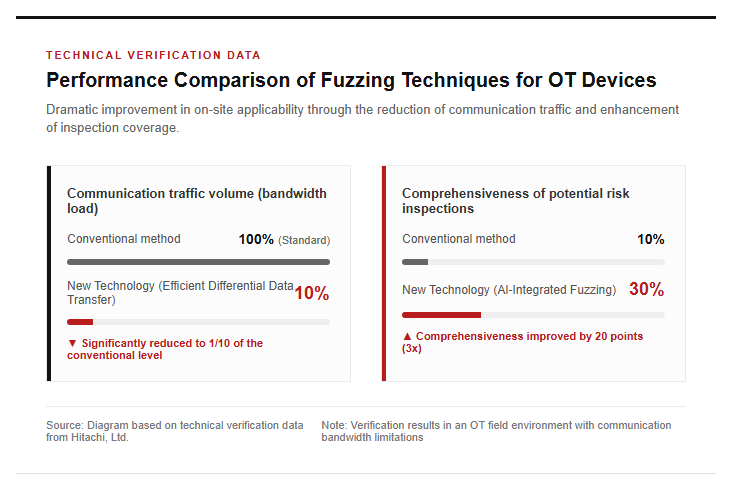
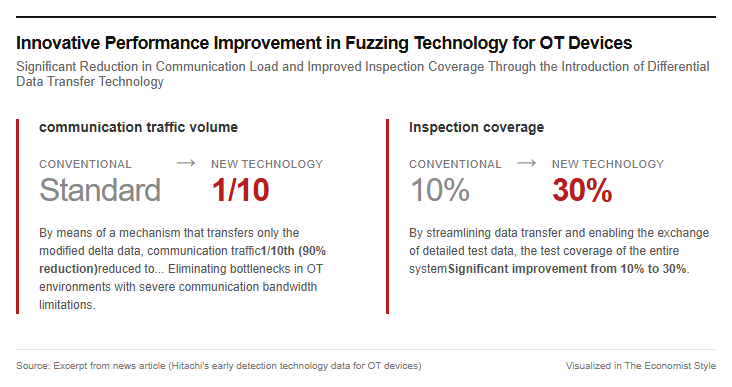
The first pillar supporting “Fix Before Attack” is early detection technology that proactively identifies potential vulnerabilities before third-party disclosure. Hitachi has established a continuous inspection mechanism combining generative AI-integrated fuzzing technology for OT devices with component analysis (SCA/SBOM) technology that visualizes software components. Fuzzing is an advanced inspection method that sends large amounts of random or intentionally manipulated test data to target devices, uncovering potential unknown bugs and vulnerabilities from system behaviors and responses. Conventionally, OT devices installed in factories and infrastructure sites had strict communication bandwidth limitations, making the exchange of detailed inspection data a bottleneck; however, Hitachi has developed a technology to efficiently transfer only changed differential data, succeeding in reducing communication traffic to one-tenth while improving inspection coverage from 10% to 30%. This makes it possible to identify potential risks within internal systems early—without waiting for vulnerability information to be disclosed by external researchers or attackers—and to establish a defense posture ahead of the attack preparation stage. Please refer to the figure below.
Visualizing the Scope of Impact Using Security Digital Twins and a Three-Tier Model
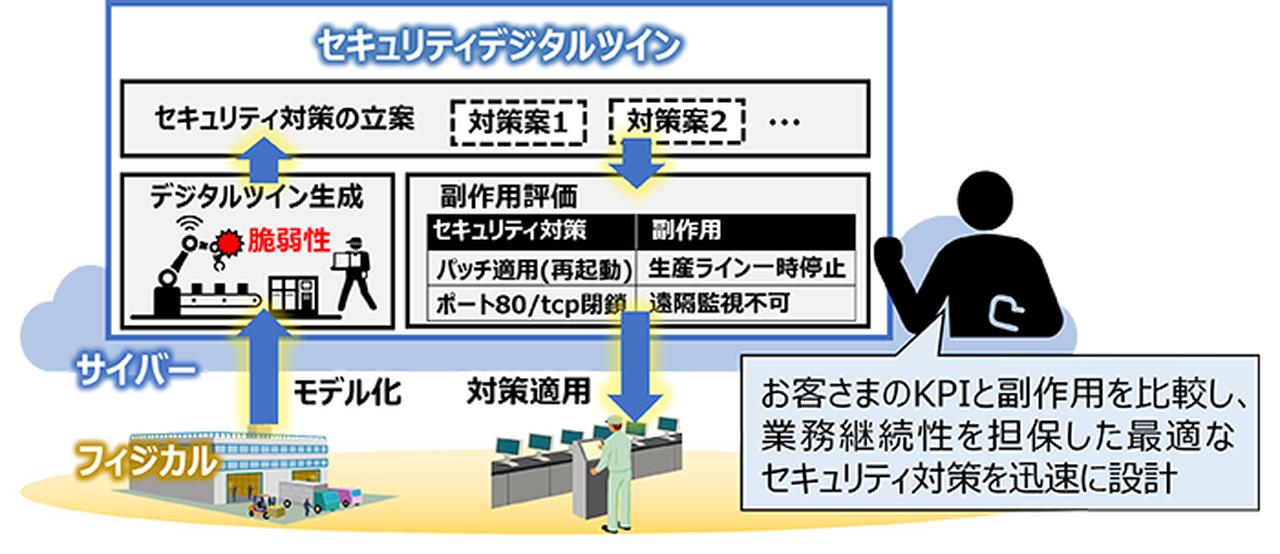
To accurately understand how much impact a detected vulnerability has on actual operations and business, Hitachi’s proprietary “Security Digital Twin” technology has been introduced. This is a technology that models the OT system operating in the physical space into three tiers—component devices (assets), humans operating them or attackers (actors), and critical business workflows (processes)—and precisely reconstructs them in cyberspace. With conventional technical indicators such as CVSS (Common Vulnerability Scoring System) alone, it is impossible to determine specific business impacts, such as “what kind of damage a specific vulnerability will cause to which of our facilities or manufacturing lines.” On the Security Digital Twin, simulations are conducted in advance when an attack is made on a specific device, quantitatively visualizing the risk of production line stoppages and the degree of impact on product shipment rates (KPIs). This enables on-site operation managers and executive management to quickly and accurately identify critical vulnerabilities that should be given top priority for business continuity, without being misled by uniform severity scores.
Roadmap for the Automated Formulation of Countermeasures and Future Societal Implementation
Automated suggestion of countermeasures and operational automation via SSVC and ticket management integration
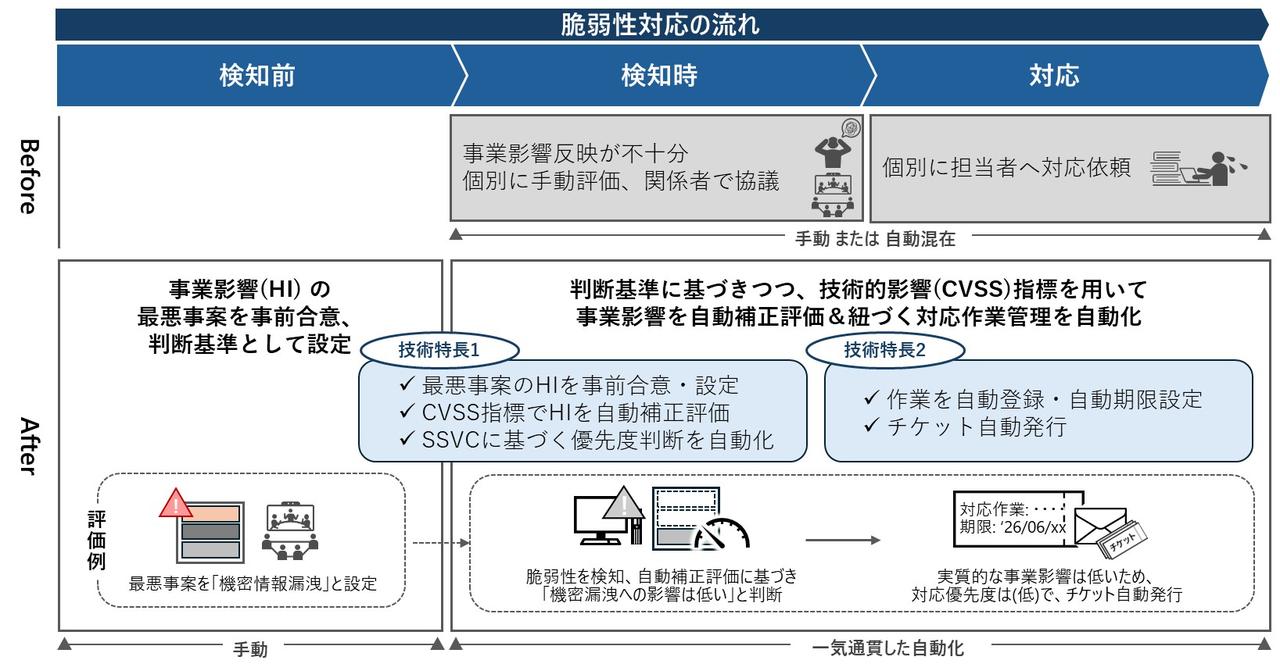
Fix Before Attack goes beyond mere impact analysis to provide comprehensive support ranging from the formulation of concrete security measures to the automation of operational management. Based on the analysis results from the digital twin, the system utilizes generative AI to automatically generate optimal remediation proposals, such as blocking specific communication on firewalls, restricting access permissions, or applying alternative controls. In addition, focusing on SSVC (Stakeholder-Specific Vulnerability Categorization)—a vulnerability assessment framework that accounts for business impact—Hitachi has established an algorithm that automatically determines response priorities by combining it with CVSS technical evaluations by pre-setting the worst-case scenario (Human Impact) in the event of a system failure. These determination results are automatically integrated with internal ticketing systems to centrally manage everything from vulnerability detection to the assignment of responsible personnel, setting of remediation deadlines, and visualization of progress. Unlike conventional approaches, this eliminates the need for time-consuming consultations across multiple departments and allows for the presentation of objective, accountable grounds for decisions to auditing authorities and business partners, thereby drastically reducing the burden on operational staff while preventing missed responses. Please refer to the figure below.
Future Outlook and Key Points: PoC Promotion and Transition to Managed Security Services
Hitachi’s proposed “Fix Before Attack” is poised to evolve further through upcoming demonstration experiments and global expansion. Demonstrations of this achievement were already showcased at the international conference “ETSI Security Conference 2026,” held in Sophia Antipolis, France, from October 19 to 22, 2026, drawing high attention from global experts. Moving forward, in addition to repeated internal verifications at its own production facilities and infrastructure systems, Hitachi will step up joint proof-of-concept (PoC) trials with critical infrastructure operators in fields such as electric power and transportation. Furthermore, it will be incorporated as a core security function of “Lumada 3.0,” the company-wide digital business platform promoted by Hitachi, and will be integrated with the “Critical Infrastructure Defense Program,” a cyber defense program for critical infrastructure launched by U.S.-based Anthropic, as well as with advanced AI “Claude” and solutions such as “HMAX Cyber.” With support from programs like the Economic Security Critical Technology Development Program of the New Energy and Industrial Technology Development Organization (NEDO), there are high expectations for its early practical application as a managed security service designed to protect all of social infrastructure from cyberattacks.
Reference page
- [Hitachi News Release] Hitachi Proposes “Fix Before Attack” to Support Critical Infrastructure Vulnerability Mitigation in Hours
お探しのページが見つかりません:日立お探しのページが見つかりませんwww.hitachi.co.jp - [Hitachi R&D Topics] Hitachi Develops Method to Automatically Determine Priority of System Vulnerability Responses Based on Business Impact
 日立、事業影響を踏まえてシステム脆弱性対応の優先度を自動判断する手法を開発 - 研究開発:日立第三者に説明可能な判断基準と運用自動化で、脆弱性対応体制の強化を支援日立は、限られた人員でも重要な脆弱性に優先的に対応できるよう、システム脆弱性対応の優先度を事業影響に基づいて自動判断する手法を開発しました。近年、サイバー攻撃の増加・高度化...rd.hitachi.co.jp
- [Hitachi R&D Topics] Developed Security Digital Twin Technology Enabling the Design of Security Measures That Ensure Business Continuity
 業務継続性を担保したセキュリティ対策の設計を可能とするセキュリティデジタルツイン技術を開発 - 研究開発:日立稼働停止が困難なOTシステムで脆弱性が放置される問題を解決可能日立は、業務継続性*1を担保したセキュリティ対策を設計可能なセキュリティデジタルツイン(Security Digital Twin)技術を開発しました。これまで日立が培ってきたO...rd.hitachi.co.jp

【#Hitachi #Cybersecurity #CriticalInfrastructure #DigitalTwin #FixBeforeAttack #GenerativeAI #OTSecurity #PSIRT】


コメント