On October 16, 2026, Fukuoka Institute of Technology and Kumamoto University concluded a comprehensive partnership agreement aimed at cultivating next-generation advanced professionals to support Kyushu’s semiconductor industry. The background involves the concentration of related industries following the entry of global giant TSMC into Kumamoto, alongside a serious future shortage of semiconductor talent.
- Overview of the Historic Agreement Between Fukuoka Institute of Technology and Kumamoto University
- The Rapidly Expanding Semiconductor Industry in Kyushu and the Ripple Effects of TSMC’s Entry
- Kumamoto University’s Advanced Research and Education Infrastructure and the Sharing of Practical Training Facilities
- Establishment of Fukuoka Institute of Technology’s “Semiconductor Engineering Course” and Practical Education in Taiwan
- Anticipated Annual Shortage of 300 Workers from FY2028 to FY2034 and SME Support
- Sustainable Development of the Revitalized Silicon Island Kyushu and the Future Vision of Industry, Academia, and Government
Overview of the Historic Agreement Between Fukuoka Institute of Technology and Kumamoto University
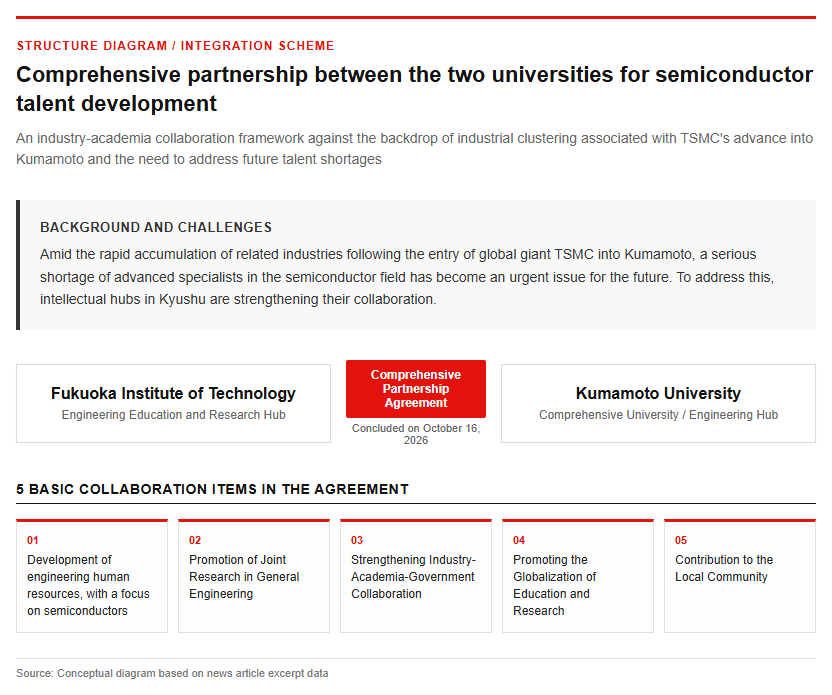
On October 16, 2026, Fukuoka Institute of Technology and Kumamoto University held a signing ceremony for a comprehensive partnership agreement at the Fukuoka Institute of Technology headquarters building. The ceremony was attended by Hisao Ogawa, President of Kumamoto University, and Riichi Murayama, President of Fukuoka Institute of Technology, among others, who pledged cooperation toward cultivating advanced human resources to drive sustainable growth in Kyushu’s semiconductor industry. The partnership outlines five basic pillars of collaboration: the development of engineering talent centered on semiconductors, the promotion of joint research across general engineering, industry-academia-government collaboration, the promotion of globalization in education and research, and contribution to the local community. By establishing a strong network between Fukuoka and Kumamoto—major intellectual hubs in Kyushu—a system has been put in place to integrally utilize the educational resources and research infrastructure of the entire region. This agreement goes beyond mere cooperation between universities, generating high expectations as a practical partnership model to address the rapid development of the industrial sector.
The Rapidly Expanding Semiconductor Industry in Kyushu and the Ripple Effects of TSMC’s Entry
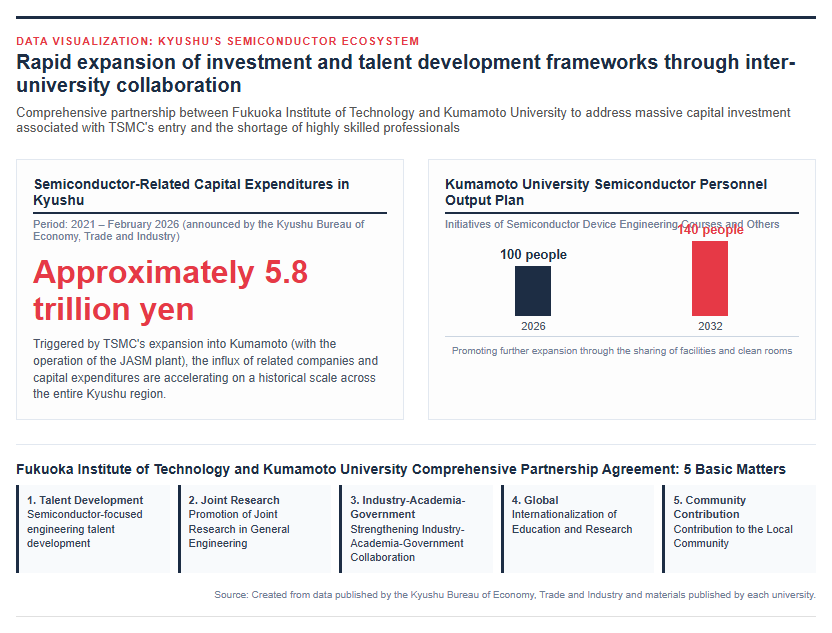
In the Kyushu region, triggered by Taiwan Semiconductor Manufacturing Company’s (TSMC) expansion into the town of Kikuyo in Kumamoto Prefecture and the launch of operations at its JASM plant, semiconductor-related companies are accelerating their expansion and capital investments. According to an announcement by the Kyushu Bureau of Economy, Trade and Industry, semiconductor-related capital investments announced across Kyushu between 2021 and February 2026 have reached a total scale of approximately 5.8 trillion yen. Kyushu, once boasting a massive global market share and known as “Silicon Island,” is thriving once again as a major hub for semiconductor production in Japan. However, compounded by the rapid advancements in AI and robotics, the surging demand for engineers and R&D talent on the manufacturing front lines has intensified recruitment competition among companies. While plant construction and capital investment are moving forward rapidly, the risk of a lagging supply of personnel to operate and develop these facilities on-site is becoming a reality, making talent acquisition the top priority for sustaining Kyushu’s growth.
Strengths of Both Universities in Specialized Education and Specific Measures for Mutual Cooperation
Kumamoto University’s Advanced Research and Education Infrastructure and the Sharing of Practical Training Facilities
Kumamoto University has promoted advanced organizational development as a pioneer in regional semiconductor research and education. In April 2022, it established the Semiconductor Research and Education Center, and in academic year 2024, it newly established the Semiconductor Device Engineering Course within the Faculty of Engineering, working to foster practical engineers. Furthermore, in 2025, it completed a dedicated research building equipped with cleanrooms capable of cutting-edge prototyping and experimentation. Kumamoto University has set a plan to expand the number of graduates in this field to 100 in 2026 and 140 in 2032. The recent comprehensive partnership agreement includes provisions for students and researchers from the Fukuoka Institute of Technology to also mutually utilize these advanced research facilities and practical training equipment, such as cleanrooms. This has made it possible to transcend the framework of private and national universities to share advanced experimental environments, and dramatically increase hands-on training opportunities to work with cutting-edge equipment.
Establishment of Fukuoka Institute of Technology’s “Semiconductor Engineering Course” and Practical Education in Taiwan
Fukuoka Institute of Technology is proceeding with plans to establish a new “Advanced Engineering Department, Semiconductor Engineering Course” (capacity: 20 students) in April 2027, in conjunction with a reorganization of its Faculty of Engineering. The course’s defining feature is that all 20 elite, small-group students will study abroad in Taiwan—the heart of the semiconductor industry—and work on their graduation research under a credit-transfer system. The destination institution, National Yunlin University of Science and Technology, is a top-tier educational institution where over 70 percent of the faculty have practical industry experience, and which has produced numerous professionals for local companies, including TSMC. In September 2026, as a preliminary model case, four fourth-year students from the Department of Electronic and Information Engineering traveled to National Yunlin University of Science and Technology for a four-and-a-half-month long-term study abroad program. The recent comprehensive agreement with Kumamoto University also envisions future mutual exchanges with Taiwanese universities and research institutions partnered with both universities, aiming to build a cross-border international education network.
Overcoming the Talent Challenges Facing Kyushu and Future Prospects
Anticipated Annual Shortage of 300 Workers from FY2028 to FY2034 and SME Support
According to estimates released in March 2026 by the Kyushu Semiconductor Workforce Development Consortium, an industry-academia-government organization, the semiconductor industry in Kyushu is projected to face a persistent labor shortage of approximately 300 people annually from fiscal 2028 through fiscal 2034. While the demand plan for fiscal 2025–2027 (approximately 2,900 people) is expected to be met through aggressive recruitment activities, a supply-demand gap will emerge from fiscal 2028 onward as the number of job openings expands to about 3,300. Securing talent is in an extremely critical state, particularly for local small and medium-sized enterprises (SMEs), which tend to be at a disadvantage compared to major companies in terms of brand recognition and compensation packages. The comprehensive partnership between the two universities plays a role not only in cultivating advanced researchers but also in expanding the training foundation for production engineers and operators who can immediately contribute on-site. Supplying top-tier talent to SMEs that support the local supply chain is essential for boosting Kyushu’s industries.
Sustainable Development of the Revitalized Silicon Island Kyushu and the Future Vision of Industry, Academia, and Government
As Fukuoka Institute of Technology President Riichi Murayama stated, “We want to bring our respective strengths together and build a partnership model with an eye on the whole of Kyushu,” and as Kumamoto University President Hisao Ogawa emphasized, “We want to promote industry-academia-government collaboration and globalization,” this partnership is directly linked to industrial promotion across the entire Kyushu region. Working in tandem with the expansion of loans by financial institutions and infrastructure support by local governments, universities acting as hubs of knowledge play a crucial role in serving as the core of human resource supply. Moving forward, the educational model centered around Fukuoka and Kumamoto universities is expected to spread to other universities and colleges of technology within Kyushu, and further influence the STEM career choices of junior and senior high school students. By creating a sustainable human resource development ecosystem through the joint efforts of industry, academia, and government, the initiative aims to establish a strong “Reborn Silicon Island Kyushu” that remains unaffected by fluctuations in the semiconductor market.
Reference page
- [Fukuoka Institute of Technology News Release] https://www.fit.ac.jp/news/archives/5416
- [Fukuoka Institute of Technology Press Release (Establishment of Semiconductor Engineering Course)] https://www.fit.ac.jp/news/archives/5373
[#FukuokaInstituteOfTechnology #KumamotoUniversity #SemiconductorWorkforceDevelopment #SiliconIslandKyushu #TSMC #IndustryAcademiaGovernmentCollaboration]

コメント