
On October 22, 2026, the Japanese Trade Union Confederation (Rengo) announced its basic framework for the 2027 shunto (spring labor-management wage negotiations), presenting a wage hike demand target of “around 6%, with 5% or higher” and setting its first medium-term goals looking toward 2030. Against the backdrop of ingrained high prices and a chronic labor shortage, the initiative is designed to foster sustainable wage increases that extend beyond single-year negotiations and ensure they take root among small and medium-sized enterprises (SMEs).
- Key takeaway of the event: 6% central demand and establishment of first mid-term goals
- The Structure of Single-Year and Medium-Term Targets: A 1% Real Wage Increase and the Roadmap to 2030
- The Wage Increase Gap Between Large Enterprises and SMEs: The Wall of 5.01% and 4.69%
- The Plight of a 54.2% Cost Pass-Through Rate and the Difficulty of Passing on Labor Costs
- Upward Pressure from AI and Labor-Saving Investments and Minimum Wage Hikes
- Future Outlook and Key Points: The BOJ’s Rate Hike Decision and the Initial Momentum of Shunto (Spring Wage Negotiations)
Key takeaway of the event: 6% central demand and establishment of first mid-term goals
In its basic framework for the 2027 Shunto (spring labor offensive) released on October 22, 2026, Rengo set its overall wage hike demand target at “centering on 6%, with 5% or more.” A major feature is that while maintaining the conventional demand level of “5% or more,” it sets 5% as the minimum target and explicitly states a more aggressive “centering on 6%” as the primary target. Furthermore, going beyond single-year negotiation targets, it has introduced its first medium-term targets looking ahead to 2030. Specifically, it has set a policy aiming for wage levels by 2030 based on a median of 360,000 yen per month for 35-year-olds and 340,000 yen per month for 30-year-olds. Although the final tally for the 2026 Shunto achieved an average wage hike rate of 5.01%, maintaining a high level in the 5% range for the third consecutive year, unions that achieved a wage increase of 5% or more accounted for only 43% of the total, and small and medium-sized enterprises continue to fall short of the 5% mark. In light of these circumstances, Rengo aims to establish wage-hike norms throughout society and raise the overall economic floor. Please refer to the figure below for an overview of the overall structure.
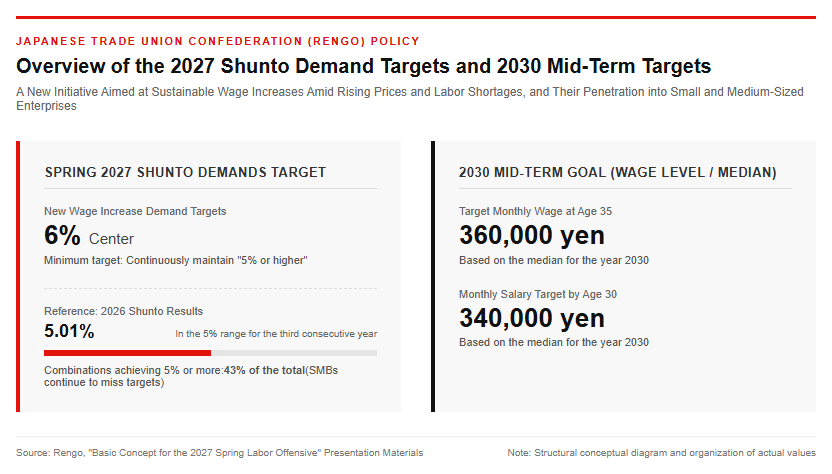
The Structure of Single-Year and Medium-Term Targets: A 1% Real Wage Increase and the Roadmap to 2030
Rengo’s first-ever medium-term goal has been calculated on the premise of raising current wage levels by approximately 15% over the four years leading up to 2030. As a breakdown, a 2% inflation rate and an increase in real wages of 1% or more are set as the base for each year, with additional upward effects factored in from government investment in people, technological innovation, and the expansion of domestic investment. Against the backdrop of wages continuing to rise at a pace of 1% to 2% annually in major overseas countries, it has been pointed out that it is essential to sustain the improvement speed of real wages across Japan as a whole at 1% or more. While single-year negotiations tend to be easily influenced by annual financial results and price fluctuations, setting a medium-term goal is expected to make it easier to project medium- to long-term livelihood planning and corporate investment in human capital. This clearly demonstrates the intention to shift from a mere cost-offsetting base-up to a sustainable structure that contributes to value creation and the improvement of living standards.
Structural Challenges and Corporate Disparities Hindering the Spread of Wage Increases
The Wage Increase Gap Between Large Enterprises and SMEs: The Wall of 5.01% and 4.69%
According to RENGO’s final tally for the 2026 shunto (spring labor-management wage negotiations), the overall average wage increase rate stood at 5.01%. However, when limited to small and medium-sized unions with fewer than 300 employees, it remained at 4.69%, resulting in a 0.32 percentage point gap. Compared to the average wage increase rate of 5.37% for large enterprises, this disparity becomes even more pronounced. Since small and medium-sized enterprises (SMEs) account for about 70% of Japan’s employment, the overall average of 5.01% was partly driven up by the exceptional growth seen in large corporations, and the reality is that many frontline workers do not actually feel a 5% wage hike. Furthermore, according to a survey by Tokyo Shoko Research, the planned implementation rate for base pay increases (base-up) for fiscal 2026 dropped to 46.8% from the previous year, with a majority of companies stopping at regular annual increments and unable to take the step toward raising the foundational salary itself. Although the number of companies implementing wage hikes is increasing, challenges remain regarding the sustainability required to raise the wage tables themselves, making the resolution of the structural gap between large enterprises and SMEs a major theme for the 2027 shunto.
The Plight of a 54.2% Cost Pass-Through Rate and the Difficulty of Passing on Labor Costs
The biggest barrier for small and medium-sized enterprises (SMEs) in securing the financial resources for wage increases is price-pass-through negotiations with business partners. According to a survey conducted by the Small and Medium Enterprise Agency in March 2026, the overall price-pass-through rate for costs remained at just 54.2%, meaning businesses are still forced to shoulder roughly half of the resulting cost increases themselves. Furthermore, looking at the breakdown by cost category, while the pass-through rate for raw material costs is 55.7%, the pass-through rate for labor costs—representing increases in personnel expenses—stands at the lowest level of 50.0%. While market trends for raw materials can be easily demonstrated objectively, labor costs tend to be viewed as a company’s voluntary management decision, creating a structural challenge where it is difficult to gain understanding from ordering clients. Being forced to raise wages while price pass-through makes little progress compresses profit margins, creating a vicious cycle that makes capital investment and business continuity difficult. Bankruptcies caused by labor shortages in fiscal 2025 increased to 441 cases, approximately 1.3 times the previous fiscal year, with 77% of them being small-scale businesses with fewer than 10 employees. Please refer to the figure below for a detailed breakdown of the price-pass-through structure.
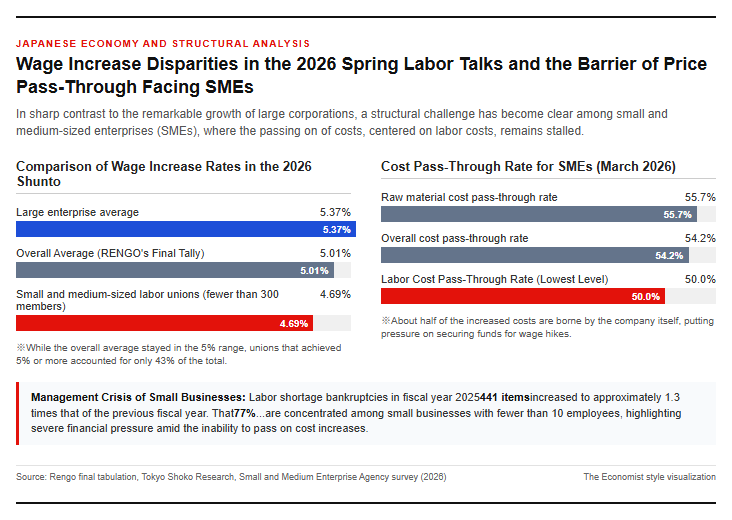
Productivity Improvement: Impact on and Outlook for the Japanese Economy
Upward Pressure from AI and Labor-Saving Investments and Minimum Wage Hikes
As companies can no longer rely solely on passing on price increases, labor-saving investments utilizing AI and robotics, along with productivity improvements, are anticipated as new means to generate the financial resources for wage hikes. In the draft framework for the spring 2027 labor-management negotiations revealed by Keidanren in September 2026, strong emphasis is placed on restructuring work styles premised on AI and robotics, as well as securing funds through productivity gains. Meanwhile, as a separate channel from labor-management negotiations, hikes in the minimum wage are acting as an upward pressure on wages from below. The national weighted average guideline for the regional minimum wage for fiscal 2026 reached 1,176 yen (a 4.9% increase), directly raising hourly wage rates, particularly in regional areas and for non-regular employment. Caught between dual pressures—demands from Shunto negotiations from above and minimum wage hikes from below—the review of wage structures for the middle class and financial support for labor-saving investments have become matters of extreme urgency.
Future Outlook and Key Points: The BOJ’s Rate Hike Decision and the Initial Momentum of Shunto (Spring Wage Negotiations)
The future focus will be on the initial stances of labor and management, which will become apparent from the autumn to winter of 2026, and their impact on the Bank of Japan’s monetary policy. The initial momentum of the Shunto labor negotiations will be shaped around November 2026 through the draft of Keidanren’s “Committee on Management and Labor Policy Report,” the demand guidelines of major industry-specific unions, and the movements of companies that announce early wage hikes. Following the achievement of a 5.01% increase in the 2026 Shunto, the probability that the BOJ will implement an additional rate hike within the year reached 93% in financial markets, with the sustainability of the virtuous cycle of wages and prices serving as a key rationale for the rate hike decision. The key factors determining the success or failure of the Japanese economy’s exit from deflation and sustainable growth will be the extent to which demands centered around 6% in the 2027 Shunto are reflected in actual agreements, and whether the ripple effects of wage increases will spread thoroughly to small and medium-sized enterprises and regional areas.
Reference page
- [Japanese Trade Union Confederation (RENGO): “2026 Spring Labor Offensive Demands and Response Tally”] https://www.jtuc-rengo.or.jp/activity/roudou/shuntou/index2026.html
- [Ministry of Health, Labour and Welfare: “Spring Wage Increase Results in Major Private Enterprises”] https://www.mhlw.go.jp/stf/seisakunitsuite/bunya/koyou_roudou/roudouseisaku/shuntou/roushi-c1.html
- [Japan Business Federation (Keidanren): “Report of the Committee on Management Labor Policy”] https://www.keidanren.or.jp/
【#Shunto #Rengo #WageHikes #EconomicNews #JapaneseEconomy #SMEs #Inflation #MonetaryPolicy】

コメント