In September 2026, Microsoft announced “Office in Copilot,” a new feature that allows users to directly complete tasks such as document creation and co-authoring for Word and Excel within AI applications. Behind this is the aim to counter emerging startup competitors as conversational AI becomes a new gateway for daily workflows, and to reclaim the dominance in business software that the company has maintained for many years.
- Key Points of the Announcement and a Fundamental Reversal of the Working Environment
- The Three Pillars Formed by Home, Code, and Autopilot
- The Battle for Supremacy with Generative AI Startups and the Gateway to Document Creation
- The Reality of an Adoption Rate of Around 7 Percent and the Transition to a Usage-Based Hybrid Model
- Friction Between Frontline Frustrations and Governance & Security
- Future Outlook and Prospects for Utilization in Japanese Companies
Key Points of the Announcement and a Fundamental Reversal of the Working Environment
On September 25, 2026, Microsoft announced a major overhaul of Copilot, followed by the gradual rollout of “Office in Copilot” to the Frontier program starting on October 9, 2026. Previously, Microsoft 365 Copilot operated on a hierarchical relationship of “human to Office, and then to AI,” where users would open individual applications like Word or Excel and invoke AI features as a supplementary tool. The new Office in Copilot completely reverses this relationship, shifting to a workflow where users first open Copilot and directly create or revise Word documents, Excel workbooks, and PowerPoint presentations within its conversational interface and workspace. The created files are saved to backend OneDrive and automatically synchronized with the original Office applications while retaining formatting and version history. Furthermore, even the process of real-time co-editing and exchanging comments with colleagues based on AI-generated drafts can be completed entirely within Copilot. For the new workflow architecture centered around Copilot, please refer to the diagram below.
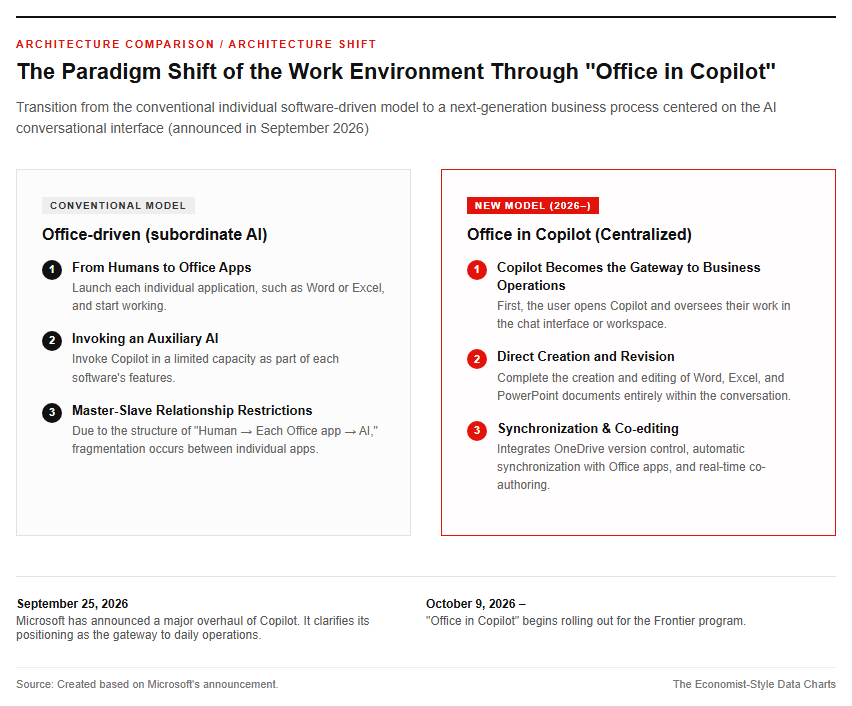
An environment is emerging that reduces the need for users to choose individual apps for each task, allowing them to accomplish tasks simply by communicating their objectives in natural language.
The Three Pillars Formed by Home, Code, and Autopilot
The new-generation Copilot unveiled by Microsoft centers on three core elements: Home, Code, and Autopilot. The first, Home, serves as the starting point for work, integrating Chat for everyday conversations and Cowork for advanced tasks; Office in Copilot also operates on this Home interface. The second, Code, is a feature that leverages the technological foundation of GitHub Copilot, an AI assistant for software development. Even general, non-engineer employees can build custom business applications, data aggregation dashboards, and automated workflows through natural language dialogue. The created deliverables are securely hosted within the company’s Microsoft 365 environment by the Copilot Managed Runtime and operated under the governance of the IT department. The third, Autopilot—renamed from the experimental agent Scout announced in June 2026—is an autonomous AI agent that operates 24/7 in the cloud. Even when users are away from their PCs, it takes over routine tasks and progress management across Teams and Outlook. This architecture elevates AI from a mere Q&A tool to a colleague capable of handling delegated work, with a phased rollout beginning in late September 2026.
The competitive environment and structural changes in the market behind the announcement
The Battle for Supremacy with Generative AI Startups and the Gateway to Document Creation
Behind this overhaul lies the rapid intensification of competition in the enterprise generative AI market. For office PC work, the tools opened first thing in the morning have long been dominated by Windows, Outlook, and Office software. However, OpenAI’s ChatGPT and Anthropic’s Claude have made deep inroads into corporate operations, and the habit of opening an AI chat first to create outlines and drafts of materials has spread rapidly. In particular, on September 16, 2026, Anthropic integrated its “Cowork” AI—which automates PC tasks—with Claude chat, rolling out document co-editing features with colleagues ahead of the competition. Microsoft’s announcement of the overhaul came just nine days later, indicating that it was a swift countermeasure to avoid ceding the initiative in document creation to a competitor. Please refer to the figure below for a feature comparison with competing tools and the status of corporate adoption.
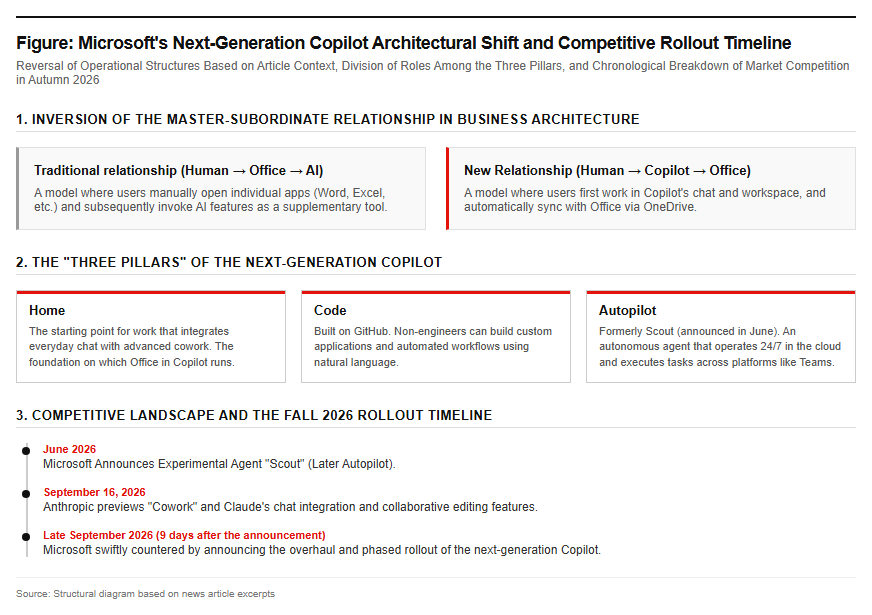
By establishing a system that goes beyond merely generating drafts to complete the entire process—up to the final polishing by multiple internal team members—within Copilot, Microsoft is attempting to keep users on its own turf and recapture “the gateway to document creation.”
The Reality of an Adoption Rate of Around 7 Percent and the Transition to a Usage-Based Hybrid Model
Another critical background factor is the sluggish adoption of the existing Microsoft 365 Copilot and the challenge of recovering infrastructure investments. While the number of paid Microsoft 365 subscriptions has reached approximately 450 million globally, subscriptions for Copilot—which requires an additional fee of $30 per user per month (approximately 4,500 yen in Japan)—stood at only around 30 million as of the end of June 2026, representing an adoption rate of just about 7 percent. Although this marked an increase of about 50 percent in a single quarter from 20 million in the January–March 2026 quarter, approximately 93 percent of subscribers remain unbilled. Meanwhile, the company expects capital expenditures on data centers, GPUs, and other infrastructure to reach approximately $175 billion for the full year of 2026, making the establishment of a monetization model commensurate with these massive investments an urgent priority. In response, while keeping everyday conversational features at the flat rate of $30 per month, Microsoft introduced a usage-based pricing model via “Copilot Credits” for the use of Code, Autopilot, Cowork, and top-tier models from OpenAI and Anthropic. Through this two-tiered pricing structure combining flat-rate and usage-based models, the company aims to transition to a structure that links computing costs with revenue.
Technical significance and practical challenges toward implementation
Friction Between Frontline Frustrations and Governance & Security
While new features boast ideal capabilities, various frictions are emerging on the front lines of corporate business. According to a survey conducted in March 2026 by the consulting firm SDE Partners, while Microsoft Copilot holds the top adoption share as a company-wide standard AI tool at 45.3%, 83.0% of users reported feeling that its practical-level features are insufficient. As a result, it has been revealed that 70.3% of users rely on “shadow AI” by simultaneously using external tools such as ChatGPT (51.3%), Gemini (41.2%), and Claude (19.4%). Additionally, security risks stemming from inadequate access management have been pointed out. Because Copilot performs cross-searches across diverse data within an organization, environments with poor permission settings are prone to over-permissioning, where confidential information is unintentionally exposed. Surveys in this area show that approximately 16% of critical files are exposed to the risk of over-sharing, with 83% of that over-sharing occurring between internal groups. Furthermore, the ability for anyone to create their own apps using Code raises concerns that unmaintainable tools will proliferate, much like the “rogue macros” of the past.
Future Outlook and Prospects for Utilization in Japanese Companies
Office in Copilot is being rolled out sequentially, starting with general consumers and organizations participating in early access programs. However, Autopilot—the always-on agent—will only support English for the time being, with the timing for Japanese language support currently undecided. For Japanese companies to adapt to this new trend, they need to proactively organize internal data and tighten access permissions rather than simply waiting for the tools to be deployed. Furthermore, the skills required of business professionals are undergoing a transformation. The focus is shifting from traditional manual operational skills, such as entering formulas and adjusting slide formatting, to the ability to break down business processes, give precise instructions to AI, and verify the accuracy and governance of generated outputs. Regarding pricing, rather than a uniform flat-rate distribution for everyone, organizations are required to design individually optimized models that balance flat rates and usage-based billing depending on the importance of the tasks and computational volume. It is a test of whether the foundation built by the titan of office software can establish itself as the de facto standard for enterprises even in the era of AI agents.
Reference page
- [Microsoft Official Blog “Introducing the new Copilot with Home, Code and Autopilot”] https://blogs.microsoft.com/blog/2026/09/25/introducing-the-new-copilot-with-home-code-and-autopilot/
- [Microsoft Tech Community “Introducing Office in the new Microsoft Copilot app”] https://techcommunity.microsoft.com/blog/microsoft-copilot-blog/introducing-office-in-the-new-microsoft-copilot-app/4561230
- [Microsoft Investor Relations “FY2026 Q4 Press Release”] https://www.microsoft.com/en-us/investor/earnings/fy-2026-q4/press-release-webcast
【#GenerativeAI #Microsoft #Copilot #Technology #BusinessEfficiency #Cloud #DX】


コメント