On October 23, 2026, NTT Docomo announced the “personalized automated video composition technology,” which uses AI to automatically configure live video footage according to viewers’ preferences. This development comes against the backdrop of a growing demand for personalized viewing centered around specific favorite performers (“oshi”) in music concerts and other live events, as well as challenges in conventional streaming such as the operational burden on viewers and the risk of missing key staging moments.
- Key Points and Development Background of AI Technology for Individual Optimization
- The Mechanism of Automated Composition by Video Understanding AI “VLM”
- Personalization of the Five Senses through Integration with Audio XR Technology
- Comparison and Superiority over Conventional Streaming Methods and Multi-Angle
- Applications to sports viewing and XR/AR devices
- Future Prospects Pioneered by 6G High-Capacity and Low-Latency Communications
Key Points and Development Background of AI Technology for Individual Optimization
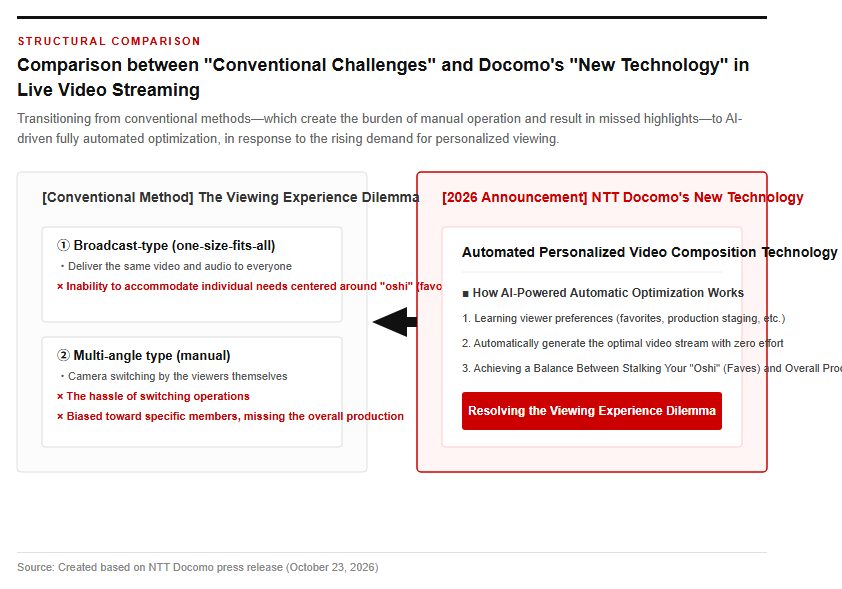
On October 23, 2026, NTT DOCOMO, INC. announced the development of “personalized video automatic composition technology,” which utilizes AI to automatically generate and distribute video optimized for the preferences of each individual viewer. In recent years, viewing formats for music live streams and various forms of entertainment have changed significantly, with a remarkably high individual demand to focus on specific performers (so-called “oshi”), specific stage productions, or musical scenes rather than the group as a whole. However, conventional live streaming services have primarily adopted a style that provides a uniform video and audio feed to all viewers. While multi-angle distribution—allowing viewers to select multiple camera angles themselves—has also been introduced, it has structural challenges, such as the hassle of manual camera switching operations and the risk of missing the overall grandiose stage production or highlights of other members by constantly following a specific performer. The newly developed technology is a groundbreaking approach that resolves this dilemma in the viewing experience, automatically composing a video stream that perfectly matches each person’s preferences without requiring any effort from the user.
The Mechanism of Automated Composition by Video Understanding AI “VLM”
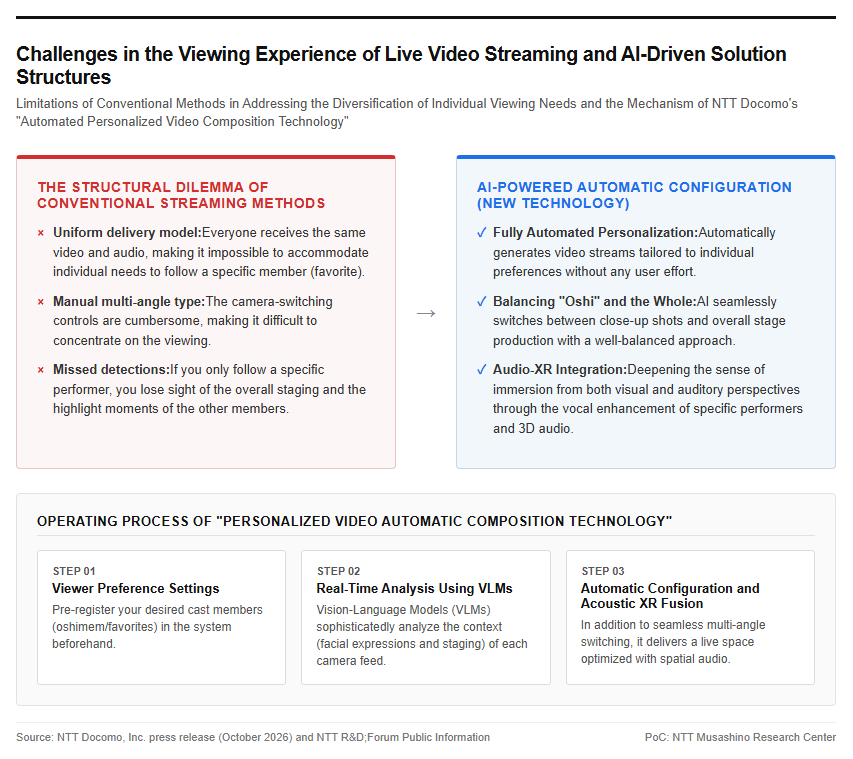
At the core of this technology is the “VLM (Vision Language Model),” an AI model that integrates and advancedly processes and understands visual information (video and images) and linguistic information (text). In terms of its mechanism, viewers set their desired performer (their favorite, or “oshi”) in advance within the system. Once the broadcast begins, the AI uses the VLM to analyze the content and context of each camera feed in real-time, discerning in a well-balanced manner between close-up shots capturing the designated performer’s expressions and performance, and overall shots capturing the stage’s lighting, dance formations, and production highlights. Based on these discernment results, the AI automatically switches between these multiple angles according to an algorithm, seamlessly assembling an optimal video composition. This eliminates the need for viewers to continuously operate their smartphones or remotes to select cameras while watching the live performance, enabling them to stay focused on the screen while simultaneously enjoying the scenes they “want to see” along with the powerful impact of the entire stage.
The Next-Generation Entertainment Experience Brought by the Fusion of Video and Audio
Personalization of the Five Senses through Integration with Audio XR Technology
This technology is also being integrated with personalization not only in visual terms, but also in acoustic terms. At the “NTT R&D Forum” to be held at the NTT Musashino R&D Center from November 18 to 20, and on November 24 and 25, 2026, an experiential demonstration combined with the “Acoustic XR” technology developed by NTT Corporation is scheduled to be unveiled. Acoustic XR is a cutting-edge technology that places sound sources at three-dimensional positions in a virtual space, fusing the local sound environment with virtual acoustics. In this demo, in addition to the automated composition of video by AI, demonstrations will be conducted using Acoustic XR to spatially emphasize the singing voice of a specific performer and to precisely control the direction of sound arrival according to changes in their standing position on the stage. This will enable users to experience a live space where close-up footage of a specific favorite member and dance footage of the entire group are fused while clearly listening to that member’s singing voice, realizing an immersive live streaming experience that caters to individual preferences both visually and aurally.
Comparison and Superiority over Conventional Streaming Methods and Multi-Angle
When compared with conventional standardized live streaming and user-controlled multi-angle streaming, the advantages of this technology are exceptionally high. With conventional uniform broadcasting using switchers, overall harmony is prioritized, making it difficult to meet the fine-grained demands of individual fans. Furthermore, conventional multi-angle streaming has the drawback of distracting viewers with screen operations, which diminishes the immersion of the viewing experience. In contrast, this technology highly integrates the benefits of both passive viewing convenience and active customizability. Just as a professional director switches feeds while understanding the directorial intent, the AI automatically executes cut-ins tailored to individual preferences while maintaining the highlights of the stage, thereby achieving a high-level balance between content quality and personal satisfaction.
Future Technological Developments and Their Impact on Society in the 6G Era
Applications to sports viewing and XR/AR devices
NTT Docomo has set a policy to expand the scope of application of this technology beyond the music live entertainment market to a wide range of contents and devices. For example, in the field of sports viewing, the distribution of automatically tracked and composed video focusing on specific players of interest, managers, or bench movements is anticipated. Furthermore, by combining this with wearable devices such as XR glasses and AR glasses, which are expected to become widespread in the future, it will become possible to provide an intuitive personalized experience linked to the viewer’s gaze and spatial recognition. From entertainment and sports to education and event distribution, utilization in a diverse range of fields is anticipated.
Future Prospects Pioneered by 6G High-Capacity and Low-Latency Communications
The greatest point of focus moving forward is the integration with communication infrastructure aimed at expanding simultaneous connections and realizing ultra-low-latency streaming. When tens of thousands to millions of users simultaneously request different video streams and audio processing, massive data processing and transmission bandwidth will be required. NTT Docomo is poised to strongly promote research and development with an eye toward utilizing ultra-high-capacity, ultra-low-latency communication networks required in the future 6G (6th-generation mobile communication system) era. If a technological foundation is established to deliver individually optimized, high-quality video and audio in real time to a massive user base, the revenue models and viewing culture of the live streaming business itself will likely be fundamentally redefined.
Reference page
- [NTT DOCOMO News Release] https://www.docomo.ne.jp/info/news_release/2026/10/23_01.html
[#NTTDoCoMo #AI #PersonalizedVideoAutoCompositionTechnology #VLM #LiveStreaming #6G]
コメント