On October 23, 2026, the Bank of Japan released the “Financial System Report (October 2026 Issue),” evaluating that Japan’s financial system maintains stability as a whole. While this is underpinned by the robust capital bases of financial institutions, there are growing concerns regarding a compound shock combining high crude oil prices, diminished expectations for AI investment, and sharp interest rate hikes, as well as an increasing degree of linkage with overseas non-bank markets.
- Key Points of the Event and Financial System Stability
- Capital Resilience in Composite Stress Scenarios
- Surge in Overseas Funds and Structural Changes in Financial Intermediation
- The Risks of AI Investment Homogenization and the Use of Common Models
- Unrealized Losses on Yen-Denominated Bonds and Changes in Deposit Liquidity
- Future Developments and the Required Risk Management Framework
Key Points of the Event and Financial System Stability
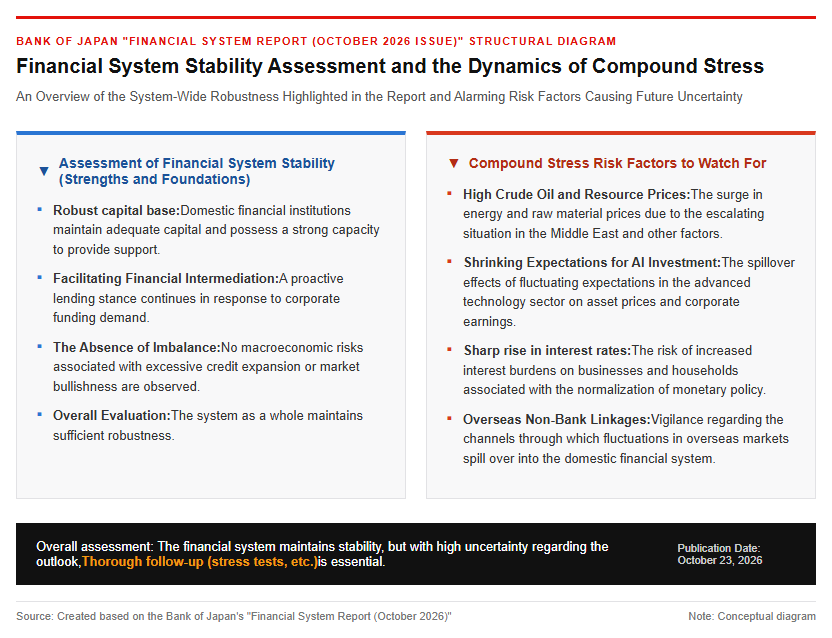
On October 23, 2026, the Bank of Japan released its latest “Financial System Report (October 2026 Issue).” Published twice a year, this report comprehensively examines and evaluates the soundness of Japanese financial institutions and the stability of the financial system as a whole. In its general assessment, the Bank of Japan analyzed that as private-sector fund demand continues to grow, financial institutions maintain an active lending stance, and the financial intermediation function is operating extremely smoothly. From a macroeconomic perspective as well, it concluded that financial imbalances associated with excessive credit expansion or overly bullish expectations are not observed, and that robustness is maintained throughout the system as a whole. However, it points out that high uncertainty remains regarding the trends in asset prices such as stock and real estate prices, soaring energy and raw material prices due to escalating tensions in the Middle East, and the impact of rising policy interest rates on businesses and households, which require careful monitoring. Please refer to the figure below to confirm the basic structure of the financial system.
It is becoming increasingly important to assess changes in the environment surrounding the financial system from multiple perspectives.
Capital Resilience in Composite Stress Scenarios
In this report, a macro stress test was conducted assuming a compound shock in which multiple risks materialize simultaneously, in addition to past Lehman shock-type stress. Specifically, a severe scenario was established in which WTI crude oil prices temporarily surge to $180 per barrel, Japanese and U.S. long-term interest rates rise by 1.5 percentage points, and AI-related stocks plummet on a scale comparable to the burst of the dot-com bubble. The test covered 105 major domestic banks and 247 shinkin banks (credit unions), measuring the impact through the January–March quarter of 2029. The simulation results confirmed that while the capital adequacy ratios of the financial institutions would temporarily decline, they would comfortably remain above the regulatory levels mandated by law throughout the period. This calculation indicates that the financial system’s overall resilience and loss-absorption buffers are maintained even in severe environments characterized by overlapping high oil prices, falling stock prices, and rising interest rates.
Linkages with Overseas Non-Banks and the Spillover of AI Investment Risks
Surge in Overseas Funds and Structural Changes in Financial Intermediation
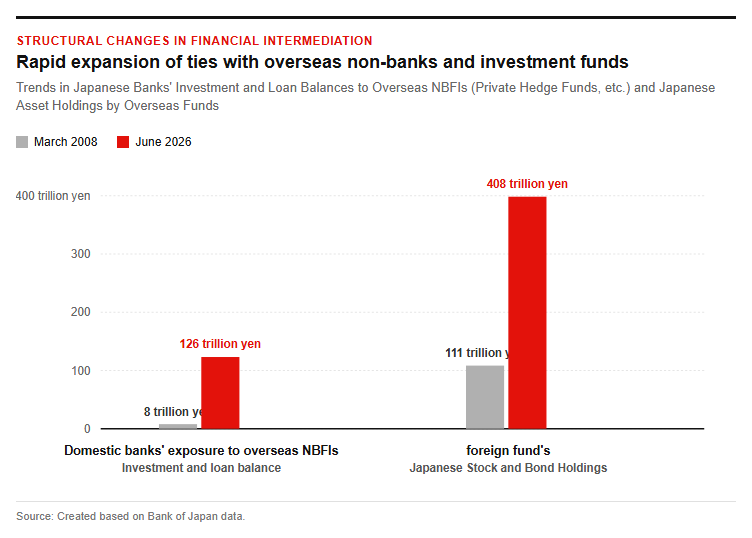
In recent global financial markets, the presence of non-bank financial intermediaries (NBFIs) has been expanding rapidly. According to an analysis by the Bank of Japan (BOJ), Japanese banks’ investment and loan balances to overseas NBFIs, including private funds and hedge funds, increased significantly from 8 trillion yen as of March 2008 to 126 trillion yen in June 2026. Furthermore, overseas investment funds’ holdings of Japanese domestic stocks and bonds have also grown remarkably from 111 trillion yen to 408 trillion yen. As a result of this strengthened tie between Japan’s financial intermediation system and overseas funds, there is a growing risk that shocks in overseas markets or position adjustments by funds will directly spill over into Japan’s financial markets. The BOJ is increasingly on guard, particularly regarding the possibility of rapid drawdowns on commitment lines for overseas funds during a large-scale shock.
The Risks of AI Investment Homogenization and the Use of Common Models
With the explosive adoption of AI technology, major IT companies are monopolizing semiconductors and cloud infrastructure, bringing the concentration risk of the digital supply chain in financial institutions to the fore. In addition, the homogenization of investment behavior is progressing as a significant concern, as many market participants utilize the same AI models and data sets for investment decisions and risk assessment. It has been pointed out that if the market is shaken by rising geopolitical risks or concerns over the monetization of AI investment, autonomous AI agents could issue high-speed, simultaneous risk-averse sell orders, thereby amplifying financial shocks. If such a rapid price drop (flash crash) occurs, investment funds would be forced into a fire sale of assets to secure cash liquidity, raising the risk that market-wide liquidity will suddenly freeze. Please refer to the posted image to review the technology-driven risk transmission pathways.
Challenges and Future Outlook in a Rising Interest Rate Environment
Unrealized Losses on Yen-Denominated Bonds and Changes in Deposit Liquidity
Amid rising domestic interest rates, financial institutions engaged in securities investment are seeing widening unrealized losses on their holdings of yen-denominated bonds. The impact of these unrealized losses is particularly pronounced among regional banks and shinkin banks, which hold bonds with longer durations (average remaining maturities). However, many regional financial institutions have proactively reduced their holdings and shortened the duration of their portfolios, taking steps to curb the unlimited expansion of unrealized losses through risk reduction. On the other hand, higher interest rates have heightened depositors’ yield-seeking behavior, leading to a shift of funds from transactional deposits such as ordinary deposits to higher-yielding time deposits. Because deposits acquired by offering high interest rates tend to have high interest rate sensitivity and low stickiness, banks are required to re-examine the validity of their conventional “core deposit” models and strengthen their liquidity risk management.
Future Developments and the Required Risk Management Framework
Looking ahead at financial conditions, as the Japanese economy fully transitions into a “world with interest rates,” financial institutions are required to build advanced risk management frameworks and flexible business strategies. Particularly in regions where population decline and a shrinking number of business establishments are progressing, there is a risk that medium- to long-term declines in loan demand and staffing constraints will weigh on management, making the forward-looking restructuring of business models, as well as business reorganization and integration, critical issues. Furthermore, the emergence of state-of-the-art “frontier AI” has sophisticated cyberattack methods, making cybersecurity measures—including the proactive halting of systems—and the establishment of AI governance indispensable. The Bank of Japan plans to encourage financial institutions to address potential vulnerabilities through examinations and off-site monitoring, and financial institutions must strive to balance the maintenance of a stable revenue base with appropriate risk-taking.
Reference page
- [Bank of Japan] Financial System Report (October 2026 Issue)
金融システムレポート(2026年10月号) : 日本銀行 Bank of Japanwww.boj.or.jp - [Bank of Japan] Financial System Report (October 2026 Issue) Full Text PDF
https://www.boj.or.jp/research/brp/fsr/data/fsr261023a.pdf

[#BankofJapan #FinancialSystemReport #MonetaryPolicy #JapaneseStocks #AIInvestment #InterestRateHike #RiskManagement]

コメント