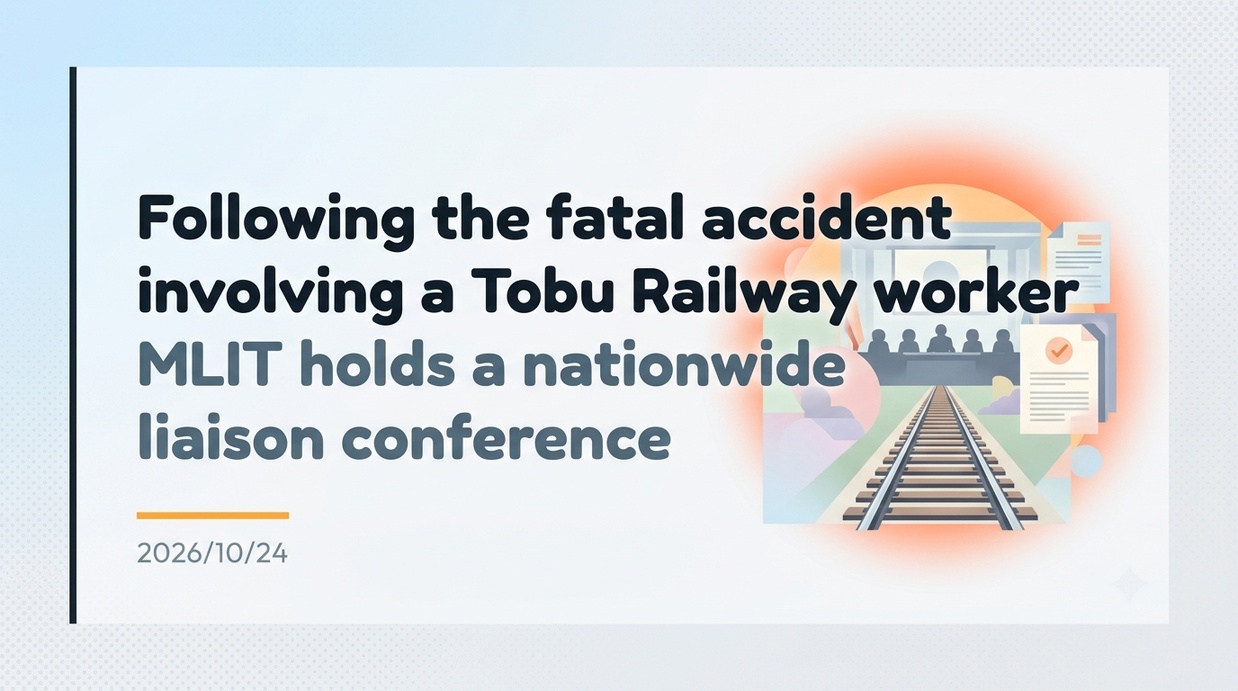
Following the accident on August 20, 2026, on the Tobu Nikko Line, which resulted in the deaths of four workers, the Ministry of Land, Infrastructure, Transport and Tourism has decided to hold an emergency railway safety liaison meeting targeting railway operators nationwide. An interim report on the accident highlights that, in addition to inappropriate work direction by an off-duty supervisor, a “culture of silence”—where workers were unable to voice objections for fear of reprimand—served as a backdrop that nullified safety management.
- Worker Struck-by Accident and Its Background on the Tobu Nikko Line
- Emergency Guidance System for Railway Operators Nationwide by the Ministry of Land, Infrastructure, Transport and Tourism
- Absence of On-Site Managers and Confusion in the Chain of Command
- The Psychology of Fearing Reprimand and the Suppressive Structure of Safety Signals
- Commonalities with Past Major Railway Accidents and Transport Safety Management
- Future Developments and Key Points to Watch for Recurrence Prevention
Worker Struck-by Accident and Its Background on the Tobu Nikko Line
On August 20, 2026, at Shin-Kanuma Station on the Tobu Nikko Line located in Kanuma City, Tochigi Prefecture, a major track intrusion accident occurred in which four workers engaged in weeding work alongside the tracks were struck and killed by the “Spacia X” limited express train entering the station. The accident occurred just before 10:00 a.m., and at the time, a total work crew of 10 people gathered from the work-awarding company Tobu Construction and subcontracted businesses was deployed at the site. The workers were carrying 11 kg herbicide sprayers on their backs and proceeding with work on the tracks beneath the former inbound platform. Although three train watchers to monitor approaching trains were stationed at the site along with a site manager in charge of overseeing the work, the workers failed to evacuate in time when the train entered, leading to this tragic accident. Tobu Railway began investigating the cause immediately after the accident, and on September 30, 2026, submitted an interim report summarizing the overview of the accident and the facts grasped thus far to the Kanto District Transport Bureau of the Ministry of Land, Infrastructure, Transport and Tourism. Detailed investigations by the police and the Japan Transport Safety Board, including charges of professional negligence resulting in death, are currently ongoing. The following diagram shows a typical on-site layout image during work within the tracks.
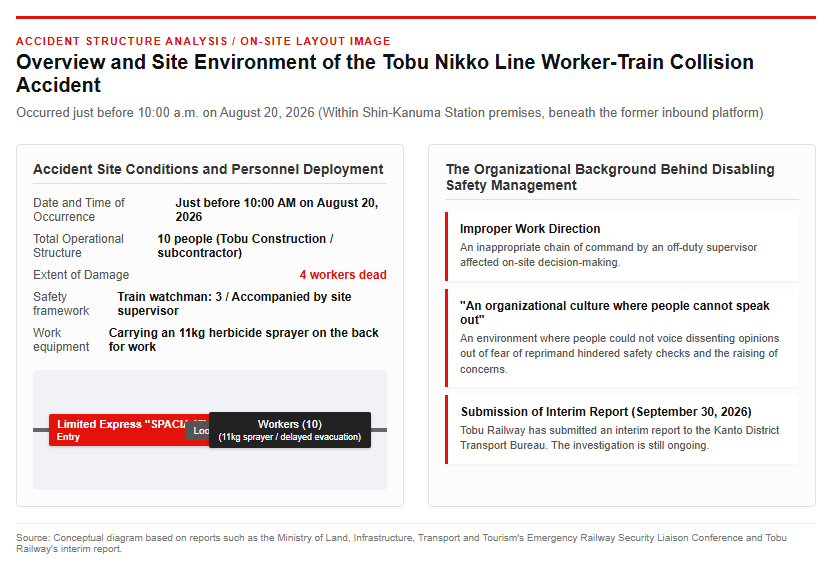
As ensuring on-site safety is considered the top priority for railway operators, deviations from work procedures and a lack of safety training have emerged as major issues.
Emergency Guidance System for Railway Operators Nationwide by the Ministry of Land, Infrastructure, Transport and Tourism
Following the fatal accident on Tobu Railway, the Railway Bureau of the Ministry of Land, Infrastructure, Transport and Tourism (MLIT) announced on October 1, 2026, that it will hold an “Emergency Railway Safety Liaison Meeting” convening railway and tram operators nationwide, with the aim of re-inspecting safety management systems for on-track work and ensuring thorough recurrence prevention measures. The meeting is scheduled for October 23, 2026, from 15:00 to 17:15, and will be held in a hybrid format using the MLIT headquarters conference room in Kasumigaseki, Chiyoda-ku, Tokyo, along with an online connection. Attendees will include JR group companies, major private railway operators in the Kanto area, and regional railway companies across the country. The meeting agenda is scheduled to begin with an address by the Councillor for Technology at the MLIT Minister’s Secretariat, followed by a report from Tobu Railway on the overview of and countermeasures for the Shikanuma Station accident, the sharing of measures to prevent train-strikes in cooperation with the Safety and Health Department of the Ministry of Health, Labour and Welfare, and a lecture on safety management—including partner companies—by the National Institute of Occupational Safety and Health, Japan. The figure below illustrates the implementation structure of the emergency meeting and the flow of information sharing.
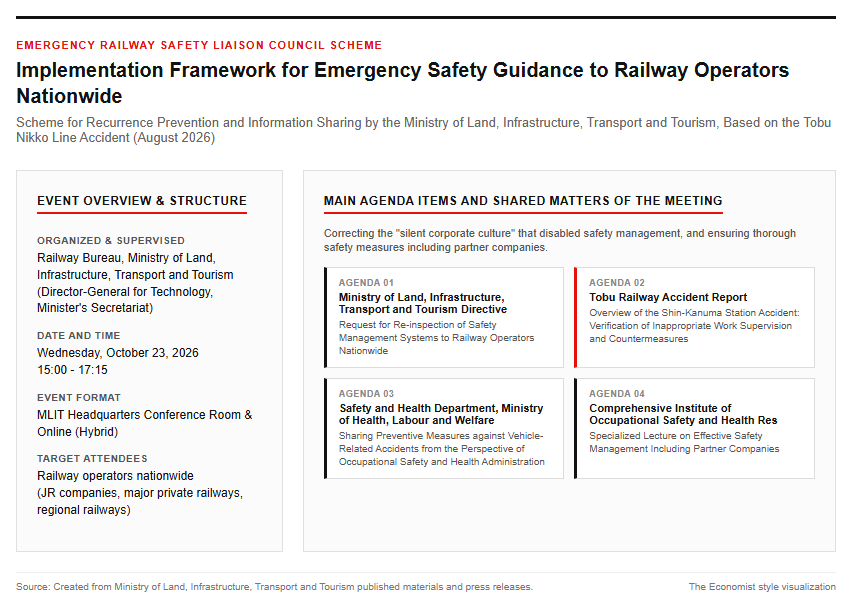
Through this conference, the Ministry plans to share case studies of measures taken by various operators and lessons learned from the field, while vigorously promoting effective safety guidance that includes partner companies.
Lax Safety Management and Organizational Issues Revealed in the Interim Report
Absence of On-Site Managers and Confusion in the Chain of Command
An interim report submitted by Tobu Railway to the Kanto District Transport Bureau has revealed extremely inappropriate command and control structures and rule violations at the accident site. At the time of the accident, the employee designated as the actual work supervisor had been appointed just three days prior and had no experience in weeding on tracks. Instead of supervising, they merely took documentary photographs from the rear, effectively abandoning work command duties. In contrast, the supervisor’s boss (the site representative)—who was not scheduled to work and was technically off-duty after a night shift—appeared at the site and took over overall command from the inexperienced supervisor. Approximately five minutes before the accident, as time ran out before a train’s approach, this off-duty boss instructed the workers to move onto the tracks beneath the inbound platform. Furthermore, it has been revealed that subcontracted workers hired through Tobu Construction had not undergone prior safety training, and pre-work briefings were insufficient. As the original safety management rules became hollowed out and superiors without formal authority haphazardously controlled the site, all barriers that could have prevented the accident malfunctioned.
The Psychology of Fearing Reprimand and the Suppressive Structure of Safety Signals
What emerged as the most serious issue highlighted in the interim report is the organizational psychology in which frontline workers and train lookouts could not speak up despite perceiving danger. Just before the accident, a train lookout was aware that there was less than three minutes remaining until the next limited express train passed, and had emphasized the lack of time to an off-duty supervisor. However, when the supervisor instructed them to enter beneath the platform, the lookouts and workers continued working in compliance with the order, even while feeling that it was dangerous because of the short time until the next train. In interviews, frontline personnel responded, “I thought I’d get yelled at for voicing my opinion” and “Saying anything extra would just cause trouble,” revealing that they were under psychological tension where they could not raise objections out of fear of reprimand or adverse consequences from superiors. At a press conference, the head of the facilities department at Tobu Railway also admitted that an environment had not been established in which safety-related doubts and opinions could be mutually confirmed and shared on-site. The presence of an intimidating management culture and power gradients at the site had internally neutralized the human safety signals, which serve as the ultimate safeguard to prevent accidents.
Restructuring of the safety management system across the entire railway industry
Commonalities with Past Major Railway Accidents and Transport Safety Management
The “organizational culture of refraining from reporting or dissenting” that has now come to light reveals structural issues common to past major railway accidents and scandals in other industries. In the derailment accident on JR West’s Fukuchiyama Line in 2005, the national accident investigation report pointed out that an excessive “daytime training” system for conductors who made mistakes and the fear of disciplinary action hindered concentration on driving, serving as a background factor in the accident. Furthermore, the investigation report on the train-striking accident that occurred at Toyama Chihou Railway analyzed the reality that education on the company’s “Train-Striking Accident Prevention Guidelines” was insufficient, and regulations such as the obligation to assign dedicated lookouts had become hollowed out. The “Transport Safety Management System,” which the Ministry of Land, Infrastructure, Transport and Tourism has promoted the introduction of, requires top management and frontline staff to work as one, pay attention to frontline issues, and continuously improve the safety management system. However, in organizations where daily reprimands and pressure exist, there is an extremely high risk that safety rules will remain merely formal documents, leaving unaddressed the structural flaws where near-misses and danger signals from the front lines fail to reach superiors.
Future Developments and Key Points to Watch for Recurrence Prevention
While we must await the detailed investigation results from the police and the Japan Transport Safety Board regarding the ultimate technical causes and legal liability of the accident, the focus of future recurrence prevention measures across the entire railway industry is shifting toward “onsite-led safety assurance” and “the establishment of psychological safety.” Specific initiatives required of each operator include clarifying the “authority to stop work safely,” which allows workers to immediately halt operations if they perceive danger even under instructions from a supervisor or work director, and establishing independent escalation channels to internally report and consult on unsafe behaviors without routing through direct supervisors. Furthermore, it will be essential to introduce a “Just Culture” that prioritizes grasping facts without blaming unintentional errors or the expression of dissenting opinions, as well as maintaining a comprehensive training system encompassing partner companies and dispatched workers. Starting with the emergency safety liaison meeting convened by the Ministry of Land, Infrastructure, Transport and Tourism, the greatest point of focus for preventing future accidents involving personnel being struck by trains will be how railway companies can build open and communicative safety management organizations, rather than simply adding to manuals.
Reference page
- [Ministry of Land, Infrastructure, Transport and Tourism Press Release] https://forms.cloud.microsoft/r/w2mFGUAK6p
【#TobuRailway #MLIT #RailwayAccident #SafetyManagementSystem #StruckByTrainAccident #TransportSafety】
コメント