
A research team at KAIST (Korea Advanced Institute of Science and Technology) in South Korea has developed an innovative polymer separation membrane technology that can separate crude oil at room temperature without heating. This achievement could fundamentally overturn the energy-intensive distillation process that has lasted for over 100 years, bringing dramatic cost reductions and reduced environmental impact to the petroleum refining industry.
- Room temperature separation technology that overturns a century-old distillation method
- An astonishing mechanism that forms its own filter
- Industrial competitiveness brought by a 36% reduction in operating costs
- Accelerating decarbonization by reducing carbon emissions by 37%
- High Barriers to Implementation by Utilizing Existing Equipment
- The ‘Age of Molecules’ Expanding Beyond Oil Refining
- Challenges Toward Commercialization and the Path to Large-Scale Demonstration
Room temperature separation technology that overturns a century-old distillation method
For over 100 years, humans have obtained petrochemicals by heating crude oil to 350 to 400 degrees and separating each component from differences in boiling points. However, this method consumes enormous amounts of energy, with the annual energy consumed by the global refining process reaching 1,100 terawatt-hours (TWh), equivalent to the annual power generation of about 130 large nuclear power plants. The research team led by Professor Dong-Yeon Ko at KAIST overturned the conventional wisdom of “boiling and separating” by successfully filtering crude oil precisely at room temperature using inexpensive polymer membranes. This research was published in the international academic journal Nature dated June 24, 2026, attracting global attention.
An astonishing mechanism that forms its own filter
The core of this technology lies in the use of polyacrylonitrile (PAN), a common porous polymer membrane. Until now, academic convention held that a special coating on the membrane surface was essential for precise separation at the molecular level, but the research team deliberately poured crude oil into the uncoated “plain film.” They discovered a phenomenon called ‘spontaneous pore contraction,’ in which heavy components in crude oil adhere to the pores of the membrane and spontaneously form ultra-fine separation pathways smaller than 2 nanometers. Please refer to the diagram below.
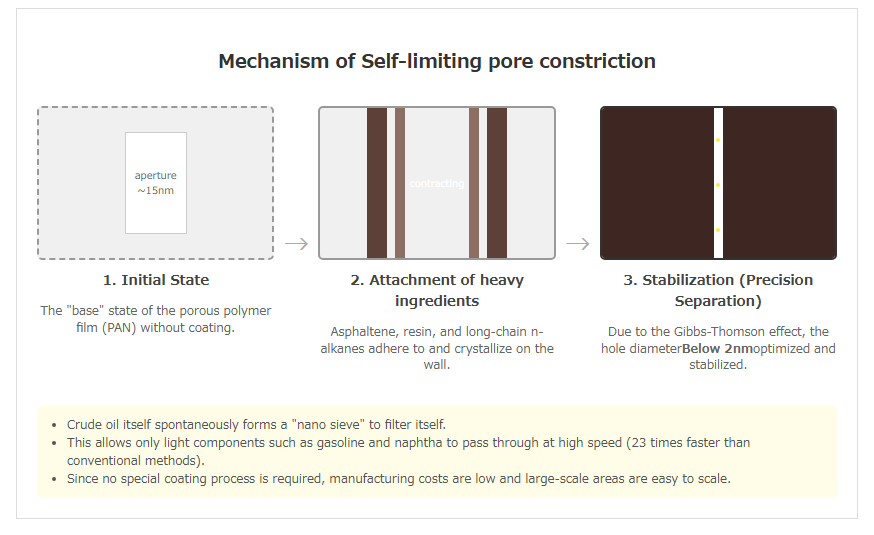
。 This allows the crude oil itself to create an optimally nanosized sieve for filtering, allowing only light components like gasoline and naphtha to pass through at high speed.
Overwhelming Economic and Environmental Impact
Industrial competitiveness brought by a 36% reduction in operating costs
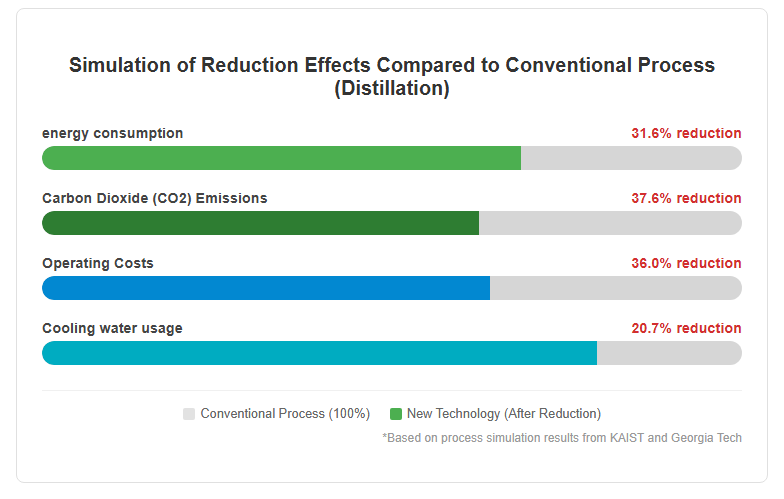
The newly developed separation membrane achieves an overwhelming separation speed of more than 23 times that of conventional crude oil separation membranes. Thanks to this high productivity, it is estimated that operating costs applied to the actual refining process can be reduced by 36% compared to conventional distillation processes. Additionally, since there is no need to boil crude oil, managing cooling water becomes easier, and cooling water usage can be reduced by 20.7%, which is a major advantage. As global cost competition in the petrochemical market intensifies, this dramatic cost reduction in the refining process has become a powerful tool for companies to dramatically enhance their price competitiveness.
Accelerating decarbonization by reducing carbon emissions by 37%
The environmental impact is also significant; simulations show it can reduce carbon dioxide (CO2) emissions by 37.6% and energy usage by 31.6%. If this technology is introduced throughout South Korea’s refining and petrochemical industry, it would be estimated to reduce annual greenhouse gas emissions by about 10 million tons, which is equivalent to the emissions of about 4 million gasoline vehicles. Pressure to decarbonize is intensifying in the petroleum refining industries of China and other countries, making the transition to low-carbon technologies an urgent priority. This membrane separation technology could be a decisive step toward achieving carbon neutrality. Please refer to the comparison chart below.
。
High Barriers to Implementation by Utilizing Existing Equipment
Another major strength of this technology is that it can be introduced without major upgrades to existing refining facilities. Instead of replacing an entire large distillation column, it can be applied by adding filter modules to existing piping, resulting in a low initial investment burden. Through joint research with HD Hyundai Oil Bank, demonstration experiments using actual crude oil are being conducted, and verification aligned with industrial realities is underway. Data showing almost no performance degradation even after 28 days of continuous operation underscores the high practicality for commercial use.
Transformation of the Chemical Industry and Future Prospects
The ‘Age of Molecules’ Expanding Beyond Oil Refining
The research team believes that this membrane separation platform can be expanded beyond crude oil refining to include a wide range of chemical processes. Specifically, this includes refining oil obtained by pyrolysis of waste plastics, recovering solvents used in battery manufacturing, pharmaceutical refining, and biofuel production. Until now, the era of separating substances by “heat (distillation)” has the potential to shift to the “molecular era,” where molecules are directly controlled and separated through separation membranes, representing a paradigm shift across the entire chemical industry. This versatile membrane technology will serve as an indispensable foundation for building sustainable chemical processes.
Challenges Toward Commercialization and the Path to Large-Scale Demonstration
The current challenge is to scale up this technology, which succeeded at the laboratory scale, into large-scale modules that operate in real factories. In actual refineries, since tens of thousands of cubic meters of crude oil are processed daily, large-area membranes must be produced to ensure long-term operational reliability. Furthermore, future verification will be required to ensure consistent performance not only for Middle Eastern crude oil but also for a wide variety of crude oils with different properties, such as North American shale oil and Canadian oil sands. The research team aims for industrial application within the next three to five years, and plans to continue advancing and demonstrating the technology.
[#韓国経済 #KAIST #石油精製 #脱炭素 #エネルギー革命 #科学技術 #カーボンニュートラル #ネイチャー]


コメント