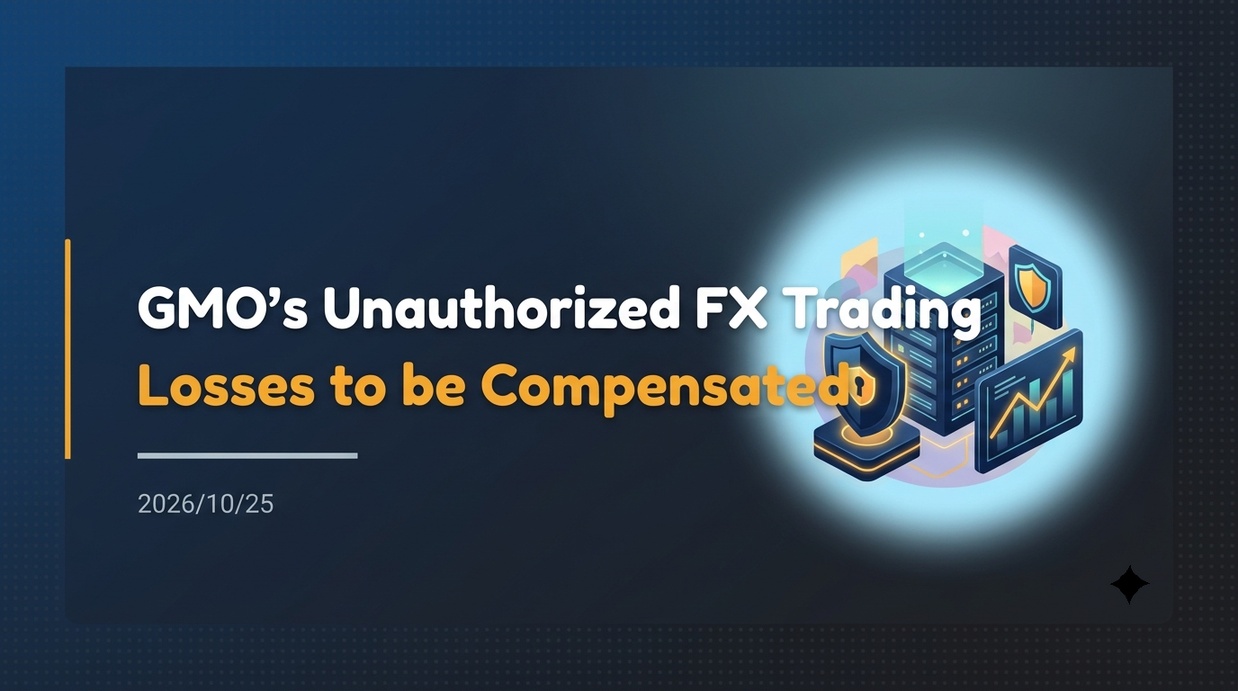
On October 24, 2026, GMO Internet Group announced a policy to compensate for losses from unauthorized trades resulting from a cyberattack on its cloud service for automated FX trading, and to pay a flat consolation payment of 5,000 yen to users. Behind this lies an unprecedented “account destruction” technique that directly manipulates customers’ financial assets to cause intentional losses, alongside malicious double extortion.
- Full Compensation for Unauthorized Transaction Damages and Payment of Relief Money
- Complete Overhaul of System Infrastructure and Free Provision of Alternative Services
- The Mechanism of Account Destruction Targeting FX Automated Trading VPS
- Extortion Demands by Attackers and GMO’s Refusal to Comply
- Urgent Request to the Government for “Active Cyber Defense”
- Cybersecurity in the Financial Securities Market as a Whole and Future Points of Focus
Full Compensation for Unauthorized Transaction Damages and Payment of Relief Money
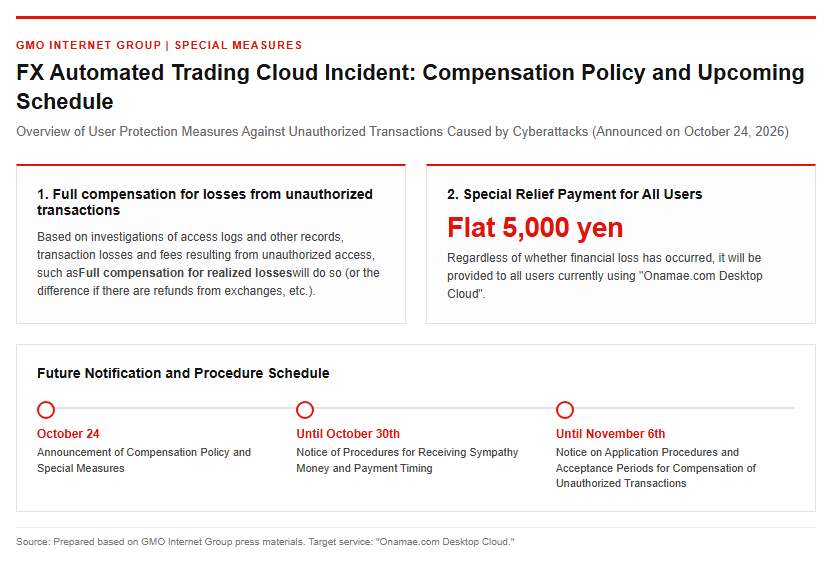
On October 24, 2026, GMO Internet, Inc. and GMO Internet Group, Inc. announced their compensation and special measures policy for affected users regarding a cyberattack targeting “Onamae.com Desktop Cloud,” a Virtual Private Server (VPS) service designed for automated FX (foreign exchange margin trading). The company will compensate for realized losses (such as trading losses and fees) incurred in trading accounts due to unauthorized transactions that were contrary to the users’ intentions, caused by unauthorized access. The scope of compensation will be the actual loss amount investigated and certified by the company based on objective trading records, access logs, and other data. If refunds are issued by exchanges or other entities, the company plans to pay the difference. Furthermore, regardless of whether they suffered financial damage, the company has decided to pay a flat sympathy payment of 5,000 yen to all users currently using the service. Procedures and timing for receiving the sympathy payment will be notified to registered email addresses by October 30, 2026, while the application method and acceptance period for unauthorized transaction compensation will be provided by November 6, 2026. Specific compensation procedures outlining the overall picture of the damage can be confirmed in the provided diagram.
As a provider of internet infrastructure, we place the highest priority on protecting customer assets and trust, and are taking sincere and prompt measures to provide relief for the damage incurred.
Complete Overhaul of System Infrastructure and Free Provision of Alternative Services
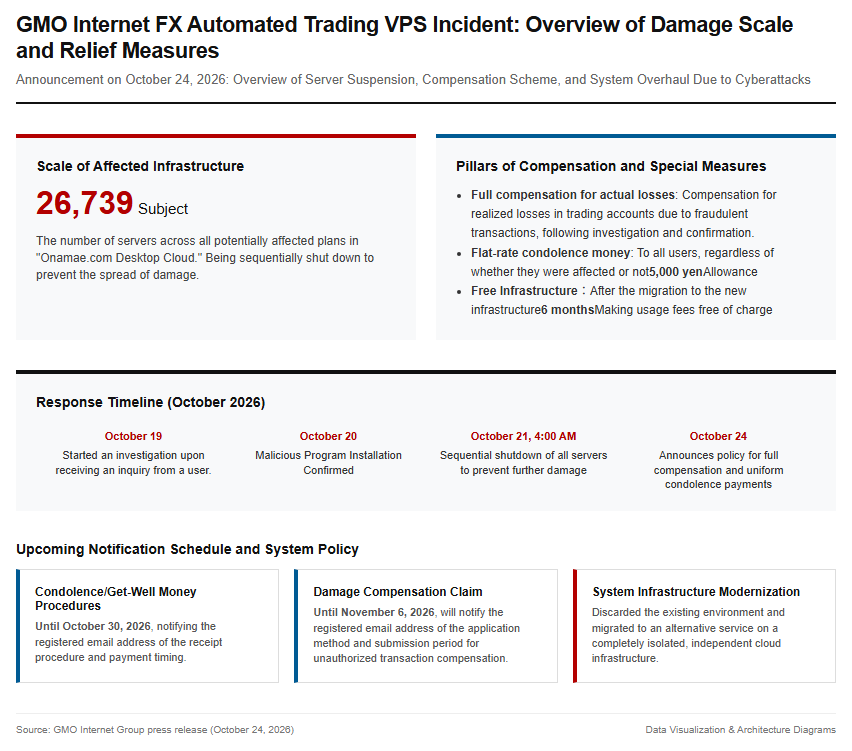
In response to this incident, GMO Internet has decided not to restart or restore the current system infrastructure that suffered unauthorized access as-is, but instead to radically overhaul its security architecture. The company initiated an investigation upon receiving an inquiry from a user on October 19, 2026, confirmed the installation of unauthorized programs on October 20, and sequentially shut down servers across all plans starting at 4:00 a.m. on October 21 to prevent further damage (affecting a potential 26,739 servers). From the perspective of prioritizing safety, the company will discard the existing operational environment and migrate to an alternative service operated on a completely isolated, independent cloud infrastructure. For subscribers who wish to continue using the Windows desktop environment, the company will guide them in switching to this alternative service and implement a special measure to provide the service free of charge for six months following the migration. Migration procedures and contract terms will be subject to user consent, and detailed explanations will be provided in advance. The architectural diagram below illustrates the differences in security configurations between the old and new systems.
Our goal is not merely to restore the system, but to rebuild the infrastructure configuration itself from scratch, thereby providing a robust security environment that prevents similar intrusions from ever happening again.
Cyberattack Tactics and the Reality of Multi-Extortion
The Mechanism of Account Destruction Targeting FX Automated Trading VPS
What is particularly notable about this attack is that it went beyond mere theft of personal information or ransomware demands through encryption; it employed an extremely malicious and novel tactic known as “financial sabotage,” which directly damages investors’ financial assets. “Onamae.com Desktop Cloud” is a virtual server environment tailored for investors, designed to run automated trading software such as MetaTrader (MT4/MT5) 24 hours a day. The attackers exploited security vulnerabilities within the server infrastructure to gain unauthorized access and obtained the trading account login credentials (IDs and passwords) for various securities and FX companies that had been stored there. Furthermore, even after the company completely halted VPS operations on October 21, the attackers used the stolen credentials to log in directly to the trading servers of various financial institutions from their own devices. They then executed a destruction-dedicated automated trading program called “DEMOFASTLOSS,” rapidly triggering ultra-high-frequency trades involving minor currency pairs that incurred spread (bid-ask spread) losses within just one to two seconds. As a result, investors’ account balances were wiped out by millions of yen within seconds, leading to a succession of forced liquidations.
Extortion Demands by Attackers and GMO’s Refusal to Comply
GMO Internet Group has revealed that it has received a monetary demand (a ransom demand) from the individual or individuals suspected of carrying out the attack. The attacker is threatening that if the monetary demand is not met, they will not only continue unauthorized manipulation of customer accounts opened at more than 70 domestic and international securities and FX companies, but also illegally disclose information regarding services and customer PCs, execute ransomware attacks, and leak information regarding the company’s systems and operational structure to the outside. However, stating that “complying with the demand does not guarantee the deletion of acquired information or the prevention of unauthorized use,” the company has expressed a firm policy of refusing to yield to threats or monetary demands under any circumstances. All evidence, including communication records and logs, has been submitted to police authorities (cybercrime division), and a strict investigation is underway as a criminal case. In addition, to prevent secondary damage, swift measures were implemented in cooperation with major securities companies and exchanges, including blocking access via the service, forcibly terminating all active sessions, and monitoring for unauthorized transactions. Users are urged not to be misled by uncertain information and to check official announcements.
Calls for Active Cyber Defense and Future Market Impact
Urgent Request to the Government for “Active Cyber Defense”
On October 23, 2026, GMO Internet Group made an emergency recommendation (request) to relevant government agencies for the application of “Active Cyber Defense,” based on related laws that came into full effect on October 1, 2026. Active Cyber Defense is a security framework in which the state and related agencies take the lead against serious threats in cyberspace to identify the attacker’s infrastructure and intrusion routes, and neutralize them by infiltrating the server of the attack origin to stop and delete programs. The company determined that this incident is not merely a system failure of a single enterprise, but an unprecedentedly malicious cybercrime directly targeting the financial assets of the general public, and that it is difficult to counter highly sophisticated cross-border criminal groups through defense or post-incident response by private companies alone. Therefore, the company positioned this case as “the first invocation of Active Cyber Defense” and strongly requested that the government lead the tracking, blocking, and neutralization measures of the attack infrastructure. This request, based on a strong sense of crisis as a private infrastructure provider, has made a significant impact on the operation of national-level cyber security.
Cybersecurity in the Financial Securities Market as a Whole and Future Points of Focus
This incident serves as an extremely serious warning to online financial services as a whole, including financial futures and foreign exchange (FX) trading markets. Even in guidelines such as the “Guidelines for Preventing Unauthorized Access in Internet Trading” established by the Financial Futures Association of Japan, security management measures have been required, such as the introduction of multi-factor authentication (MFA), communication encryption, strict risk management of outsourced vendors, and behavior detection through log analysis. However, in this incident, structural design issues on the cloud VPS side and settings during remote connections were exploited, materializing a new threat scenario in which customer assets are compromised without directly bypassing the robust authentication of the financial institution itself. For financial business operators and third-party service providers, thoroughly implementing defense-in-depth and fundamentally reviewing ID and password management have become urgent tasks. Moving forward, major points of focus will include the progress of compensation for victims, the government’s decision on applying active cyber defense, the police’s investigative developments, and the reconstruction of third-party risk management frameworks across the entire industry.
Reference page
- 【[[Important] Regarding Cyber Attacks on Onamae.com Desktop Cloud Service (4th Report) | GMO Internet Group, Inc.】https://group.gmo/info/alert/20261024/
【#GMO #CyberAttack #FXUnauthorizedTrading #DamageCompensation #ActiveCyberDefense】

コメント