The preliminary US Composite Purchasing Managers’ Index (PMI) for October, released by S&P Global, came in at 57.6, slipping slightly from the previous month’s five-year high, but maintaining strong growth momentum against the backdrop of robust demand. While this reflects heightened business activity due to expanding demand, the rise in selling prices—fueled by soaring raw material and fuel costs—has sharply accelerated to its fastest pace since August 2022, rapidly intensifying concerns over persistent inflation and prolonged monetary tightening.
- Composite PMI of 57.6 Indicates Economic Expansion and Strong Demand
- Strong Performance in the Manufacturing Sector and Full-Fledged Employment Expansion
- The Pressure of Rising Selling Prices and Supply Delays
- Surge in Crude Oil Prices and Deterioration of Household Inflation Expectations
- Expectations of Further Fed Rate Hikes and the Shock of 5.0% Long-Term Interest Rates
- Upcoming Key Events and Their Long-Term Impact on Corporate Management
Composite PMI of 57.6 Indicates Economic Expansion and Strong Demand
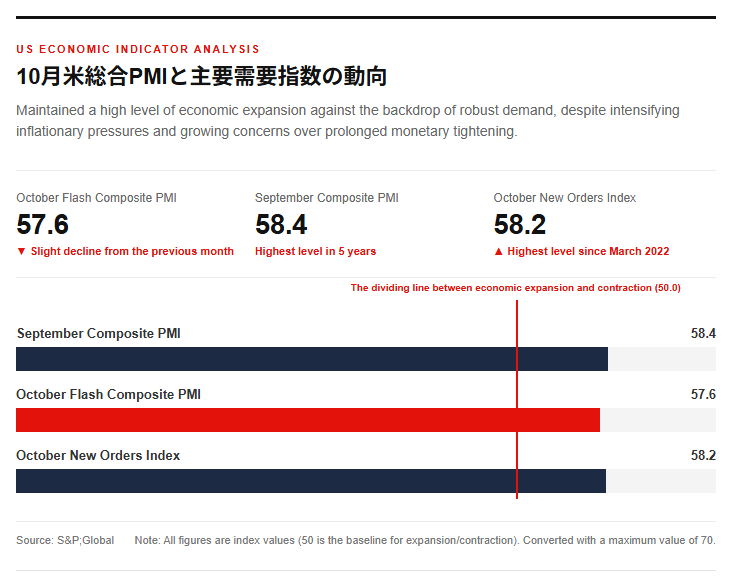
Released on October 23, 2026, S&P Global’s flash US Composite PMI registered 57.6, and while down slightly from 58.4 in September 2026—which was the highest level since July 2021—it remained well above the boom-or-bust threshold of 50, maintaining a robust expansion trend. Chris Williamson, Chief Business Economist at S&P Global Market Intelligence, noted that, excluding the exceptional post-pandemic reopening period, the current months represent the strongest growth phase since early 2015. In particular, the level of the output index is considered consistent with a scenario where U.S. real gross domestic product (GDP) is expanding robustly at an annualized rate of around 5%. On the demand side, the new orders index came in at 58.2, hitting its highest level since March 2022. Domestic demand remains strong, centered on the service sector, and companies moving to build up precautionary inventories in preparation for supply shortages and future cost increases is also a factor driving up orders. To meet the increase in customer demand, business activity is intensifying. Please refer to the figure below.
Strong Performance in the Manufacturing Sector and Full-Fledged Employment Expansion
Looking at the breakdown for October 2026, the services PMI edged down from 58.8 in the previous month to 57.9, while the manufacturing PMI rose from 55.9 to 56.0, showing resilience that topped the market consensus of 55.5. The increase in new orders and expansion of production in the manufacturing sector are also clearly reflected in employment. The manufacturing employment index leaped to its highest level since March 2012, confirming that companies are aggressively hiring personnel to meet expanding demand. Backlogs of work have piled up at many companies to their highest level since May 2022, putting them in a state of holding orders that exceed their current operating capacity. Although an increasing number of companies are struggling to secure personnel with the appropriate skills, their hiring appetite to cope with the surging backlog of orders remains robust. Favorable trends in corporate earnings and profits are supporting the employment growth, and capacity-expansion movements centered around the manufacturing sector are becoming a major engine supporting the growth momentum of the U.S. economy.
Rapid Acceleration of Price Pressures and Supply Chain Bottlenecks
The Pressure of Rising Selling Prices and Supply Delays
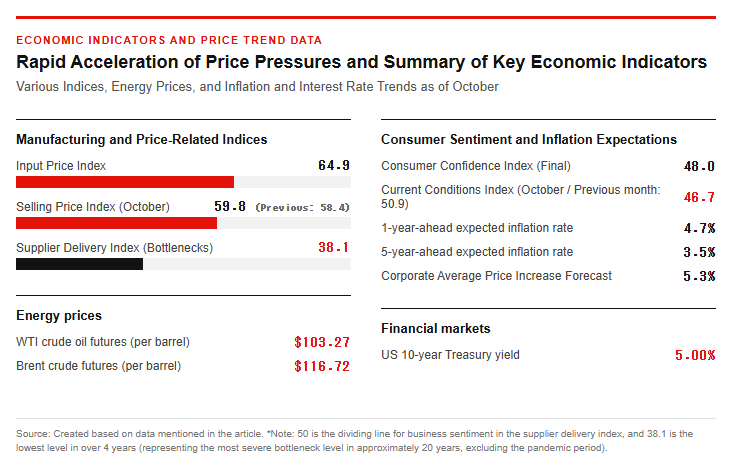
While corporate activity remains brisk, the trend of passing on increasing costs into prices is intensifying. The October selling price index reached 59.8, rising from 58.4 in the previous month and recording its highest level since August 2022. Both the manufacturing and service sectors are implementing price hikes. Behind this are circumstances such as the input price index remaining high at 64.9 and the supplier delivery index dropping to 38.1—its lowest level in over four years—intensifying supply chain bottlenecks. Due to significant delivery delays and the accumulation of backlogs, companies find themselves in an environment where it is easier to pass on soaring costs to final prices. It is analyzed that bottlenecks in the supply chain have reached their most severe level in about 20 years since the survey began, excluding the pandemic period. The rise in input costs is a major concern for corporate management, casting strong uncertainty over the future price outlook.
Surge in Crude Oil Prices and Deterioration of Household Inflation Expectations
One of the direct factors rapidly driving up price pressures is the resurgence of energy prices. Triggered by rising tensions in the Middle East, WTI crude futures surged to $103.27 per barrel and Brent crude futures to $116.72, marking their highest levels in approximately six months. The rise in gasoline and diesel prices accompanying higher crude oil costs is directly spilling over into the costs of a wide range of goods and services via distribution and transportation expenses. High diesel prices are dealing a direct blow to retailers’ delivery costs, squeezing corporate profit margins. Such price hikes are dealing a direct blow to consumer sentiment. The University of Michigan’s final consumer sentiment index for October 2026 remained at 48.0, while the current conditions index—reflecting worsening living standards—fell sharply from 50.9 in the previous month to 46.7. Households’ one-year-ahead inflation expectations rose to 4.7%, and five-year-ahead inflation expectations climbed to 3.5%, reinforcing the view among consumers that high inflation will persist for the long term.
The Future of Monetary Policy and Future Market Outlook
Expectations of Further Fed Rate Hikes and the Shock of 5.0% Long-Term Interest Rates
Driven by strong economic indicators and the re-acceleration of price pressures, expectations are rapidly emerging that the US Federal Reserve (FRB) will prolong its monetary tightening. In the Fed’s quarterly business survey, companies’ average price hike expectation for this year rose to 5.3%, being upwardly revised for the third consecutive quarter. Furthermore, among corporate chief financial officers, “monetary policy” was cited as the biggest concern, and rising financing costs are beginning to pressure management. Starting with New York Fed President Williams, Fed officials have successively made hawkish remarks suggesting the possibility of additional rate hikes to curb inflation. In the market, following the anticipated pause in rate hikes at the October 27-28 FOMC, a 25-basis-point rate hike at the December meeting is rapidly being priced in. In the bond market, the US 10-year Treasury yield has risen to the major milestone of 5.00%, weighing on stock prices. Please refer to the figure below.
Upcoming Key Events and Their Long-Term Impact on Corporate Management
Looking ahead to future market developments, the greatest focus will be on a critical phase where, alongside the FOMC’s policy decisions, the release of the preliminary July-September GDP figures and the Fed’s closely watched PCE price index coincide with a concentration of earnings announcements from major tech companies. Whether rising oil prices and supply chain disruptions will remain temporary uncertainties or evolve into persistent stagflation risks is the central focus of debate. The persistence of a high-interest-rate environment acts as a factor that depresses equity market valuations, making downward pressure particularly likely for stocks that have been bought on high growth expectations. Meanwhile, capital shifts within the market are underway, with the energy sector hitting record highs in response to rising energy prices. For corporations, whether they can achieve sustainable price pass-throughs while absorbing higher raw material and labor costs will be the dividing line that determines their future performance and competitiveness.
Reference Page
- 【US Business Activity Growth Remains Near 5-Year High in October】https://jp.investing.com/news/economic-indicators/article-1723823
【#USPMI #InflationReacceleration #FedMonetaryPolicy #USLongTermYields #OilPriceSurge #StagflationRisk】

コメント