
In the foreign exchange market as of 7:00 AM on October 24, 2026, the dollar-yen exchange rate hovered in a calm state at 156.86–87 yen per dollar, up slightly from the previous day. In the background, opposing factors—yen-buying pressure stemming from U.S. Treasury purchases and lower U.S. long-term interest rates driven by concerns over AI overinvestment, alongside higher crude oil prices due to escalating Middle East tensions—are deadlocked, with strict capital selection currently underway in the market.
- Major Exchange Rate Trends as of 7:00 AM on October 24
- The End of the 158-Yen Range Deadlock and the Sudden Plunge into the 156-Yen Range
- Renewed Concerns Over AI Overinvestment and Safe-Haven Flows into U.S. Treasuries
- The Mechanism Behind the Unusual Yen Appreciation Amid Crude Oil Breaking 6
- Differentiation in European Debt and the Surge in French Government Bond Yields
- Domestic Price Increases and Pressure for the Normalization of the Bank of Japan’s Monetary Policy
- Historical Lessons from Coordinated Intervention and Key Monitoring Points Ahead
Major Exchange Rate Trends as of 7:00 AM on October 24
As of 7:00 AM on October 24, 2026, in the Tokyo foreign exchange market, the US dollar-Japanese yen exchange rate is trading between 156.86 and 156.87 yen per dollar, representing a modest dollar-higher, yen-lower movement of 9 sen compared to the same time the previous day. Meanwhile, the euro-yen exchange rate is quoted between 175.72 and 175.73 yen per euro, marking a slight increase of 4 sen from the previous day. Although the overseas markets experienced severe volatility the day before, position-adjusting moves have become dominant in the early morning market hours in Japan ahead of the weekend, maintaining a temporary state of calm for now. The recent trends of major currency pairs in the foreign exchange market are as follows.
- USD/JPY: 156.86–156.87 yen (+0.09 yen from the previous day)
- Euro/Yen: 175.72 yen to 175.73 yen (+0.04 yen from the previous day)
In trading on the previous day, the 23rd, volatile price movements unfolded within the projected range of 155.80 to 157.60 yen presented by Gaitame.com. At one point, the yen surged to 156.08 yen, and moments were observed where it came close to breaking below the psychological 156 yen mark. However, toward the end of the New York session, dollar-buying driven by the resilience of U.S. economic indicators and pre-weekend position adjustments pushed the levels back up to the upper 156 yen range as the Tokyo market opened this morning. As dip-buying interest intersects with the rapid appreciation of the yen, market participants are closely monitoring the nervous price movements.
The End of the 158-Yen Range Deadlock and the Sudden Plunge into the 156-Yen Range
The most notable event in this week’s foreign exchange market is that the deadlock around 158 yen per dollar, which had been firmly maintained until the middle of the week, collapsed, and the yen rapidly appreciated into the 156 yen range. In the foreign exchange market up to October 21, upward pressure on the yen caused by declining U.S. long-term interest rates and expectations of additional rate hikes by the Bank of Japan and downward pressure on the yen caused by high crude oil prices and the still-large interest rate differential between Japan and the U.S. were in a nearly even balance. However, entering October 22, this delicate equilibrium suddenly broke in favor of a stronger yen. On the 22nd, the dollar-yen fell by about 0.9% on a closing price basis, marking the first time in 14 trading days that the daily trading range exceeded 1 yen. Please refer to the figure below.
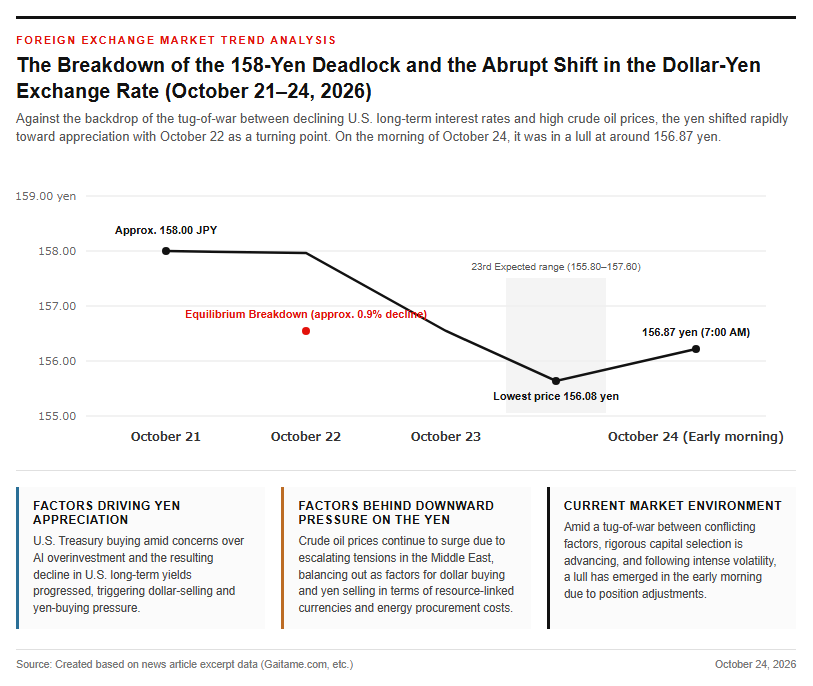
The market temporarily recorded 156.69 yen, its lowest level since September 30, and staged a further decline to 156.08 yen the next day on the 23rd. From a technical analysis perspective, the lower limit of the daily Ichimoku Kinko Hyo cloud (around 156.05 yen) is strongly perceived as the immediate downside target. Many market participants point out that the unwinding of yen-carry trade positions, which had accumulated over a long period, progressed all at once. Having broken downward from the long-standing 158-yen range, the psychological sentiment in the foreign exchange market has reached a major turning point.
Structural Factors That Drove the Markets and Cross-Asset Analysis
Renewed Concerns Over AI Overinvestment and Safe-Haven Flows into U.S. Treasuries
The primary trigger for the sharp drop in the exchange rate from the 158 yen level was the plunge in artificial intelligence (AI) and semiconductor-related stocks in the stock market, alongside the resulting turmoil in the credit market. High-tech stocks had rebounded earlier in the week on the back of strong earnings, but the sentiment changed drastically when US-based Meta Platforms indicated during its earnings call that it plans to continue making massive capital expenditures going forward. In the market, caution over massive fundraising needs and high interest burdens escalated rapidly, spreading doubts about the feasibility of recovering investments. Furthermore, cascading concerns over debt at US-based CoreWeave and declines in major semiconductor manufacturing equipment maker Lam Research accelerated the selling of growth stocks for position adjustment across global stock markets.
- Nikkei Stock Average: Plunges 1,713 yen from the previous day to 62,907.84 yen on October 22
- US 10-Year Treasury Yield: Briefly slips below 5.0% to 4.9530% amid flight to safety
Investment money that reduced its risk tolerance in the stock market fled en masse to U.S. Treasuries, which are considered the most liquid and safest assets. This buying of government bonds drove the 10-year U.S. Treasury yield below the milestone 5% level, strongly highlighting the narrowing of the interest rate differential between Japan and the U.S., and ultimately cementing the trend of selling the dollar and buying the yen.
The Mechanism Behind the Unusual Yen Appreciation Amid Crude Oil Breaking 6
What stood out as exceptionally unusual in the current market environment is the simultaneous surge in international crude oil prices and the appreciation of the yen. Normally, for Japan—which relies on imports from abroad for the vast majority of its energy resources—rising oil prices translate to an expanding trade deficit and an outflow of national wealth, typically acting as a structural downward pressure on the yen. However, in the international commodity market on October 23, North Sea Brent crude futures climbed to $116.72 per barrel, marking a sharp weekly gain of over 6%. This was driven by mounting geopolitical risks in the Middle East, including attacks on Saudi Arabia, shipping anxieties around the Red Sea and the Strait of Hormuz, and tanker attacks by Iran. Please refer to the figure below.
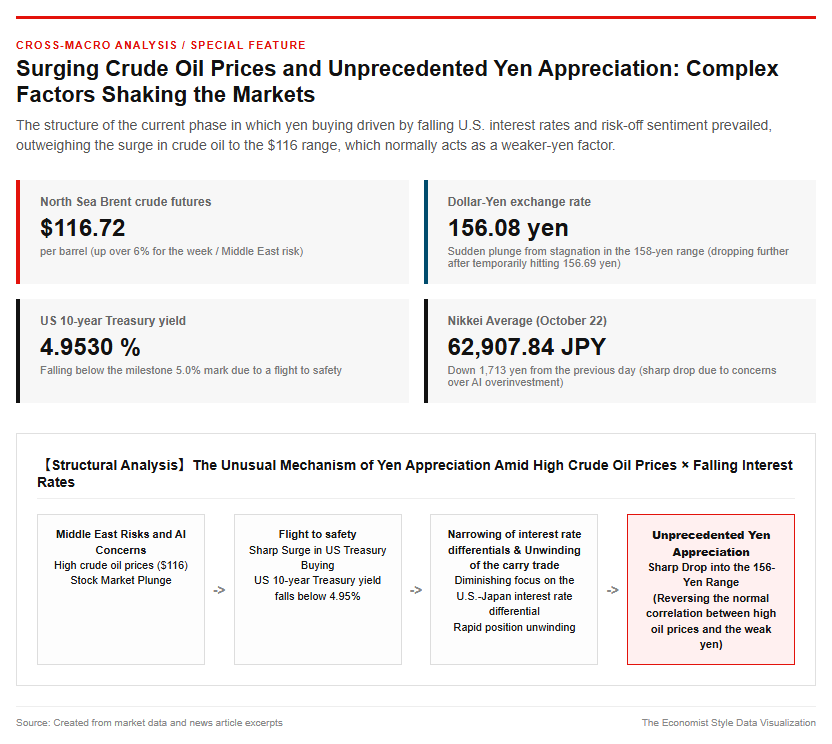
Even in an environment where crude oil prices in the $116 range would normally act as a powerful catalyst for yen depreciation, yen buying dominated the foreign exchange market. This indicates that risk-off yen-buying pressure—accompanying a sharp drop in U.S. long-term interest rates and global stock declines—completely overpowered the downward pressure on the yen caused by high oil prices. Market participants are now facing complex cross-asset correlations that overturn the conventional dogma that “higher oil prices equal a weaker yen,” and are required to decipher a multifaceted macroeconomic environment.
Differentiation in European Debt and the Surge in French Government Bond Yields
Looking across this week’s global markets, a high degree of selective capital allocation has been highlighted, one that cannot be explained by the simple dichotomy of risk-on versus risk-off. In the bond market, while U.S. and German government bonds were bought as safe-haven assets, causing their yields to fall, French government bonds were subjected to intense selling. Driven by concerns over political instability and fiscal deficit issues, the yield on France’s 10-year government bond surpassed 5%, and the yield spread with German bunds widened sharply. The market did not simply lump all government bonds together as a single asset class; rather, it clearly differentiated between nations equipped with the fiscal discipline to withstand a high-interest-rate environment and those that are not.
A similar sorting phenomenon was notably observed in other asset classes.
- Mexican Peso: Plunges to around 18.7 pesos against the dollar, while the peso-yen rate softens to around 8.4 yen
- Gold Spot: Falls Below $4,000, Dropping About 4% on the Week Due to Selling to Secure Liquidity, Despite Being Viewed as a Safe-Haven Asset
As high-yielding emerging market currencies—which had previously been bought during risk-on phases—and even gold, a traditional safe-haven asset, were sold off, global liquidity concentrated in a very select few core assets. This process of sorting nations and assets is precisely the deep-seated factor that amplified global volatility.
The Future Course of Monetary Policy and the Medium- to Long-Term Outlook for Foreign Exchange and Stock Markets
Domestic Price Increases and Pressure for the Normalization of the Bank of Japan’s Monetary Policy
As a domestic factor supporting the stronger yen that cannot be overlooked, we must consider the re-acceleration of inflationary pressure within Japan and the Bank of England’s (wait, Bank of Japan’s) stance on interest rate hikes. According to the national Consumer Price Index (CPI) for September released by the Ministry of Internal Affairs and Communications, the core index excluding fresh foods rose 2.1% from the same month of the previous year, while the core-core index excluding fresh food and energy recorded a 2.4% increase. In response to the entrenchment of rising prices, the BOJ raised its policy interest rate to 1.0% in early 2026, and the short-term market uncollateralized overnight call rate has also risen to around 1.25% following the policy change in September. The Financial System Report published by the BOJ in October also examined the robustness amid adjustments in AI investments and the rising interest rate phase, and the path toward policy normalization is steadily progressing.
Also, reflecting rising domestic interest rates, Japanese institutional investors have been net sellers of foreign bonds for five consecutive weeks. A structural change is beginning to emerge in the capital flows that previously involved massive yen-selling and foreign currency investment in pursuit of high overseas interest rates. Whether Governor Ueda shows a positive stance toward additional rate hikes at the Bank of Japan’s Monetary Policy Meeting to be held from October 29 to 30 will be a crucial turning point in exploring further room for the yen’s appreciation.
Historical Lessons from Coordinated Intervention and Key Monitoring Points Ahead
To forecast the macro trends of the foreign exchange market, it is necessary to look back at the background of the historic joint U.S.-Japan intervention carried out at the end of July 2026. Following the yen’s drop to 163.99 yen per dollar on July 23—its weakest level against the dollar in 39 years and 8 months—Japanese and U.S. monetary authorities embarked on a joint yen-buying intervention between July 30 and 31, marking the first such action in approximately 28 years. The scale of Japan’s intervention reached approximately 13 trillion yen, and the U.S. side also conducted euro-selling, yen-buying intervention, demonstrating a strong cooperative stance by agreeing to utilize the FIMA Repo Facility in the future. As the history of past joint interventions in 1998, 2000, and 2011 shows, even if temporary highs or lows are reached immediately following an intervention, it often ultimately forms a major market bottom or top, leading to a trend reversal.
The key indicators to watch in the market from next week onward are as follows.
- US 10-Year Treasury Yield: Will it Clearly Reclaim the 5.0% Milestone or Continue to Stay Below It?
- North Sea Brent Crude: Will the upward trend from the $116 range continue amid escalating tensions in the Middle East?
- Monetary Policy Meetings in Japan, the US, and Europe: Interest Rate Policies at the Bank of Japan Meeting and the US Federal Open Market Committee (FOMC)
Amid the intersection of defense lines by Japanese and monetary authorities, the monetary policies of various countries, and the earnings trends of tech companies, the foreign exchange market has entered a critical phase toward a new equilibrium point.
Reference Page
- [Foreign Exchange Rates: 24th (7:00 AM JST)] https://www.oanda.jp/lab-education/market_news/
[#ForeignExchange #USDJPY #ExchangeRate #CurrencyIntervention #BankOfJapan #USTreasuries #HighOilPrices #MonetaryPolicy]


コメント