
The U.S. Department of Commerce’s Bureau of Industry and Security has announced new export controls prohibiting Chinese companies from remotely accessing AI chips via overseas data centers. This decision comes amid growing concerns over circumvention of regulations and military diversion through third countries such as those in Southeast Asia.
- The Full Picture of Remote Access Regulations and Key Points of the New Rules
- Introduction of a Licensing Requirement for Five Countries, Including Southeast Asia, and the Risk of Circumvention
- The Unveiling of the Scandal and the Course of Rapid Developments by the U.S. Department of Commerce
- 12 Million TPP Threshold and Customer Verification Obligations for Data Centers
- Scrutiny of Exception Rules and Scope of Application for Commercial Recommendation Systems
- Immediate Blow to Asian Stock Markets and Cloud Providers
- The Course of the US-China Tech Hegemony Struggle and Future Key Points
The Full Picture of Remote Access Regulations and Key Points of the New Rules
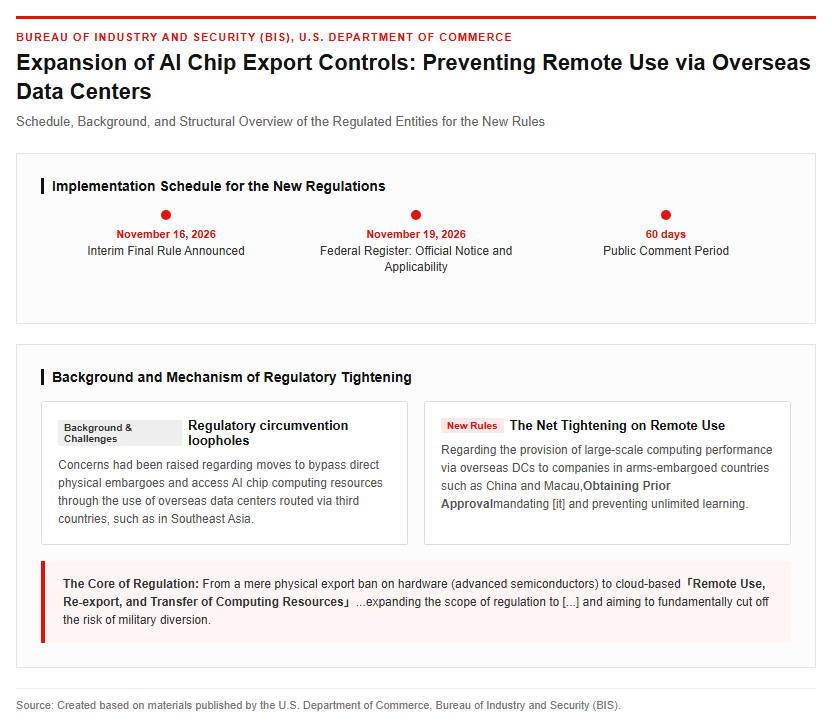
On November 16, 2026, the Bureau of Industry and Security of the U.S. Department of Commerce announced an interim final rule as a new regulatory measure targeting advanced semiconductor technology. The most significant feature of this new rule is that it goes beyond simply banning the export of advanced U.S. AI chips themselves, extending the regulatory net to remote cloud-based access and utilization of computational resources on AI chips installed in overseas data centers. This aims to close the cloud loophole that has previously been exploited to circumvent physical chip embargoes. The rule is officially published and takes effect in the U.S. Federal Register on November 19, 2026, and includes a 60-day public comment period. Specifically, it mandates obtaining prior authorization when shipping, re-exporting, or transferring U.S. advanced semiconductors to overseas data centers that provide large-scale computing performance to companies belonging to the group of arms-embargoed countries, including China and Macau. Through this, the regulation seeks to prevent the unrestricted development and training of superintelligent AI models built upon U.S. technology infrastructure. Please refer to the configuration diagram below.
Introduction of a Licensing Requirement for Five Countries, Including Southeast Asia, and the Risk of Circumvention
The new regulations outline not only restrictions on remote access via data centers, but also stricter export controls targeting specific third countries. Specifically, five countries—Brazil, Indonesia, Malaysia, Singapore, and Thailand—have been designated as “regions with a higher-than-normal risk of circumvention,” and new license applications will be required for the export or transfer of advanced semiconductors to these countries. While these regions, primarily centered in Southeast Asia, have experienced a boom in AI data center construction in recent years, suspicions have emerged that they are being used as hubs for Chinese companies to secure computing power while evading U.S. export controls. However, provisions have also been established allowing exemptions from these license requirements if the recipient is a U.S.-headquartered company or its subsidiary and detailed monthly transaction reports are submitted to the Department of Commerce. The Department of Commerce has indicated it is prepared to take strict countermeasures, such as import restrictions and adding entities to restriction lists, against countries that turn a blind eye to circumvention activities.
The Unveiling of the Scandal and the Course of Rapid Developments by the U.S. Department of Commerce
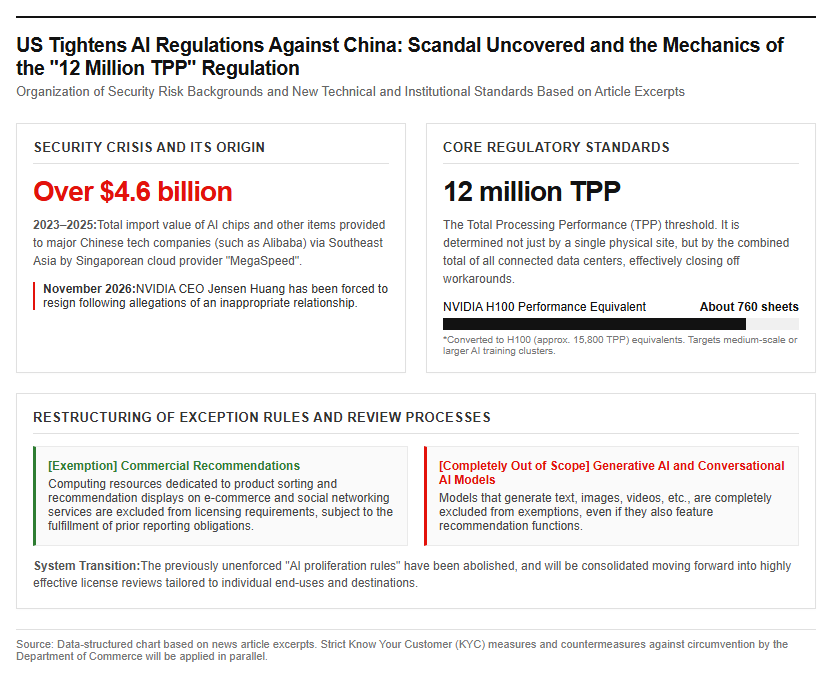
Behind the US authorities’ sudden and drastic tightening of regulations lies a major scandal surrounding AI semiconductor giant NVIDIA and a heightened sense of national security crisis. In November 2026, Jensen Huang, then-CEO of NVIDIA, was forced to resign. This occurred after allegations surfaced regarding his improper relationship with a former executive of Singapore-based cloud provider Megaspeed, who was suspected of having ties to Chinese intelligence agencies. It was alleged that large-scale smuggling and remote utilization of AI chips had been carried out through the company. Megaspeed reportedly provided the computing power of NVIDIA-installed chips at data centers across Southeast Asia to major Chinese IT firms such as Alibaba, importing over $4.6 billion worth of technology between 2023 and 2025. Amid mounting criticism within the government over delayed regulations, the Department of Commerce was forced to introduce comprehensive rules aimed at cutting off indirect access.
Technical Mechanisms and Regulatory Frameworks
12 Million TPP Threshold and Customer Verification Obligations for Data Centers
The core criterion in the current remote usage regulations is the threshold setting of “12 million TPP” for total processing performance. TPP (Total Processing Performance) is a unit used by the U.S. Department of Commerce to measure the computing performance of chips, and for clusters connecting multiple chips, the combined total is applied. Converted to the performance of NVIDIA’s H100 high-performance AI chip (approx. 15,800 TPP), this is equivalent to about 760 units, a scale easily reached by medium-scale or larger AI training clusters. Under the regulatory rules, determinations are made based on the combined performance not only of the same physical data center, but also of entire “connected data centers” linked via digital networks, making it impossible to evade regulations through methods that disperse locations. Furthermore, data center operators and exporters are mandated to conduct rigorous “Know Your Customer” (KYC) due diligence to investigate the direct and indirect capital structures of their customers. Failure or refusal to verify will be immediately presumed a violation.
Scrutiny of Exception Rules and Scope of Application for Commercial Recommendation Systems
While strict regulations are imposed, clear exceptions are also established to avoid unduly disrupting regular commercial activities. Computational resources dedicated exclusively to “commercial recommendation systems”—which sort and display products or content on e-commerce sites, social media, and the like—are deemed to pose a low security threat and will be exempt from licensing requirements provided that prior reporting obligations are fulfilled. However, conversational AI and generative AI models that newly generate text, images, video, software, and other content are completely excluded from this exception, even if they also incorporate recommendation features. Furthermore, the “AI Diffusion Rule” and blanket regulations regarding model weights, which were enacted under the Biden administration but never enforced, will be abolished and replaced by a streamlined system of highly effective license reviews tailored to individual end uses and destinations. Please refer to the conceptual diagram of the mechanism below.
Impact on Industry and Key Points to Watch Going Forward
Immediate Blow to Asian Stock Markets and Cloud Providers
Following the notice of the new regulations taking effect, Asian stock markets and semiconductor- and data center-related stocks immediately took a major hit. In the market on November 17, 2026, shares of Malaysia’s YTL Power, which had been developing AI infrastructure in partnership with NVIDIA, plummeted by nearly 10%, and shares of data center infrastructure providers MN Holdings and Critical Holdings also recorded declines of around 20%. Furthermore, the stock prices of Chinese AI developers relying on overseas computing resources fell across the board, with Chinese tech giant Alibaba dropping 5% and Tencent falling 3%. Market analysts point out that a decline in utilization rates and delays in plans for AI data centers deployed in Southeast Asia, along with increased computing costs for Chinese companies, are unavoidable. Meanwhile, the Malaysian government has signaled its intention to comply with U.S. regulations, and Singaporean authorities have begun discussions with the U.S. government to gauge the impact.
The Course of the US-China Tech Hegemony Struggle and Future Key Points
In strong response to the latest U.S. measures, China’s Ministry of Foreign Affairs strongly pushed back, calling it “classic economic coercion and the exercise of long-arm jurisdiction,” and hinted at countermeasures to protect its legitimate interests. The focus moving forward is centered on the extent toFromArgb—[Correction based on context: extent to which]—permission will be granted to continue services to existing customers within the 90-day grace period granted to overseas data centers already in operation. Furthermore, in the U.S. Congress, bipartisan bills such as the “Remote Access Security Act,” which directly regulates remote access via the cloud from a legal standpoint, are under deliberation, and further tightening of surveillance by the legislature and the Department of Commerce is expected. Against the U.S. encirclement strategy aiming to choke off both physical smuggling countermeasures and remote cloud utilization, how the Chinese side will accelerate the formation of a domestic self-sufficient semiconductor ecosystem marks a new phase in the international competition for AI and the restructuring of the supply chain.
Reference Page
- [U.S. Department of Commerce Bureau of Industry and Security (BIS) Interim Final Rule (RIN 0694-AK50)] https://www.bis.gov/media/documents/rin-0694-ak50.pdf
- [U.S. Federal Register Official Document] https://www.federalregister.gov/d/2026-23529
【#AIChips #USCommerceDepartment #NationalSecurity #SemiconductorRegulations #CloudAccess #GeopoliticalRisk】

コメント