
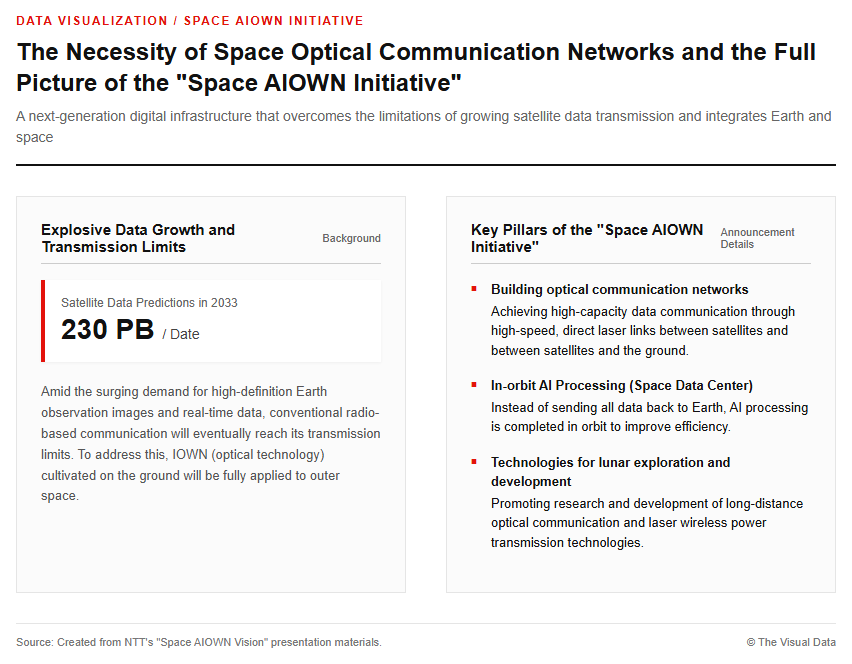
NTT has announced the “Space AIOWN” vision to expand optical information networks into outer space. Behind this are the transmission limits of satellite data, which is projected to expand to 230 PB per day by 2033, and the growing demand to build an integrated terrestrial-space digital infrastructure for the AI era.
- Announcement of the “Space AIOWN Initiative” and Key Points of the Events
- The Structure of Data Communication Bottlenecks Reaching 230 PB by 2033
- Mechanism of Space Data Center and Optical Ground Station APN Integration
- Tackling Lunar Infrastructure: “Cislunar Optical Communication” and Laser Power Beaming
- Five-Company Mega-Constellation Collaboration and the Public-Private Space Strategy
- Future Developments and Key Highlights of Terrestrial-Space Integrated Infrastructure
Announcement of the “Space AIOWN Initiative” and Key Points of the Events
On November 16, 2026, NTT Corporation presented the “Space AIOWN Vision” at its technology base in Musashino, Tokyo. It is a new next-generation digital infrastructure that breaks through the communication limits of conventional radio waves and directly connects space and the ground via an optical network.
The key announcements are as follows.
– Construction of an optical communication network connecting inter-satellite and satellite-to-ground links using laser beams
– Realizing a Space Data Center That Completes AI Processing in Orbit
– Advancing Research on Long-Distance Optical Communication and Laser Wireless Power Transmission Technologies with a View to Lunar Development
The roles played by space can be summarized into two key areas: satellite communications and Earth observation. In terms of communications, the introduction of Docomo Starlink Direct and other services is expanding connectivity in mountainous and maritime regions. On the observation side, demand for high-definition imagery and real-time data is surging. To support these capabilities, a policy has been announced to fully apply IOWN (Innovative Optical and Wireless Network) optical technology, cultivated on the ground, to outer space.
The following diagram shows an overview of the space optical communication network.
The Structure of Data Communication Bottlenecks Reaching 230 PB by 2033
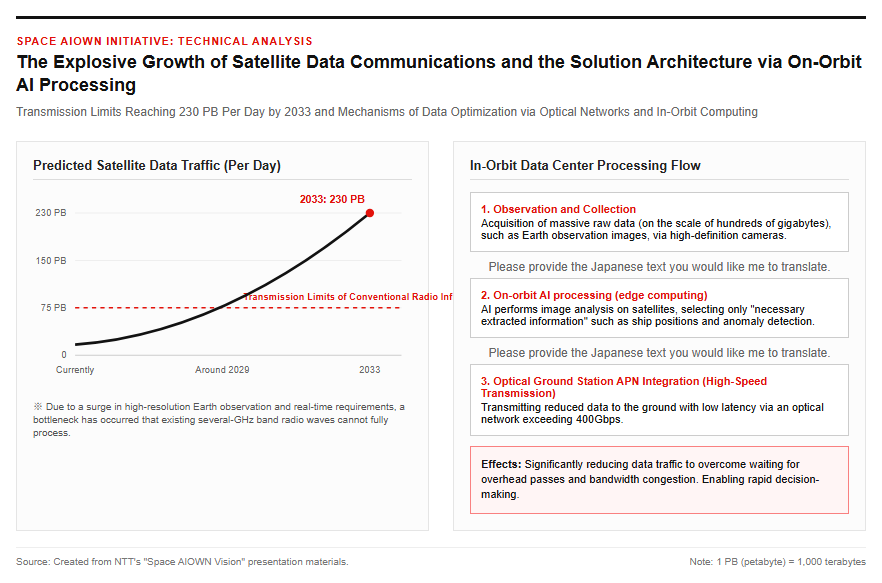
In the field of space communications, existing radio infrastructure is facing severe transmission capacity limits. It is projected that by 2033, the volume of data traffic handled between satellites and the ground will reach a scale of 230 PB per day.
The structural challenges inherent in conventional radio wave communication are as follows:
– the available frequency band being limited to a width of several gigahertz, resulting in spectrum congestion
– the fact that low Earth orbit satellites orbit the Earth in about 90 minutes, resulting in very short available communication time with ground stations
– the need for observation satellites to wait to transmit data until they fly over a specific ground station
While radio wave bandwidth is limited to around several GHz, optical communication can utilize a vast bandwidth of hundreds of GHz. It also features the advantage of not causing mutual interference with other systems. By introducing optical data relaying, which transmits data from an observation satellite to adjacent satellites, it becomes possible to deliver data to the ground in near real-time without waiting for the satellite to pass overhead.
In-Orbit Computing and Technological Deployment for Lunar Infrastructure
Mechanism of Space Data Center and Optical Ground Station APN Integration
To deliver high-capacity data to the ground with low latency, NTT will build a system that combines distributed processing in space with the coordination of ground-based optical stations.
The key points of the technical mechanism are as follows.
– Achieving High-Speed Communication Exceeding 400 Gbps with IOWN Devices and Digital Coherent Technology
– Achieved stable 25Gbps communication and ±10 km/s velocity difference compensation between satellites 5,000 km apart
– Distributed deployment of optical ground stations near data centers nationwide and globally for all-weather availability
To address optical signal attenuation caused by clouds and atmospheric fluctuations, an All-Photonics Network (APN) and control technology are used to dynamically switch to the optimal route according to the weather. Furthermore, by building a “space data center” that performs on-orbit AI processing on images captured by satellite cameras and transmits only necessary extracted information, such as the positions of vessels at sea, it significantly reduces communication volume and enables rapid decision-making.
The figure below illustrates the flow of on-orbit data processing.
Tackling Lunar Infrastructure: “Cislunar Optical Communication” and Laser Power Beaming
Initiatives are intensifying not only in near-Earth orbits, but also toward the cis-lunar region—the space between the Earth and the Moon—and lunar surface development. On November 16, 2026, NTT concluded a partnership agreement with ispace, inc., which provides lunar transportation and related services.
The primary research and development items for the lunar mission are as follows:
– Development of ultra-long-distance optical communication technology connecting Earth and the lunar surface (approx. 380,000 km)
– Development of Ultra-Low-Noise Optical Amplification Technology that Efficiently Amplifies Signals While Suppressing Noise
– Lunar Laser Wireless Power Transmission Technology Delivering Energy via Light to Rovers and Construction Equipment
Because power infrastructure is underdeveloped on the lunar surface, technology capable of flexibly supplying power to mobile objects is essential. Ground experiments have successfully demonstrated laser power transmission to a location 1 km away. With an eye on opportunities such as ispace’s lunar orbiter “Mission 2.5″—scheduled for launch as early as 2027—and “Mission 3” in 2028, the development of infrastructure for a sustainable lunar economic zone is progressing.
Impact on Industry and Security, and Future Prospects
Five-Company Mega-Constellation Collaboration and the Public-Private Space Strategy
To strengthen Japan’s space infrastructure, a memorandum of understanding for five-company collaboration toward building a mega-constellation was concluded on November 9, 2026.
The five companies participating in the collaboration and their main roles are as follows.
– Mitsubishi Electric: Overall design and integration leveraging development expertise in satellite and ground systems
– NTT and NTT Docomo Business: System Design for Space-Terrestrial Integrated Networks Utilizing IOWN Technology
– MUFG Bank and Development Bank of Japan: Financial support for supply chain construction and medium- to long-term commercialization
Under the “Space Technology Strategy” formulated by the government, a “Space Strategic Fund” totaling approximately 1 trillion yen over 10 years has been established to promote the domestic production of satellite optical communication and non-terrestrial network (NTN) technologies. To address communication frequency congestion and ensure security resilience, the public and private sectors are collaborating to aim for the early societal implementation of a multi-layered network integrating communications, observation, positioning, and data centers.
Future Developments and Key Highlights of Terrestrial-Space Integrated Infrastructure
Going forward, the transition toward a decentralized architecture that seamlessly integrates computing resources between terrestrial data centers and outer space will accelerate. A division of roles will become firmly established in which terrestrial data centers handle cloud services and real-time processing, while pre-processing and anomaly detection for space-based data are performed instantly in orbit.
The main points of focus moving forward are as follows.
– Establishment of Space IX and spatiotemporal orchestration connecting satellite networks and in-orbit nodes
– Achieving 100% 5G and 6G Area Coverage through HAPS (High Altitude Platform Station) Commercialization
– Achievement Status of the Target of 100 Billion Yen in Standalone Sales for NTT’s Space Business in Fiscal 2033
For Japanese companies, rather than vertically integrating all layers, the winning strategy in the global market will be to intensively supply foundational technologies in which they hold strengths, such as optical communication devices, thermal control, and Physical AI. Integrated space-terrestrial infrastructure as a next-generation digital foundation will be the key to solving social challenges and strengthening industrial competitiveness.
Reference page
- [NTT Group News Release] https://group.ntt/jp/newsrelease/
- [NTT Aerospace C89] https://group.ntt/jp/aerospace
- [NTT Docomo Business Press Release] https://www.ntt.com/about-us/press-releases/news/article/2026/1109.html
- [Cabinet Office Space Technology Strategy] https://www8.cao.go.jp/space/
- [PwC Japan Report] https://www.pwc.com/jp/ja/knowledge/thoughtleadership/next-generation-digital-platform.html
【#NTT #SpaceAIOWN #SpaceDataCenter #SpaceOpticalCommunications #IOWN #LunarDevelopment #MegaConstellation】


コメント