Four organizations, including the medical corporation Shueikai Kobe Asahi Hospital, have launched a proof-of-concept (PoC) operation of an interactive local AI system linked with electronic medical records starting in October 2026. The backdrop includes the regulation of overtime for doctors implemented in April 2024 and shortages of medical personnel, with the aim of safely improving operational efficiency within the hospital environment.
- 1.1 The 2024 Problem and Background of Introducing AI Linked with Electronic Medical Records
- 1.2 Integration of Specialized Expertise and Role Sharing Through Four-Party Collaboration
- 2.1 In-House Self-Contained On-Premises Architecture and Security Design
- 2.2 Four Main Operational Supports to Reduce the Burden on Medical Workers
- 3.1 Medical Device Regulation (SaMD) and the Scope of Physicians’ Responsibility
- 3.2 Announcement of PoC Results in March 2027 and Expansion to a Nationwide Model
1.1 The 2024 Problem and Background of Introducing AI Linked with Electronic Medical Records
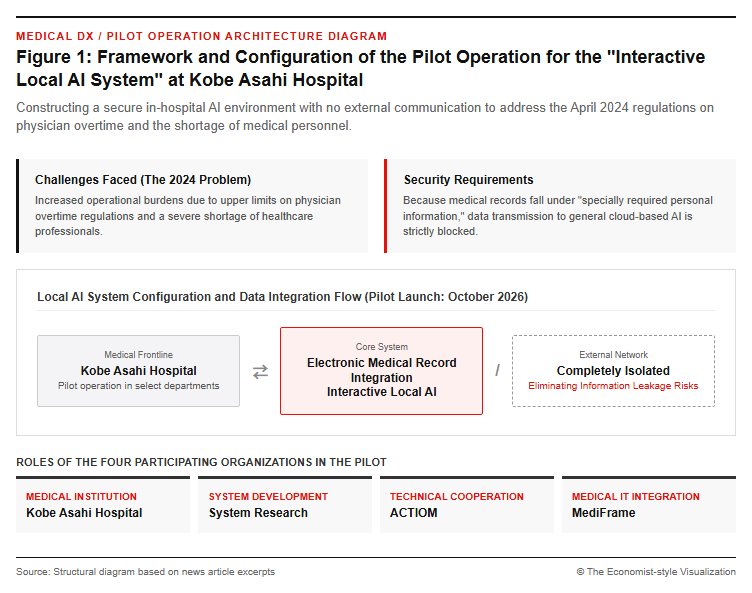
Due to the upper limits on overtime work for physicians enforced in April 2024—the so-called “2024 Problem”—and the plateauing of medical demand accompanying the declining birthrate and aging population, labor shortages and an increased operational burden have become extremely serious issues on the frontline of Japanese healthcare. While expectations for generative AI are rising as a means to resolve these challenges, medical data within electronic medical records falls under “specially-care-required personal information” according to the Act on the Protection of Personal Information. Consequently, transmitting data to general cloud-based AI services has been difficult from perspectives such as information leakage. To break through this safety management barrier, four organizations—Shueikai Kobe Asahi Hospital (Nagata-ku, Kobe City, Hyogo Prefecture), System Research Co., Ltd., ACTIOM Co., Ltd., and MediFrame Co., Ltd.—have collaborated to launch a proof-of-concept (PoC) operation for an interactive local AI system linked with electronic medical records. This demonstration began in October 2026 in certain departments at Kobe Asahi Hospital, building an environment that safely supports operations without taking frontline medical data outside the hospital. An overview of the system architecture is shown in the placeholder below.
1.2 Integration of Specialized Expertise and Role Sharing Through Four-Party Collaboration
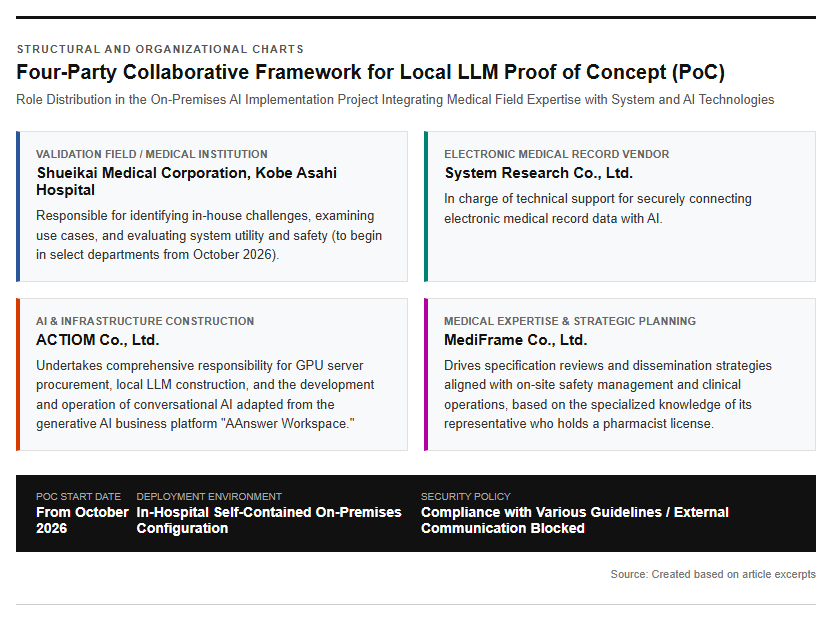
A major strength of this project is that expertise from different domains—medical practice, system infrastructure, AI technology, and medical professions—is closely integrated from the design stage of development. The division of roles among the four parties in the project is clearly defined. Kobe Asahi Hospital, which provides the verification field, is responsible for extracting in-house issues, examining use cases, and evaluating the system’s usefulness and safety. System Research, an electronic medical record vendor, provides technical support to securely connect medical record data and AI. ACTIOM is handling everything from GPU server procurement and local LLM operating environment construction to the development and operation of an interactive AI adapted from its own generative AI business platform “AAnswer Workspace.” Meanwhile, MediFrame is driving the specification review and dissemination strategy tailored to frontline safety management and clinical operations, leveraging the specialized knowledge of its representative, who holds a pharmacist’s license. By bringing together multifaceted expertise, the project realizes the construction of a system that can be genuinely utilized in the field.
2. Technical Structure of Local LLM and Four Supported Business Areas
2.1 In-House Self-Contained On-Premises Architecture and Security Design
The primary concern when introducing generative AI in medical institutions is the leakage of patient personal information and confidential data to the outside. This system adopts an on-premises local LLM configuration where the generative AI platform “AAnswer Workspace,” developed by ACTIOM, operates on a dedicated server inside the hospital. Because all processing of medical information data is completed within the closed environment of the in-house network, it cuts off the risk of patient information being sent to external public cloud services or third-party servers. Furthermore, regarding the security system, the design complies with the Ministry of Health, Labour and Welfare’s “Guidelines for the Safe Management of Medical Information Systems” and the Ministry of Internal Affairs and Communications and Ministry of Economy, Trade and Industry’s “Safety Management Guidelines for Providers of Information Systems and Services Handling Medical Information.” By thoroughly enforcing strict access control and compliance with relevant laws and regulations, the security of medical data is maintained at a high level. The conceptual image of the network connection configuration in the hospital environment is as follows.
2.2 Four Main Operational Supports to Reduce the Burden on Medical Workers
The primary objective of this system is to reduce the time medical workers spend bogged down in daily administrative tasks and reclaim time to face patients directly. Specifically, utilizing medical information from electronic medical records, it provides operational support in an AI interactive format across the following four main areas. First, it streamlines administrative tasks such as organizing medical record data and searching past data. Second, it provides document creation support where the AI automatically generates drafts of medical records and various summaries, which medical workers then inspect, modify, and transcribe into the electronic medical record. Third, it establishes an environment where necessary procedures can be quickly referenced from thick in-house manuals and regulations. Fourth, it implements support to shorten the access time to medical information necessary for operations. The key points of the support contents are as follows.
- Efficient organization and search of medical information and medical record data
- Draft generation, inspection, and transcription of medical records and summaries, etc.
- Interactive instant search of in-house regulations and operational manuals
- Prompt access to medical information related to clinical operations
3. Governance of Medical AI and Future Outlook
3.1 Medical Device Regulation (SaMD) and the Scope of Physicians’ Responsibility
When deploying generative AI in the medical field, clarifying its regulatory status and ethical governance is essential. Under the regulation of Software as a Medical Device (SaMD) in Japan’s Pharmaceuticals and Medical Devices Act (PMDJA), this system is not intended to make direct diagnoses or determine treatment policies for diseases; rather, it is positioned strictly as a tool to assist healthcare professionals with administrative tasks and document creation. Therefore, it is premised on the assumption that all final medical judgments and responsibilities rest entirely with doctors and other healthcare professionals. As indicated in the report by the Japan Medical Association’s review committee, a “Human-in-the-Loop” principle is incorporated, wherein humans must intervene to verify the validity of the content rather than using the AI’s output as-is. To prevent medical accidents caused by erroneous outputs (hallucinations), operational rules are strictly enforced to ensure that drafts generated by AI are always reviewed and corrected by healthcare professionals before being adopted.
3.2 Announcement of PoC Results in March 2027 and Expansion to a Nationwide Model
In the proof of concept (PoC) launched at Kobe Asahi Hospital in October 2026, quantitative effectiveness is being verified—such as how much actual working time has been reduced—in addition to the system’s operability and safety. The evaluation results of the demonstration are scheduled to be announced around March 2027, which is expected to clarify the specific implementation effects in clinical settings. Based on the verification results, plans are in place to gradually expand the target departments and operational scope within Kobe Asahi Hospital. Furthermore, in the future, the local LLM and electronic health record integration package established through this demonstration aims to be deployed to other regional medical institutions and hospitals, popularizing it as a universal medical DX model available nationwide. Amid growing nationwide concerns over a shortage of medical personnel, expectations are high for the development of this initiative, which achieves both patient privacy protection and the alleviation of burdens on-site.
References
- [ACTIOM Inc. Press Release] https://prtimes.jp/main/html/rd/p/000000001.000194700.html
- [Shueikai Medical Corporation Kobe Asahi Hospital] https://www.kobe-asahi-hp.com/
- [ACTIOM Inc.] https://acti0m.com/
- [MediFrame Inc.] https://mediframe.co.jp/
- [Ministry of Health, Labour and Welfare: Guidelines for the Safe Management of Medical Information Systems] https://www.mhlw.go.jp/stf/shingi/0000516275_00006.html
[#MedicalDX #LocalLLM #ElectronicHealthRecord #GenerativeAI #MedicalAI #WorkStyleReform #KobeAsahiHospital #Security]


コメント