
It has been revealed that major US private equity firm GTCR is considering a complete acquisition of payment giant Global Payments, sending the company’s stock price surging by over 10%. GTCR’s move, as the top shareholder holding a 16.35% stake through the sale of Worldpay, has drawn market attention as a massive debt-backed restructuring drama in the payment industry.
- Top Shareholder GTCR’s Consideration and Filing for Full Acquisition
- Stock Price Surge Following News Reports and the Tumultuous Background
- Business Overview of Acquisition Target Global Payments
- Background of the Worldpay Sale and GTCR’s Shareholding
- Notable Undervaluation of the Stock Price from a Metrics Perspective
- Financing and Debt Challenges Associated with the Massive Billion LBO
- Slumping Share Prices Among Major Payment Companies and Spillover Effects on Competitors
- Risk Characteristics of LBO Financing and Changes in Market Structure
- Negotiations with the Board of Directors and Progress on SEC Filings
- Waves of Consolidation in the Payments Industry and Medium-to-Long-Term Scenarios
Top Shareholder GTCR’s Consideration and Filing for Full Acquisition
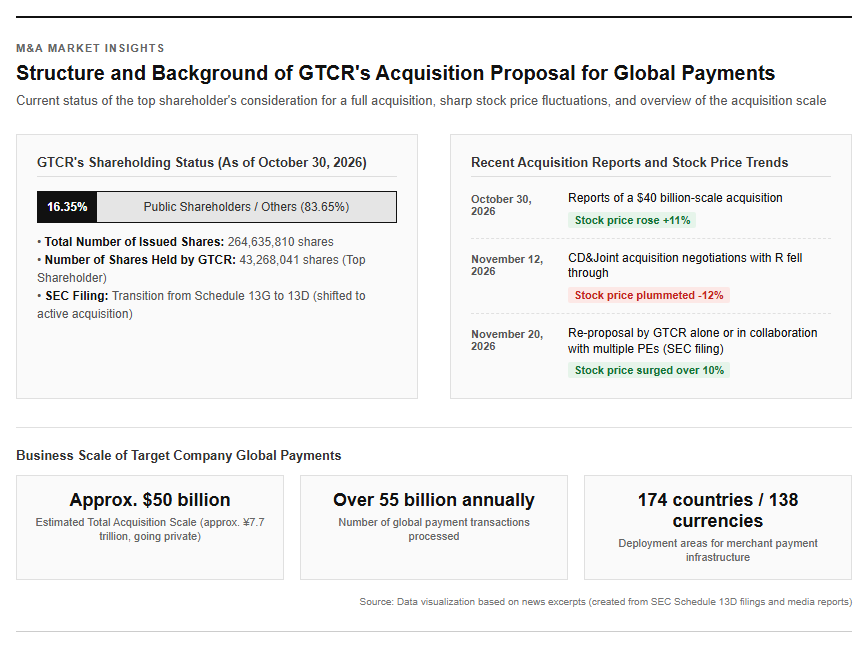
US private equity (PE) firm GTCR revealed in a “Schedule 13D” filing submitted to the US Securities and Exchange Commission (SEC) on November 20, 2026, that it is considering a strategic transaction including a proposal to additionally acquire unheld shares or acquire all shares of payment giant Global Payments. GTCR is currently the top shareholder, directly holding 43,268,041 shares, or a 16.35% stake, out of the total 264,635,810 issued and outstanding shares of the company (as of October 30, 2026). Previously, it had submitted a “Schedule 13G” indicating passive investment, but changed it to a 13D with active strategic transactions in view. Although no definitive decisions or binding agreements have been reached at this time, it is indicated that a formal acquisition proposal may be made through discussions with the board of directors, other investors, and funding sources.
Stock Price Surge Following News Reports and the Tumultuous Background
Following the news of the acquisition consideration, Global Payments’ stock price surged by over 10% on the US stock market on November 20, 2026. Bloomberg reported on the same day that GTCR was collaborating with multiple PE funds to consider a going-private acquisition totaling approximately $50 billion (approx. 7.7 trillion yen), including the assumption of existing debt and a premium. This is not the first time acquisition reports surrounding Global Payments have emerged. On October 30, 2026, a $40 billion acquisition report also drove up the stock price by 11%, but on November 12, Reuters reported that joint acquisition talks between Clayton, Dubilier & Rice (CD&R) and GTCR had broken down, causing the stock price to plunge by 12%. The move to reconfigure joint partners and reignite negotiations in just one week delivered a strong surprise to the market.
Business Overview of Acquisition Target Global Payments
Global Payments is a major payment service provider that offers payment processing and omnichannel payment solutions to merchants worldwide. Centering on acquirer operations that handle the authorization and clearing of credit and debit card payments at physical stores and e-commerce sites, the company processes over 55 billion transactions annually across 174 countries and in 138 currencies. The company deploys payment infrastructure that accommodates diverse business environments regardless of whether they are face-to-face or non-face-to-face, with its strengths lying in a large-scale merchant network and advanced transaction processing capabilities. If realized, this acquisition proposal is expected to be one of the largest going-private transactions in the history of the private equity industry.
Acquisition Background and Global Payments’ Financials and Valuation
Background of the Worldpay Sale and GTCR’s Shareholding
Behind GTCR becoming the top shareholder of Global Payments lies the large-scale M&A of Worldpay led by the company. GTCR acquired a majority stake in Worldpay from FIS in July 2023, and based on its “Leaders Strategy” approach, promoted business reforms through management renewal and investments in products and technology. Subsequently, in April 2025, it reached an agreement to sell Worldpay to Global Payments for $24.25 billion in cash and stock, with the transaction completing on January 12, 2026. By receiving a 16.35% stake in Global Payments as part of this sale consideration, GTCR became the top shareholder of the company and secured a position to participate in future value creation through the equity method.
Notable Undervaluation of the Stock Price from a Metrics Perspective
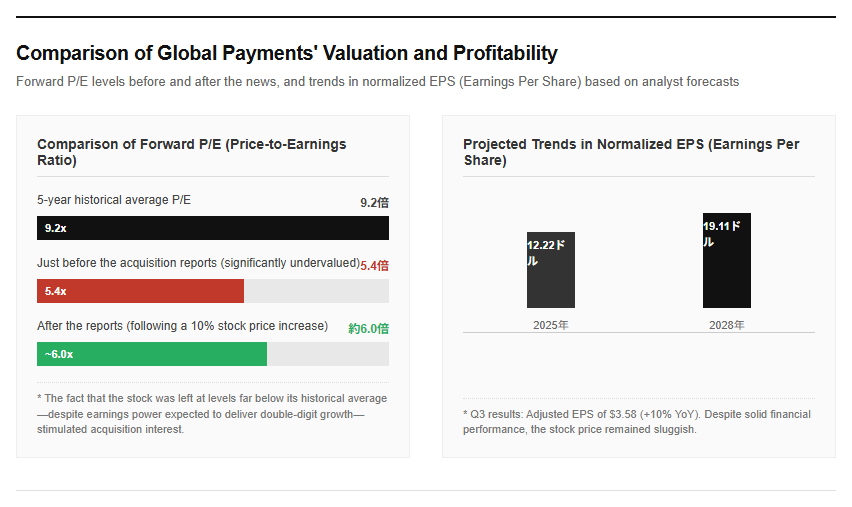
Behind this acquisition proposal is the reality that Global Payments’ stock price has been trading at a significant discount to its intrinsic value. Immediately prior to the acquisition reports, the company’s stock price languished at a forward P/E (price-to-earnings) ratio of just 5.4x, well below its 5-year average P/E ratio of 9.2x. Earnings themselves were solid, with third-quarter 2026 adjusted EPS (earnings per share) recording $3.58, a 10% increase year-over-year, and analyst forecasts projecting normalized EPS to grow from $12.22 in 2025 to $19.11 in 2028. Even after the 10% stock price increase, the P/E ratio remains at around 6x, and it is analyzed that a strong sense of undervaluation relative to earnings power expected to deliver double-digit growth stimulated acquisition interest from PE funds.
Financing and Debt Challenges Associated with the Massive Billion LBO
The biggest barriers to realizing the acquisition are the massive funding requirements and the refinancing risk of existing debt. Global Payments’ total debt has increased from $17 billion in 2024 to $22.2 billion in 2025, and the bulk of the rumored $50 billion acquisition price will rely on refinancing existing debt or raising additional debt (LBO financing). The fact that negotiations broke down once in mid-November is also said to be due to the difficulty of raising funds to structure massive loans in a high-interest-rate environment. Because LBO financing generally carries floating rates and high spreads, the post-acquisition interest burden and the feasibility of debt repayment through cash flow will be scrutinized extremely rigorously.
M&A Trends in the Payments Industry and Their Impact on the Competitive Environment
Slumping Share Prices Among Major Payment Companies and Spillover Effects on Competitors
Developments surrounding Global Payments have also spilled over to competitors that are similarly facing slumping share prices. Fiserv, a competitor in merchant payment terminals (“Clover”), trades at a forward P/E of 7.4x, while online payment competitor PayPal trades at a forward P/E of 9.6x—both below their historical average valuation levels. On November 20, 2026, PayPal announced a CFO change and a management shake-up, causing its share price to drop by 5%, though analysts pointed to a diminished possibility of support for the share price through an acquisition and a demand for organic recovery. Views are spreading in the market that PE funds have targeted Global Payments as a more attractively valued alternative asset.
Risk Characteristics of LBO Financing and Changes in Market Structure
According to Bank of Japan analyses, recent LBO financing deals have seen increased leveraging of acquired companies and massive expansions in “goodwill,” raising the risk of credit costs arising from deviations in business plans. Because it is a non-recourse structure where only the acquired company’s cash flow serves as the source of repayment, it carries the danger of falling into downgrades or the inability to refinance (refinancing risk) when interest rates rise or performance slumps. Particularly in the payments industry, competition to lower fee levels to acquire merchants has intensified, making a transformation of the revenue structure essential—not just through simple scale expansion, but via value-added services such as fraud detection, data utilization, and embedded payments.
Future Outlook and Key Points to Watch
Negotiations with the Board of Directors and Progress on SEC Filings
The primary focal point going forward will boil down to whether GTCR can submit a formal acquisition proposal to Global Payments’ board of directors and secure their agreement. The shareholder agreement concluded by GTCR during the sale of Worldpay on January 9 (or 12) includes standstill provisions and lock-up rules that restrict the acquisition of stock exceeding a certain percentage, and these conditions must be met procedurally. Furthermore, whether the investment ratio by the co-investment fund and the formation of the funding package via syndicated loans proceed smoothly will be the determining factors in whether the deal is successfully concluded.
Waves of Consolidation in the Payments Industry and Medium-to-Long-Term Scenarios
This $50 billion go-private initiative indicates that the global consolidation of the payments industry has entered a new phase. With the rise of higher cashless payment ratios, stablecoins, and AI-utilized new payment methods, business models dependent on traditional payment processing are forced to transform. If going private frees management from the short-term quarterly earnings risks of the stock market, they will find it easier to promote medium-to-long-term technological investments and structural reforms. Regardless of whether this case turns out to be a success or a failure, alliances and mergers by PE funds targeting undervalued major payment companies are expected to accelerate even further in the future.
Reference Pages
- 【GTCR Completes Sale of Worldpay to Global Payments】https://www.prnewswire.com/news-releases/gtcr-completes-sale-of-worldpay-to-global-payments-302658108.html
- 【SEC EDGAR Schedule 13D Filing by GTCR W Aggregator LP】https://www.sec.gov/Archives/edgar/data/1123360/000119312526470458/0001193125-26-470458-index.htm
- 【LBO ファイナンスの動向とリスク管理 – 日銀レビュー】https://www.boj.or.jp
【#GTCR #グローバルペイメンツ #MA #決済業界 #フィンテック #LBO #株式投資 #企業買収】


コメント