Samsung Electronics, SK Hynix, and Micron, three companies that dominate the global memory market, have been subjected to a class-action lawsuit in the United States, accusing them of unfairly inflating DRAM prices under the guise of the AI boom. This price surge has placed a severe cost burden on a broad supply chain, including Apple and the gaming industry, bringing the structural distortions of the semiconductor industry into legal proceedings.
- Overview of the Lawsuit and Plaintiffs’ Claims
- Suspicions of price manipulation under the guise of AI demand
- Structure of intentional production halts by major suppliers
- The Wafer Redistribution Dilemma Brought by HBM Shift
- Soaring device prices and the tough decisions of tech companies
- The outcome of the lawsuit and the market turning point toward 2028
Overview of the Lawsuit and Plaintiffs’ Claims
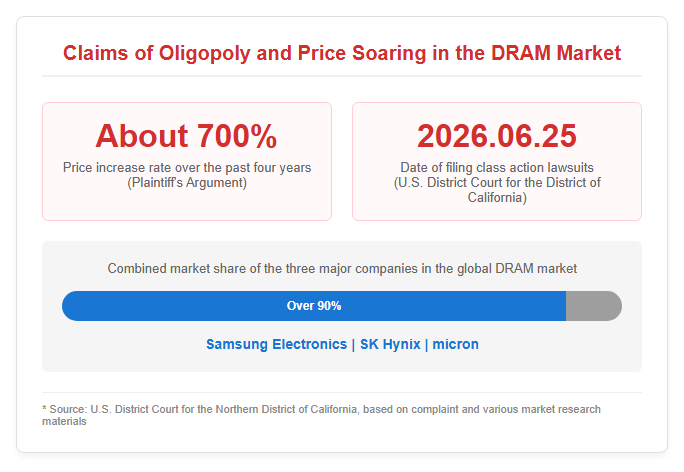
On June 25, 2026, a class-action lawsuit was filed in the U.S. District Court for the Northern District of California against three major memory companies: Samsung Electronics, SK Hynix, and Micron Technology. The plaintiffs consist of 14 individual consumers and three small and medium-sized businesses that assemble and sell PCs. They claim that these three companies systematically restricted the supply of general-purpose DRAM since 2022, causing prices to surge by about 700% over the past four years. These three companies, which control over 90% of global DRAM market sales, have been accused of exploiting a situation where consumers could not choose alternative products due to a strong oligopoly. The law firm Bateidan, representing the plaintiffs, has a proven track record of winning Google’s ad rigging lawsuits in the past, and aims to develop this lawsuit into a large-scale class action lawsuit representing all consumers and businesses that have purchased DRAM-equipped products. Please refer to the diagram below.
Suspicions of price manipulation under the guise of AI demand
The plaintiffs’ core argument is that the three companies used the shift in production to high-bandwidth memory (HBM) for artificial intelligence (AI) as a “shield” to artificially reduce the supply of general-purpose DRAM used by general consumers. According to the complaint, the three companies simultaneously halted or reduced production of older generation memory such as DDR3 and DDR4, widely used in PCs and consumer electronics, under the pretext of increased demand from AI data centers. In a normally competitive market, if one company reduces supply, others should increase production and take market share, but the fact that three companies have tightened supply in unison has been criticized as ‘coordinated price manipulation.’ Additionally, building a DRAM manufacturing plant requires massive investments ranging from $15 billion to $20 billion and several years, and the market structure, which makes entry extremely difficult, makes price control by major players easy to control—a structural flaw has been pointed out.
The underlying market structure and “strategic stagnation”
Structure of intentional production halts by major suppliers
In the first quarter of 2026, Samsung raised DRAM prices by 90% year-over-quarter, and SK Hynix and Micron followed suit with about 65% price increases, but surprisingly, none of the three companies increased production at all. Semiconductor analyst Tim Calpan described this phenomenon as a “deliberate strategic choice,” analyzing that the supply side is reaping maximum profits (rent) from the AI boom while avoiding future crash risks from capital investments. On the supply side, buyers like hyperscalers, who do not want to miss out on AI chip sales opportunities, are well aware of situations where they are forced to accept the offered price unconditionally. Even without illegal closed-door bidding, openly signaling “supply shortages continue” through investor conferences may be creating the opposite of the “prisoner’s dilemma” that implicitly maintains high prices.
The Wafer Redistribution Dilemma Brought by HBM Shift
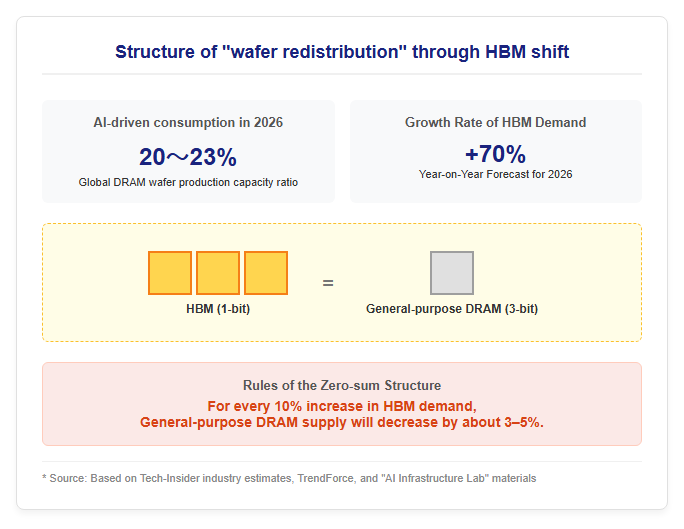
The physical cause of the ongoing surge in memory prices lies in the “wafer scramble” on the manufacturing line. HBM, the cutting-edge memory for AI, is produced on the same production line as conventional DRAM, but due to its complex structure, it requires about three times the wafer area per bit of conventional DRAM to be produced. By 2026, AI-driven memory is projected to consume about 20% to 23% of global DRAM wafer production capacity, and this “zero-sum structure” is physically reducing the supply of all other memory products. For manufacturers, HBM offers overwhelmingly high profit margins and a strong incentive to prioritize production resource allocation, resulting in general-purpose DRAM for PCs and smartphones being excluded from the market, causing prices to soar. Please refer to the diagram below.
Impact on consumers and future outlook
Soaring device prices and the tough decisions of tech companies
The explosive rise in memory prices has had a serious impact on the prices of final products. On June 25, 2026, Apple announced a significant price increase for Mac and iPad products due to soaring memory prices, temporarily reducing its market capitalization by $263 billion. To break this situation, Apple is conducting an unusual lobbying campaign against the Trump administration, seeking permission to source memory from CXMT, a Chinese company blacklisted for security reasons. In the gaming industry, Microsoft has raised the price of Xbox consoles due to memory costs rising more than 2.5 times, while Sony and Nintendo have also raised hardware prices, raising concerns about further chain price hikes in the future. Since memory is a key component accounting for about 20% to 30% of the material cost (BOM) of PCs and smartphones, the burden on consumers’ household budgets is expected to increase further through 2027.
The outcome of the lawsuit and the market turning point toward 2028
In this legal dispute, the plaintiffs emphasize their past history of pleading guilty to DRAM price fixing in the early 2000s and paying a total fine of about $700 million, and is seeking recidivism. If a class action is certified and price manipulation is found in court, each company will bear an extremely heavy financial risk of “punitive damages,” which means paying three times the amount of damages. Meanwhile, market research firm Jeffries and others predict that even with the current lawsuit ongoing, the bullish trend in memory prices will remain unshaken for the time being, and that a full-scale price improvement will continue into 2028. The key future focus will be on how quickly we can detect signals of the end of the supercycle, such as when HBM production capacity exceeds demand, signs of slowing AI investment in hyperscalers, and moments when manufacturers’ inventory days surge.
[#DRAM #半導体 #集団訴訟 #サムスン #マイクロン #SKハイニックス #AIスーパーサイクル #Apple]


コメント