Indonesia’s balance of payments turned into a surplus of $10 million in the third quarter (July–September) of 2026. This was driven by the expansion of the non-oil and gas trade surplus, fueled by rising prices of key export commodities, and a significant narrowing of the current account deficit.
- Key Highlights of the Q3 2026 Balance of Payments and Overview of the Return to Surplus
- Improvement in the Trade Balance Driving the Narrowing of the Current Account Deficit
- Steady Inflows of Foreign Direct Investment and the Return to a Surplus in Other Investments
- Uncertainty in Global Financial Markets and Capital Outflows in Portfolio Investment
- Accumulation of Foreign Exchange Reserves and Defense Capabilities Against External Shocks
- Results of the Resource Nickel Policy, Future Economic Outlook, and Key Focus Areas
Key Highlights of the Q3 2026 Balance of Payments and Overview of the Return to Surplus
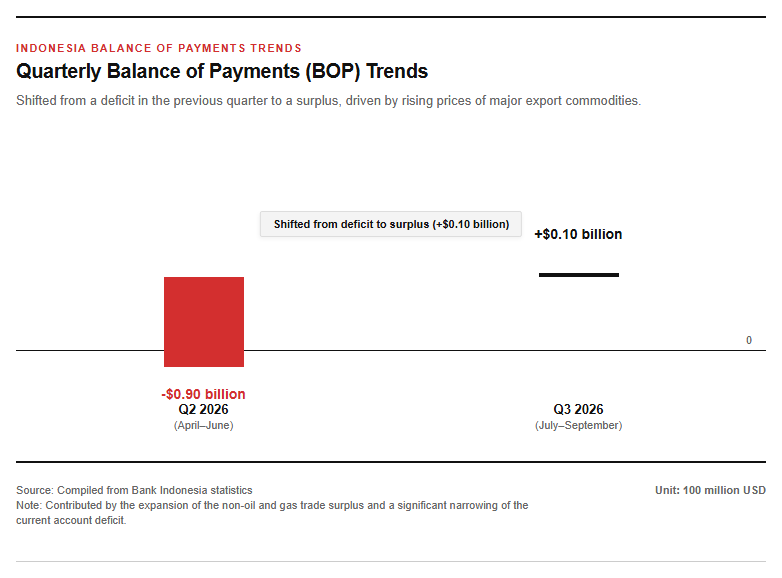
According to statistics released by Bank Indonesia, the balance of payments (BOP) recorded a surplus of $10 million in the third quarter (July–September) of 2026. This represents a significant recovery from the $900 million deficit in the previous quarter (April–June 2026), demonstrating that the country’s external economic resilience has been well maintained. Ramdan Deny Prakoso, Executive Director at Bank Indonesia, cited the narrowing of the current account deficit and the improvement in the non-oil and gas trade balance as the primary drivers of this turnaround into a surplus. Even amid ongoing global economic uncertainty, the country’s external position has demonstrated resilience, making a major contribution to macroeconomic stability. Please refer to the figure below for overall balance trends.
Improvement in the Trade Balance Driving the Narrowing of the Current Account Deficit
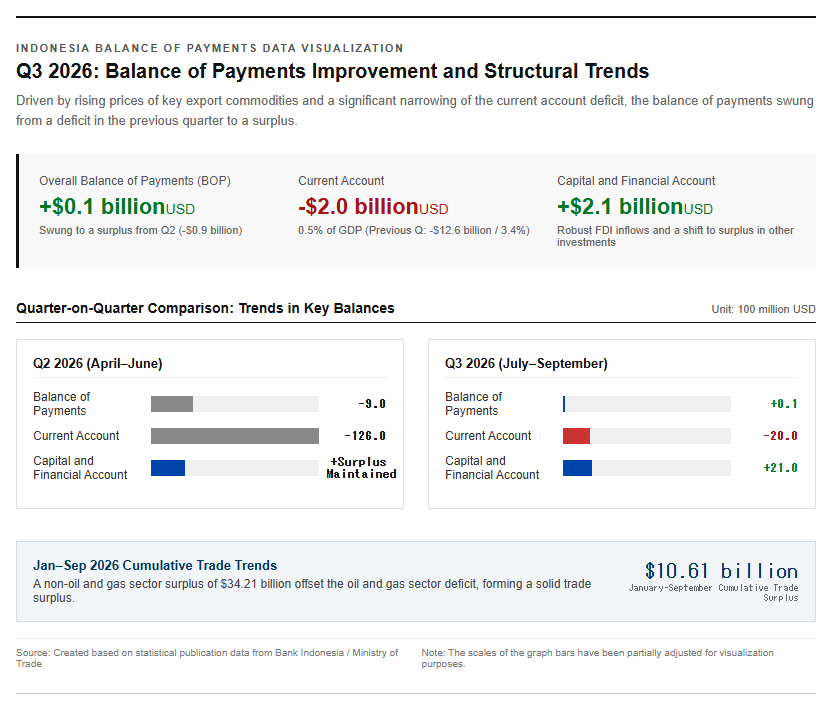
The current account deficit narrowed to $2 billion in the third quarter of 2026, remaining at just 0.5% of gross domestic product (GDP). This marks a rapid improvement from the substantial deficit of $12.6 billion (3.4% of GDP) in the previous quarter. Driving this dramatic improvement was strong non-oil and gas exports against the backdrop of rising major commodity prices in international markets. According to an announcement by Trade Minister Budi Santoso, the cumulative trade surplus from January to September 2026 reached $10.61 billion, with a $34.21 billion surplus in the non-oil and gas sector comfortably offsetting the deficit in the oil and gas sector. Furthermore, the narrowing of the oil and gas trade deficit through restrained crude oil imports, the improvement in the services account deficit driven by an increase in foreign tourists, and a decrease in return payments on foreign investments also contributed to boosting the current account.
Structure of the Capital and Financial Account and Market Environment
Steady Inflows of Foreign Direct Investment and the Return to a Surplus in Other Investments
The capital and financial account maintained a surplus of $2.1 billion in the third quarter of 2026. Although the surplus margin narrowed slightly compared to the previous quarter, it was underpinned by Foreign Direct Investment (FDI) continuing to record a steady net inflow, reflecting the country’s favorable economic outlook and investment climate. Additionally, the other investment sector turned from a deficit in the previous quarter to a surplus, aided by the repatriation of overseas deposits and cash by Indonesian residents. The entrenchment of long-term industrial investment in manufacturing and resource processing sectors acts as a buffer against short-term shocks. Please refer to the figure below for structural changes in capital flows.
Uncertainty in Global Financial Markets and Capital Outflows in Portfolio Investment
Meanwhile, the portfolio investment sector experienced leading capital outflows, recording a net deficit. This was driven by a strengthening risk-off sentiment in global financial markets, amid expectations regarding the U.S. Federal Reserve’s policy interest rates and rising geopolitical tensions in the Middle East. As a result, foreign investors temporarily withdrew funds from domestic bond and stock markets. Dr. Riyadi Dhatu Winaldi, an economist at Gadjah Mada University (UGM), pointed out that while short-term capital outflows are a factor driving fluctuations in the balance of payments, the country’s fundamentals remain sound, making consistent policy management to boost market confidence essential.
Strengthening External Resilience and Medium- to Long-Term Economic Outlook
Accumulation of Foreign Exchange Reserves and Defense Capabilities Against External Shocks
Indonesia’s foreign exchange reserves reached $146.3 billion as of the end of September 2026. This level of foreign exchange reserves is equivalent to 5.4 months of import payments, or 5.2 months of import payments and government external debt service. This significantly exceeds the international adequacy benchmark of 3 months, serving as a robust shield underpinning the country’s external payment capacity and financial system stability. Bank Indonesia maintains its defense capabilities against external shocks by utilizing “triple intervention” across the spot market, domestic non-deliverable forward (DNDF) market, and government bond market, as well as Bank Indonesia Rupiah Securities (SRBI), to curb excessive rupiah exchange rate volatility.
Results of the Resource Nickel Policy, Future Economic Outlook, and Key Focus Areas
Factors supporting medium- to long-term growth include the export ban on unprocessed nickel ore and the domestic downstreaming (value-addition) policy promoted since 2020. The promotion of investment in resource processing industries has increased exports of high-value-added products, leading to a continuous trade surplus and expanding government revenues. Key focus areas moving forward include the risk of volatility in global natural resource prices, demand trends in major trading partners, and the maintenance of exchange rate stability. Under strong policy coordination between the government and the central bank, exploring exports to non-traditional markets and deepening the domestic financial market are expected to lead to sustainable economic growth and further strengthening of external resilience.
Reference Page
- [Bank Indonesia Press Release – Indonesia’s Balance of Payments Records Surplus in Q3 2026]https://www.bi.go.id/en/publikasi/ruang-media/news-release/Pages/sp_2825526.aspx
- [Bank Indonesia – Indonesia’s Balance of Payments Report Q3/2026]https://www.bi.go.id/id/publikasi/laporan/Pages/NPI_Tw-III_2026.aspx
- [Center for Economic Transition Expertise (CETEx) – Indonesia Ban on Exports of Raw Nickel]https://cetex.org/wp-content/uploads/2026/03/Indonesia-Ban-on-Exports-of-Raw-Nickel-1.pdf
[#IndonesianEconomy #BalanceOfPayments #TradeSurplus #CurrentAccount #BankIndonesia #ForeignExchangeReserves #Macroeconomics #EmergingMarkets]


コメント