
In November 2026, DPVR officially announced the “DPVR P1 Max Eye,” an enterprise-grade VR headset supporting binocular eye tracking at up to 220Hz. This launch is driven by a sharp surge in demand for high-precision gaze data analysis and immersive training in corporate medical and training environments.
- 1-1. Specifications and Features of the 220Hz Binocular Eye Tracking Technology
- 1-2. Hardware Design and Basic Specifications Supporting Long-Term Operation
- 2-1. Specific Use Cases in Medical Care, Training, and Research
- 2-2. Security Risks and Countermeasures Associated with Enterprise Adoption of AR/VR Devices
- 3-1. Growth Trends and OEM Deployment in the Standalone VR Market
- 3-2. Challenges in Enterprise XR Technology and Future Directions for Evolution
1-1. Specifications and Features of the 220Hz Binocular Eye Tracking Technology
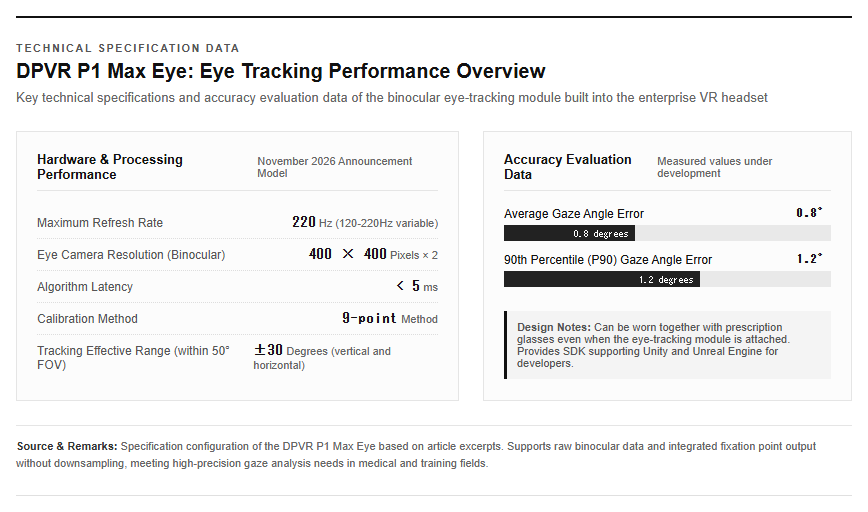
In November 2026, DPVR officially announced the “DPVR P1 Max Eye,” a model equipped with binocular eye tracking supporting a high refresh rate of up to 220Hz. The device features two 400×400-pixel eye cameras that individually capture the left and right eyes, along with a multi-light source module, capable of outputting real-time gaze data from 120Hz to 220Hz in the current firmware. Without downsampling the user’s gaze data, it can be acquired as raw data for each eye as well as a combined fixation point.
Algorithm latency is kept under 5ms, and by performing a 9-point calibration, it achieves precise tracking of 30 degrees each vertically and horizontally (within an evaluation range of 50-degree FOV) based on the optical axis. According to measurement data under development, it achieves high accuracy with an average gaze angle error of 0.8 degrees and a 90th percentile (P90) gaze angle error of 1.2 degrees. For developers, SDKs supporting Unity and Unreal Engine are provided, making it easy to incorporate advanced gaze analysis logic and intuitive gaze interactions into proprietary applications. Furthermore, the design allows users to wear prescription glasses directly even while the eye tracking module is attached, paying careful attention to practicality.
Please refer to the following image.
1-2. Hardware Design and Basic Specifications Supporting Long-Term Operation
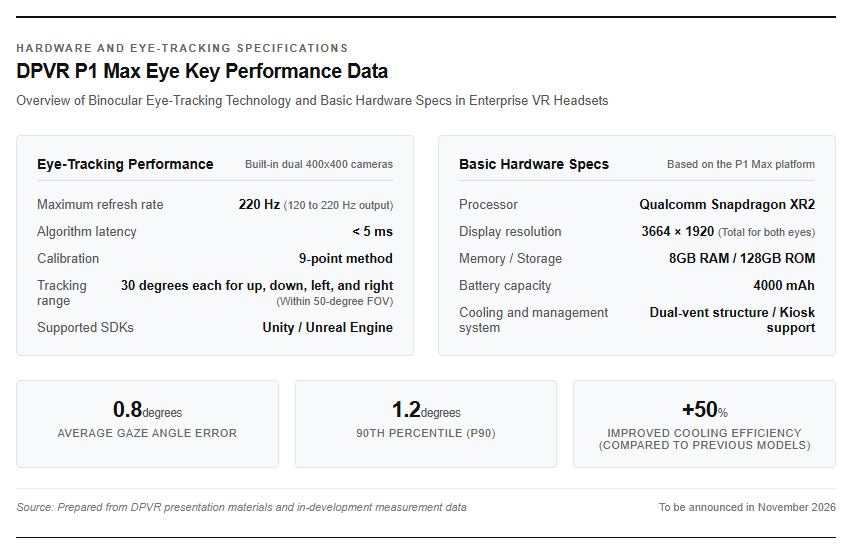
The DPVR P1 Max Eye inherits the excellent hardware foundation of the “DPVR P1 Max” enterprise all-in-one VR headset. It adopts the Qualcomm Snapdragon XR2 platform as its processor and supports decoding of up to 8K HD video. The display resolution is high-definition at a combined 3664×1920 for both eyes, and it comes standard with 8GB of RAM, 128GB of ROM, and a large-capacity 4000mAh battery. For communication, it is equipped with Wi-Fi 6 and a USB-C port, realizing fast and stable connections.
To withstand environments such as training facilities and VR arcades where large numbers of people use devices continuously, it is equipped with an active cooling system featuring a dual-vent structure with intake and exhaust vents on the top and bottom of the main unit, improving cooling efficiency by 50 percent compared to conventional models. For power management, it features a direct power supply DC port on the top of the main unit, supporting durable steel-sleeve cables in addition to standard cables. On the software side, it supports a kiosk mode that launches only specific applications and disables system menus, and integration with MDM (Mobile Device Management) tools such as ManageXR and ArborXR is also possible.
Please refer to the following image.
2. Application Domains and Security as an Enterprise and Professional Solution
2-1. Specific Use Cases in Medical Care, Training, and Research
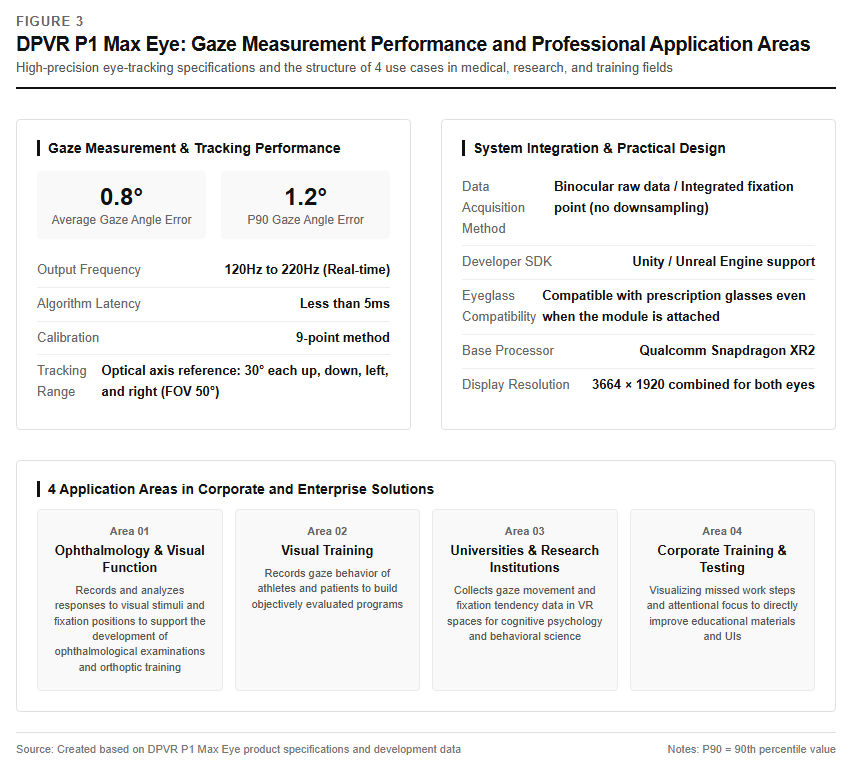
The high-precision gaze measurement capabilities provided by the DPVR P1 Max Eye deliver extraordinary effects primarily across four specialized fields. The first is “Ophthalmology and Visual Function-Related Solutions.” By recording and analyzing patient responses and fixation positions to visual stimuli presented within the VR space, it contributes to the development and verification of ophthalmological examinations and orthoptic training applications. The second is the “Visual Training” field, where programs can be built to record and objectively evaluate the gaze behavior of athletes and patients.
The third is “Research at Universities and Research Institutions.” By collecting data on human gaze movement and fixation trends in VR environments, advanced data analysis in cognitive psychology and behavioral science becomes possible. The fourth is utilization in “Corporate Training and User Testing.” By visualizing where trainees or test subjects direct their attention and where oversights occur during work procedures in manufacturing or medical settings, it can be directly applied to improving educational materials and user interfaces.
Please refer to the following image.
2-2. Security Risks and Countermeasures Associated with Enterprise Adoption of AR/VR Devices
While the corporate adoption of AR/VR devices is expanding, security measures for biometric data and environmental data collected by advanced sensors have become an urgent task. In particular, gaze data obtained through eye tracking is highly confidential information that can reveal an individual’s personal interests, psychological state, and health condition, and requires strict protection to prevent external leaks. Furthermore, the leakage of 3D room mapping data of offices or internal camera footage created by devices carries the risk of leading to breaches of a company’s facility structure and confidential information.
To address these challenges, companies need to thoroughly enforce communication path encryption (such as WPA3) and implement segmentation (network isolation) such as IoT-dedicated VLANs isolated from the core network. Furthermore, it is recommended to introduce MDM tools to establish a management system for remote data wiping, application whitelisting, and mandatory firmware updates. Incorporating the concept of “Security by Design”—embedding security from the initial stages of implementation—is the key to success.
3. Trends and Future Outlook of the Expanding Enterprise VR Market
3-1. Growth Trends and OEM Deployment in the Standalone VR Market
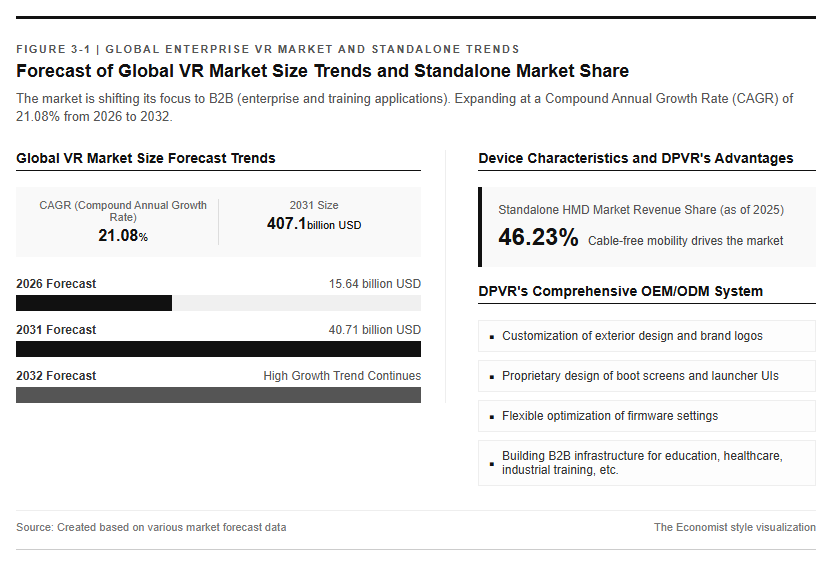
The global VR market is rapidly shifting its focus from consumers to enterprise productivity enhancement and training applications. According to market forecasts, the global VR market size is expected to grow at a compound annual growth rate (CAGR) of 21.08 percent from 15.64 billion USD in 2026 toward 2032, reaching a scale of 40.71 billion USD in 2031. Driving this growth are standalone (all-in-one) HMDs, which allow movement without the constraints of cables and accounted for 46.23 percent of market revenue as of 2025.
A major strength of DPVR lies in its comprehensive OEM/ODM customization framework, making it the only major VR manufacturer equipped with such capabilities. It supports flexible customization tailored to client companies’ requests, ranging from the device’s exterior design, brand logo, startup screen, and launcher UI to firmware settings. Rather than simply supplying hardware devices, it is chosen as a partner to build companies’ proprietary VR service infrastructures, with adoption progressing across a wide range of B2B fields such as education, healthcare, industrial training, and exhibition amusement facilities.
Please refer to the following image.
3-2. Challenges in Enterprise XR Technology and Future Directions for Evolution
While great expectations are held for the future of enterprise XR technology, there are also technical and institutional challenges that must be overcome. In utilizing high-precision eye-tracking data, the increasing cost of security compliance—such as data anonymization and strict opt-in management to comply with biometric data privacy regulations represented by Europe’s GDPR—has become an issue. Additionally, heat accumulation associated with prolonged continuous wear and improving the comfort of the eye box are areas that continue to require technological innovation.
Going forward, alongside the evolution of next-generation processors from companies like Qualcomm, untethered low-latency cloud streaming technology leveraging 5G and edge computing is expected to become widespread. This will advance the weight reduction and cost lowering of the headset itself, making large-scale enterprise deployments that distribute devices to all on-site workers increasingly realistic. Through the fusion of AI and XR, predictive interactions using gaze data and high-precision digital twin integration are set to evolve, establishing XR as a key technology that accelerates corporate digital transformation (DX).
Reference Pages
- [DPVR Official Website] https://www.dpvr.com/en/
- [DPVR P1 Max Eye Press Release (PR TIMES)] https://prtimes.jp/main/html/rd/p/000000033.000078259.html
[#VR #DPVR #EyeTracking #P1MaxEye #EnterpriseVR #XRTechnology #Security #BiometricData]


コメント