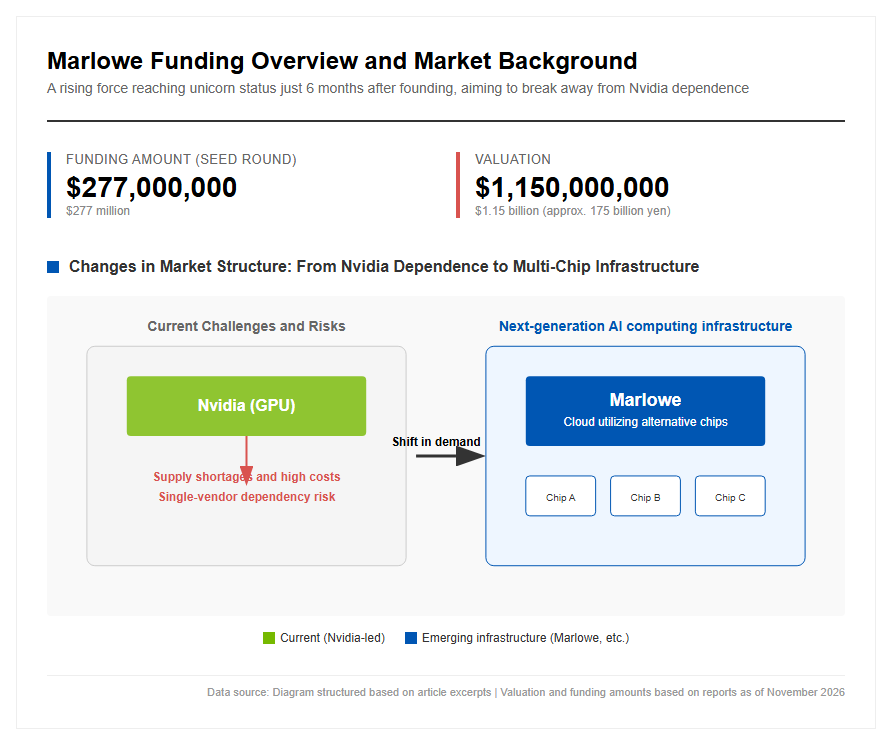
Marlowe, an AI startup co-founded by two former Microsoft vice presidents, has raised $277 million in funding. Amid growing demand for cloud computing infrastructure that utilizes AI chips other than those from dominant leader Nvidia, the company has achieved a valuation of $1.15 billion just six months after its founding.
- Key points of the large-scale funding round achieving a .15 billion valuation in 6 months of operation
- A powerhouse founding team led by former Microsoft vice presidents and an elite group of investors
- A non-Nvidia multi-chip platform in collaboration with AMD and Etched
- Construction of proprietary data centers and financial support packages for customers
- Surge in Inference Demand and the Shift Toward Custom Silicon and ASICs
- Challenges in Building a Post-Nvidia Ecosystem and Key Points to Watch
Key points of the large-scale funding round achieving a .15 billion valuation in 6 months of operation
In November 2026, it was revealed that Marlowe, an AI startup only six months old, completed a massive $277 million seed round. This funding has propelled the company’s valuation to unicorn status at $1.15 billion (approximately 175 billion yen). The round was led by major venture capital firm Accel, representing an unprecedented scale for an early-stage investment. This development is driven by rapidly increasing expectations for startups providing alternative computing infrastructure, as market participants become increasingly aware of the risks associated with Nvidia’s monopoly, including GPU supply shortages, high costs, and single-vendor dependency. The success of this funding round strongly suggests that investment activities aimed at “de-Nvidia-ization” in the next-generation AI infrastructure sector are entering full swing. The following figure illustrates the composition of the funding overview.
A powerhouse founding team led by former Microsoft vice presidents and an elite group of investors
Marlowe’s strong growth expectations are supported by an extremely experienced management team and a prestigious lineup of investors. The founding members, including co-founder and CEO Dan Lewis, include two top-tier industry executives who served as vice presidents at Microsoft. In addition to Accel, which led the seed round, prominent VCs such as Bessemer Venture Partners, Altimeter Capital Management, Atreides Management, Valor Ventures, and Neo have all participated. Furthermore, a robust structure has been built both in terms of capital and management, featuring a new investment vehicle from the Collison brothers—founders of the payment giant Stripe—and the appointment of Lior Susan, CEO of Eclipse (which led an earlier round), as Executive Chairman.
Technical strategy and business model to realize an “anti-Nvidia” approach
A non-Nvidia multi-chip platform in collaboration with AMD and Etched
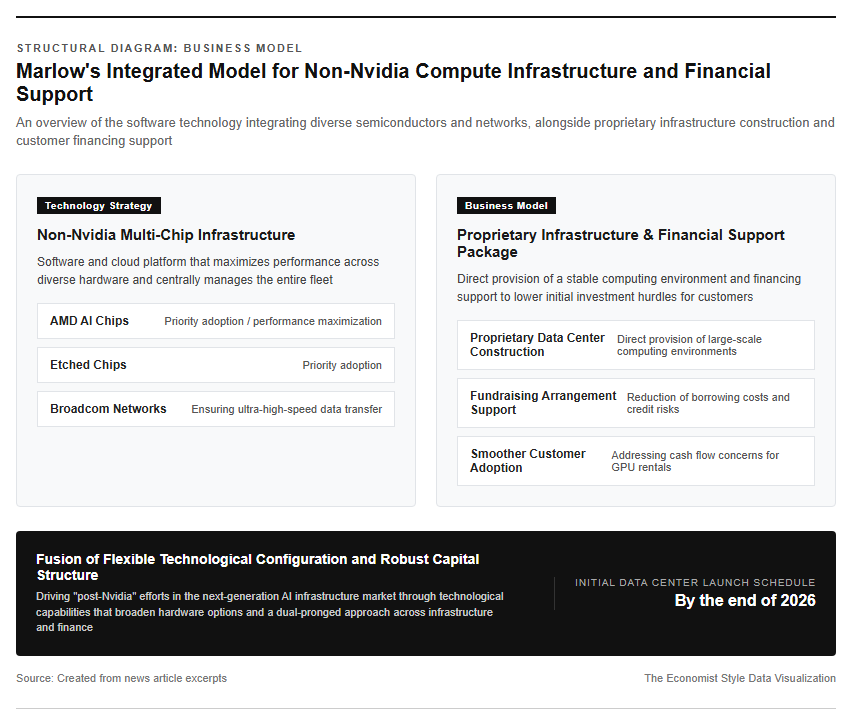
The core of Marlowe’s business lies in the development of software technology and cloud computing capabilities designed to efficiently run AI accelerators and processors other than Nvidia’s. Specifically, the company provides a platform that maximizes the performance of an entire fleet of semiconductors and centrally manages complex computational resources. The company has announced that its initial supported chips will prioritize AMD’s AI chips and semiconductors from Etched, an emerging chip company whose clients include financial giant Jane Street. Furthermore, it is adopting Broadcom products—which are co-developing AI chips that compete with Nvidia—for networking equipment to ensure ultra-high-speed data transfer. Marlowe’s strength lies in its flexible technical configuration, which addresses requests from client companies looking to “maximize the performance of the AMD chips they already own.”
Construction of proprietary data centers and financial support packages for customers
Marlowe is going beyond mere software development and has begun the direct construction of its own data center infrastructure. The first data center facility is planned to become operational by the end of 2026, with a policy to provide customers with a stable, large-scale computing environment. Additionally, a unique aspect of the company’s business model is its “assistance in arranging financing” when customers implement AI infrastructure. Currently, the cost of borrowing and credit risks associated with deploying expensive AI servers have become significant challenges, and the deteriorating cash flow of GPU rental companies is a concern for the entire industry. By directly supporting the arrangement of financing necessary for equipment deployment, Marlowe has built a mechanism that allows client companies to lower the hurdle of initial investment and smoothly implement computing resources. The following figure shows the integrated model of computing infrastructure and financial support.
Structural changes in the AI semiconductor market and future industry outlook
Surge in Inference Demand and the Shift Toward Custom Silicon and ASICs
Marlowe’s rise is deeply linked to the tectonic shifts occurring across the entire AI semiconductor market. As the focus of AI technology shifts from the “training” of large language models to “inference”—the actual operation of services—demand for specialized chips (ASICs and non-GPU processors) with superior power efficiency and cost-performance is surging. The shipment growth rate for custom ASICs is projected to reach 44.6% year-on-year in 2026, significantly outperforming the 16.1% growth rate of general-purpose GPUs. Additionally, companies adopting RISC-V, such as Tenstorrent, as well as specialized chip sets like Broadcom and Google’s TPU, are gaining market share, ushering in an era where diverse silicon architectures coexist alongside market expansion. Moves to mitigate the risk of excessive concentration in Nvidia’s dominance are driving the rapid growth of alternative markets.
Challenges in Building a Post-Nvidia Ecosystem and Key Points to Watch
For Marlowe to achieve sustainable growth, it must overcome several critical challenges. First, the company will be tested on whether it can provide a development environment that is equal to or better than the robust software ecosystem, exemplified by Nvidia’s “CUDA,” which has been cultivated over many years. No matter how superior an alternative chip may be, if software optimization or migration costs are high, customer adoption will remain limited. Second, the speed at which the scale of operations in its own data center (scheduled to be operational by the end of 2026) expands, and the maintenance of a stable supply chain, will be key. Furthermore, as Nvidia itself is reviewing customer financial guarantees and strengthening governance, how the competitive and co-existence relationships with major tech companies and hyperscalers evolve will be closely monitored. The key point to watch moving forward will be whether Marlowe can prove its effectiveness as an alternative AI foundation.
Reference Page
- 【Marlowe Raises $277 Million for Nvidia Chip Alternatives – Bloomberg】https://www.investing.com/news/stock-market-news/marlowe-raises-277-million-for-nvidia-chip-alternatives–bloomberg-93CH-5045596
【#AISemiconductors #Marlowe #Fundraising #Nvidia #Startup #SemiconductorMarket #EconomicNews #CloudInfrastructure】


コメント