
Amazon.com has agreed to acquire AI chip optimization software technology and the R&D team from AI startup Decart for approximately $7.5 billion. The move aims to enhance the processing efficiency of Amazon’s proprietary AI chips and strengthen its competitiveness in the AI semiconductor market dominated by NVIDIA.
- The terms of the .5 billion acquisition and its unusual structure
- The advanced capabilities of the Decart Optimization Stack bridging heterogeneous chips
- Challenging NVIDIA’s monopoly and plans for external sales of proprietary silicon
- Amazon stock price favorably received amid fierce competition among tech giants
- The Trend of Vertical Integration and AI Software Acquisitions by Cloud Vendors
- Antitrust and Competition Law Regulations and Points to Watch
The terms of the .5 billion acquisition and its unusual structure
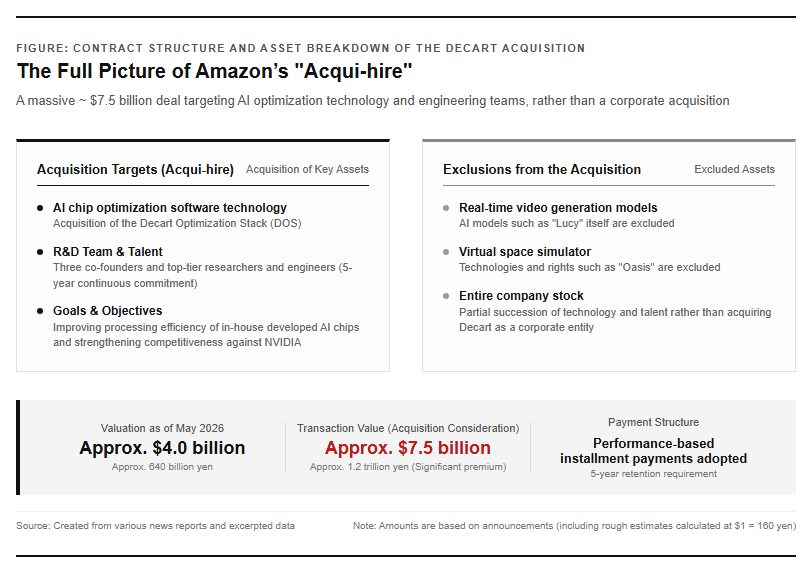
On November 23, 2026, Amazon.com agreed to acquire Israel-based AI startup Decart’s AI optimization software technology, the “Decart Optimization Stack” (DOS), and to bring its co-founders and team of researchers and engineers on board. According to reports, the transaction value is expected to reach approximately $7.5 billion (approx. 1.2 trillion yen). Rather than acquiring the entire company through a stock purchase, the deal takes the form of an “acqui-hire,” targeting key technical assets and talent. AI models developed by the company, such as the real-time video generation model “Lucy” and the virtual space simulator “Oasis,” are excluded from the acquisition. The three co-founders—CEO Dean Leitersdorf, CSO Orian Leitersdorf, and Moshe Shalev—have committed to staying at Amazon for the next five years, with a substantial portion of the consideration structured as performance-linked installment payments. Decart was valued at approximately $4.0 billion (approx. 640.0 billion yen) in its funding round as of May 2026, meaning this transaction commanded a significant premium. Please refer to the figure below.
The advanced capabilities of the Decart Optimization Stack bridging heterogeneous chips
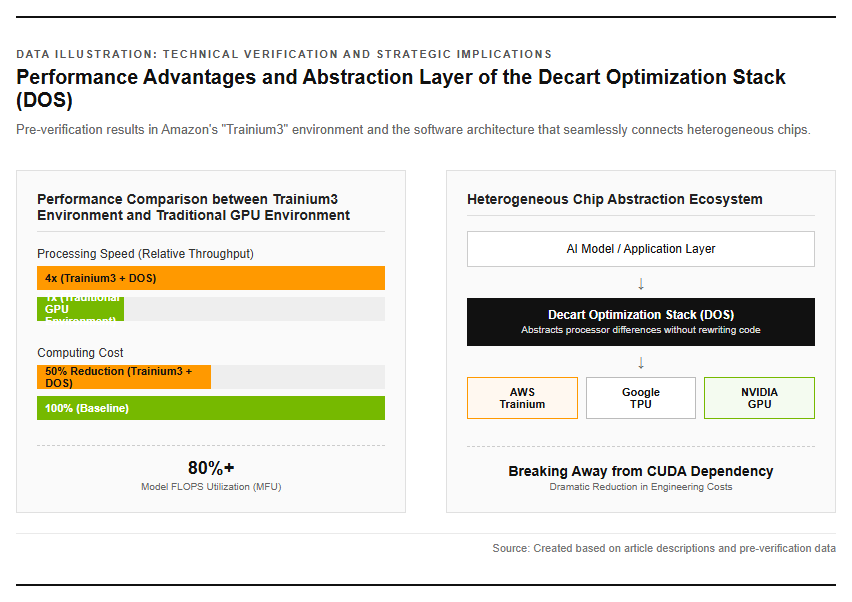
Developed by Decart, the “Decart Optimization Stack” (DOS) is a software engine that dramatically improves computational efficiency in AI training and inference processing. Its primary feature is the ability for developers to flexibly switch and migrate workloads between hardware from different semiconductor manufacturers—such as NVIDIA GPUs, Google TPUs, and Amazon’s proprietary AI chip “Trainium”—without significantly rewriting the AI model’s program code. Traditionally, AI model development has been heavily dependent on NVIDIA’s CUDA software development environment, requiring enormous engineering costs and time when migrating from one GPU supplier to another. Decart’s optimization technology abstracts these chip-level differences, making it possible to maximize processor compute capacity. In preliminary testing with Amazon, running Decart’s technology on the third-generation proprietary AI chip “Trainium3” reportedly achieved four times the processing speed at half the cost compared to equivalent graphics processing unit (GPU) environments, with Model FLOPS Utilization (MFU) exceeding 80%.
Strategic implications for Amazon and the semiconductor market
Challenging NVIDIA’s monopoly and plans for external sales of proprietary silicon
Amazon’s massive $7.5 billion investment to secure Decart’s technical assets is driven by a strategy to curb AI semiconductor procurement costs in its cloud infrastructure business (AWS) and counter NVIDIA’s market monopoly. Currently, NVIDIA GPUs hold the vast majority of the global market share in infrastructure for large language models and generative AI, and soaring semiconductor procurement costs have become a pressure point on profitability for hyperscalers. Since acquiring Israeli semiconductor design firm Annapurna Labs for approximately $350 million in 2015, Amazon has promoted the development of custom chips, announcing products such as “Trainium3,” which utilizes the latest 3-nanometer process. CEO Andy Jassy has explicitly stated plans to expand the business of selling Trainium chips directly to external companies, rather than limiting their use to Amazon’s own data centers. By integrating Decart’s optimization stack as an in-house tool, Amazon will create an environment where customer companies can easily transition from an NVIDIA environment to Amazon hardware, significantly boosting the value of its proprietary chip ecosystem. Please refer to the figure below.
Amazon stock price favorably received amid fierce competition among tech giants
Following this announcement, Amazon.com (AMZN) shares rose by approximately 4% in the U.S. stock market on November 23, 2026. Market investors positively evaluated the deal as a move that will lead to improved gross margins in the cloud business (AWS) and enhanced competitiveness in AI infrastructure. In fact, regarding the acquisition of Decart, a fierce bidding war involving multiple tech giants had unfolded over several months. In August 2026, AI startup Anthropic advanced acquisition negotiations for about $6 billion, reaching the final stages of due diligence before withdrawing from talks in early September. Additionally, Nvidia, an early investor, had also held preliminary discussions toward an acquisition. Ultimately, Amazon reached an agreement by offering approximately $7.5 billion—an increase of about 87.5% from Decart’s valuation of roughly $4 billion in May 2026. The reason Amazon went ahead with a price level that other companies abandoned is believed to be that acquiring the software layer, which dictates the adoption of its proprietary “Trainium” chips, was essential to its long-term growth strategy.
Industry Restructuring and Medium-to-Long-Term Outlook and Challenges
The Trend of Vertical Integration and AI Software Acquisitions by Cloud Vendors
Decart’s technology acquisition is positioned as part of a massive trend among major global technology companies toward the “vertical integration of AI hardware and software.” This is because the importance of software technology that extracts the utmost capability from semiconductor hardware—rather than just improving chip-level performance alone—is surging rapidly. Looking at the moves of competitors, Meta Platforms acquired a 49% stake in Scale AI for approximately $14.3 billion, and AMD agreed to acquire World Labs for $8.2 billion in September 2026, marking a succession of M&As aimed at bringing AI models and optimization tools into their own camps. While Amazon has also pursued aggressive M&As, such as acquiring satellite communications provider Globalstar for $11.5 billion and film studio MGM for $8.4 billion, this Decart transaction represents one of the largest investments in the company’s history within the AI infrastructure sector. Establishing a vertical integration model that consistently delivers everything from hardware manufacturing and optimization compilers to cloud platforms and the application layer in-house will be a crucial factor determining the winners and losers among Big Tech moving forward.
Antitrust and Competition Law Regulations and Points to Watch
Amazon’s acquisition of Decart’s technology and the onboarding of its core team come with several hurdles and points of focus to clear in future developments. The first challenge is antitrust scrutiny by regulatory authorities in various countries, such as the U.S. Federal Trade Commission (FTC) and the Department of Justice. Pre-merger reviews of startup acquisitions and “acqui-hire” talent acquisition formats by tech giants have been tightening worldwide, and it will be scrutinized whether this transaction impedes fair market competition. The second point of focus is whether the openness of the multi-chip optimization technology previously provided by Decart will be maintained or if it will be locked into the AWS environment exclusively. How compatibility with existing Decart customers like eBay and chips from other companies will be handled remains unannounced. Thirdly, attention will also be paid to whether Nvidia will step in to strengthen its software layer or alter its pricing strategy to maintain the superiority of its ecosystem. From the second half of 2026 onward, how far Amazon’s proprietary chip sales business expands and what changes it brings to market share will be the focus of the market.
Reference Pages
- [Amazon Newsroom] https://www.aboutamazon.com/news/company-news/amazon-decart-ai-optimization
[#Amazon #Decart #AISemiconductors #Trainium #AWS #Nvidia #MAndA #ITEconomy]


コメント