DeNA has announced the external availability of “AI Shain by DeNA” (AI Employee by DeNA), an autonomous AI agent, introducing a groundbreaking system that manages token consumption as working hours and overtime limits. This stems from the limitations of conventional AI use confined to individual accounts, as well as the need to maintain organizational governance and restructure business workflows.
- The Emergence and Features of AI Employees Working as Team Members
- Adoption Effects and Business Performance Proven through In-House Verification
- The Limits of AI Utilization Restricted to Individual Tools and Organizational Challenges
- Security and Approval Design for Human-AI Coexistence
- Transforming into an AI-Native Organization Through Workflow Restructuring
- Current Status and Future Highlights of the Domestic Market
The Emergence and Features of AI Employees Working as Team Members
On November 20, 2026, DeNA Co., Ltd. announced the external enterprise release of “AI Shain by DeNA,” an autonomous AI agent service that can be assigned and trained as a member of an organization. Pre-registration began in November 2026. The most prominent feature of this service is that, unlike traditional generative AI used as a tool via specific individual accounts, it is integrated into the organization as an independent colleague with its own unique account, name, email address, and departmental affiliation.
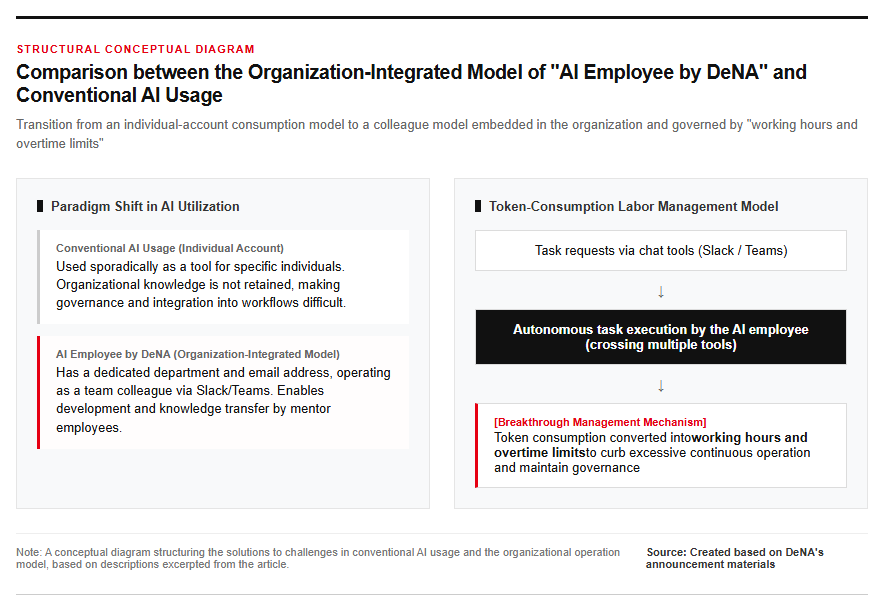
Users can assign tasks via chat tools they use daily, such as Slack and Microsoft Teams, with the same casual feel as speaking to a human colleague. The AI employee autonomously carries out internal information searches, summarizes logs, executes regular tasks, and creates tickets across multiple business tools. Furthermore, a new operational model has been adopted where token consumption in generative AI use is converted into human working hours, setting and managing overtime limits as a mechanism to curb excessive continuous operation. During onboarding, an employee mentor guides the AI through business procedures and rules for training, ensuring that business knowledge is retained and passed down within the organization even if the person in charge is transferred or leaves the company. The figure below illustrates the operational concept of an AI employee.
Adoption Effects and Business Performance Proven through In-House Verification
Within DeNA, 30 AI employees have already been assigned to actual business departments and are handling hands-on operations. Their assignments span a wide range of areas, including matching applications, estimates, and asset management ledgers in the purchasing department; initial incident response and investigation in the infrastructure department; issuing estimates and contract drafts in the sales department; and verification work in the IT quality assurance department.
As a concrete example of success, an AI employee assigned to an accounting system development and maintenance team handled actual work equivalent to a total of 52.6 hours over 8 business days following its training. This calculates to the AI employee taking over approximately 80% of an 8-hour workday, allowing human team members to reallocate the saved time to high-level decision-making tasks such as system design reviews and coordination with related departments.
When providing the service to adopting companies, DeNA handles infrastructure construction, initial setup, and post-deployment training support, establishing a system where even companies without specialized AI engineers in-house can easily onboard AI employees through a process similar to hiring a new graduate.
Challenges in Conventional AI Utilization and Governance Design
The Limits of AI Utilization Restricted to Individual Tools and Organizational Challenges
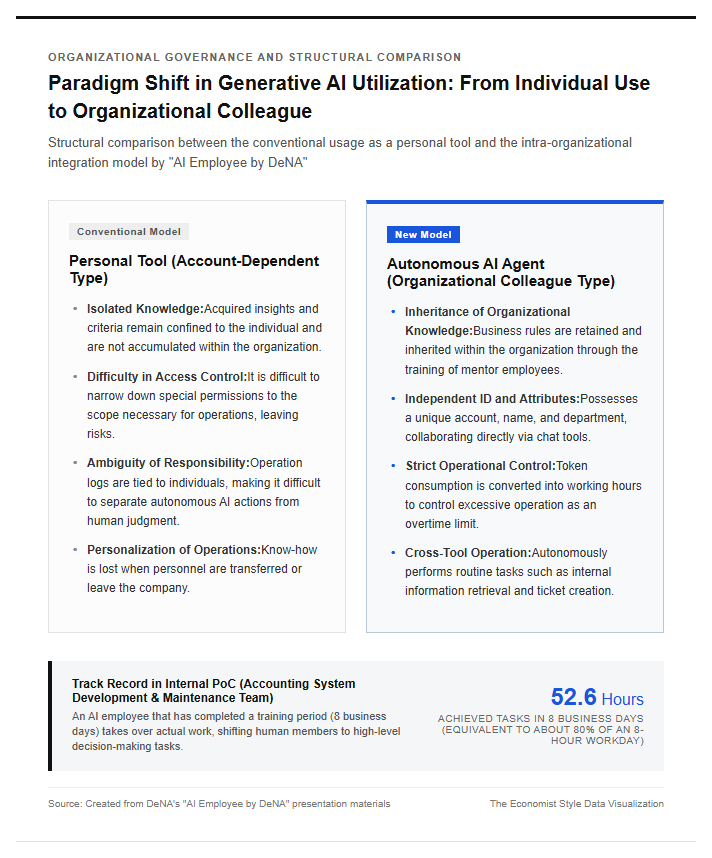
While the business use of generative AI is progressing in many companies, its utilization style often remains limited to individual tools dependent on employee accounts. When using AI via individual accounts, the judgment criteria, context, and know-how acquired by the AI through business activities remain trapped within the individual, creating a structural challenge where knowledge is not accumulated as an organizational asset.
Additionally, operating AI through individual accounts makes it difficult to narrow down permissions to only the scope necessary for the tasks at hand, easily creating risks in terms of security and access control. Furthermore, because all system operation logs are recorded as operations by the respective individual employee, it has been a barrier to enterprise adoption that in the event of a trouble, it is impossible to accurately determine whether it was caused by the AI’s autonomous operation or human instruction and judgment.
To break away from this situation of mere individual efficiency and rebuild the entire organization while exerting corporate governance, a system was developed to grant AI its own ID and affiliation. To understand the framework of integrating AI into the overall business workflow, the following structural diagram serves as a reference.
Security and Approval Design for Human-AI Coexistence
In the operation of AI employees, strict governance designs are implemented to ensure safety and transparency. AI employees are granted only the minimum access privileges necessary for their assigned tasks, and all system operations are thoroughly logged via unique IDs. This clearly ensures the traceability of human operations versus AI actions.
A dry-run function is implemented to prevent operational errors, and a process is built in where, if faced with tasks exceeding their granted permissions, AI employees consult humans and seek approval. For judgments involving legal and managerial responsibilities—such as contract execution, final purchase order approval, and employment screening judgments—a Human-in-the-Loop design where humans are always involved is strictly enforced.
Regarding data protection, customer data is not reused for training AI models without the adopting company’s consent, and is designed to be completely deleted upon contract termination as needed, thereby meeting legal compliance requirements.
DX Promotion and Future Outlook for Japanese Companies
Transforming into an AI-Native Organization Through Workflow Restructuring
DeNA has announced a company-wide “AI All-In” initiative, moving beyond simply applying AI tools to existing business processes to restructure entire workflows under the premise of AI’s existence. This is based on the insight that merely adding AI to traditional operational procedures only slightly reduces individual working hours and does not lead to dramatic productivity improvements or structural reform across the organization as a whole.
Management has outlined a policy to maintain and develop existing business operations with half the traditional headcount, reallocating the resulting capacity to new businesses and growth areas. The primary objective of this initiative is not simply cost-cutting or subtractive efficiency, but rather establishing an organizational structure capable of generating major innovations even with small teams by increasing processing speed and the velocity of trial and error.
The AI-Native Promotion Office, a specialized promotion organization, collaborates with operational business units across the company to deploy workflow overhauls that curb man-hours by more than half in departments such as customer support, legal, and QA, while dramatically improving processing speeds.
Current Status and Future Highlights of the Domestic Market
According to an IT utilization survey conducted by Nomura Research Institute targeting major Japanese companies (September 2026 survey), 73.1% of responding companies reported that they have already implemented or are actively promoting the implementation of generative AI, and the adoption rate of AI agents has also expanded to 36.7%. On the other hand, 49.1% of companies—accounting for about half—have not set specific metrics to measure the effectiveness of generative AI implementation, making the objective verification of cost-effectiveness a key future challenge alongside the expansion of adoption.
Approaches that centrally manage AI agents—such as “AI Employee by DeNA”—using the same accounts, permissions, and operation logs as humans are drawing attention as advanced case studies that IT and governance departments can easily incorporate into internal regulations.
Moving forward, the transition is expected to progress from a mere trial phase of conversational generative AI to a full-scale operational phase that integrates AI agents—which execute tasks autonomously—into the organizational workforce. Close attention will be paid to whether a new organizational model, in which humans and AI collaborate by treating AI within the same framework as labor costs and working hours, can contribute to strengthening the competitiveness of Japanese companies.
References
- [DeNA Co., Ltd. News Release] https://dena.com/jp/news/5481/
- [AI Employee by DeNA Official Website] https://ai-shain.dena.com/
- [Nomura Research Institute News Release] https://www.nri.com/jp/news/newsrelease/20261120_1.html
[#DeNA #AIEmployee #GenerativeAI #AIAgents #BusinessEfficiency #Governance #WorkStyleReform]


コメント