
The Taiwan Stock Exchange Weighted Index surged by over 3,310 points in a single day, reclaiming the 40,000-point milestone. This was driven by a dramatic improvement in market sentiment following Jensen Huang’s return as CEO of NVIDIA, alongside short-selling restrictions and public fund expansion measures implemented by Taiwanese authorities.
- 1.1 Stock Market Reclaims the 40,000 Milestone with Record-Breaking Surge
- 1.2 Sharp Rebound of Major Semiconductor Stocks and Trading Volume Characteristics
- 2.1 Surprise Return of NVIDIA Management and Improvement in AI Investment Sentiment
- 2.2 Financial Authorities Enforce Short-Selling Restrictions and Margin Trading Relaxation
- 3.1 The Impact of Expanding the National Financial Stabilization Fund to a Scale of 1 Trillion New Taiwan Dollars
- 3.2 Structural Strengths and Future Risk Factors of Taiwan’s Semiconductor Industry
1.1 Stock Market Reclaims the 40,000 Milestone with Record-Breaking Surge
On November 24, 2026, the Taiwan Stock Exchange Weighted Index closed up 3,310.46 points (a 9.14% increase) from the previous trading day, finishing at 40,122.35 points. This single-day gain marked the largest in the history of the Taiwan stock market, rapidly reclaiming the psychological milestone of 40,000 points. Both short-covering and new buying surged across the entire market, with a total of 621 listed and OTC-traded stocks hitting their daily price limits, while 390 stocks hit their daily limits on the main exchange alone. Please refer to the figure below.
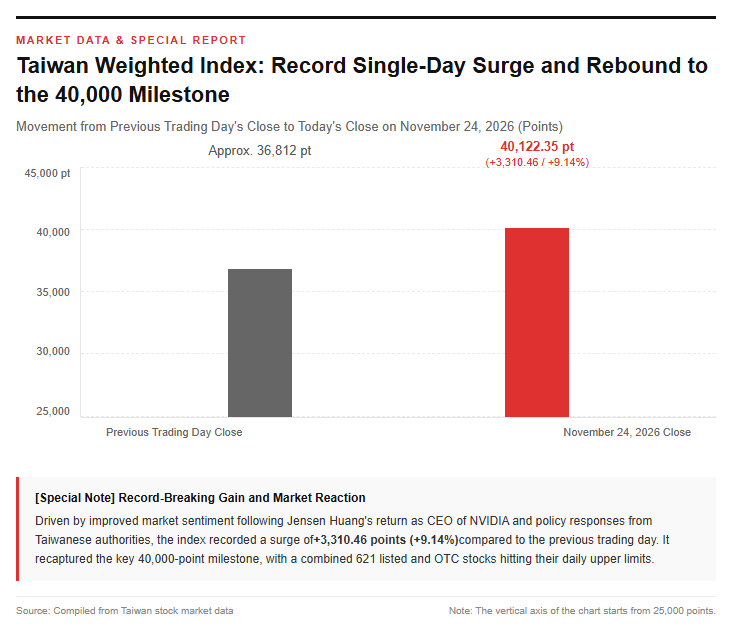
From early to mid-November 2026, the index had plunged 17.5% weekly amid doubts regarding the profitability of AI infrastructure investments and tightening US semiconductor export controls against China, causing market sentiment to deteriorate severely. However, the situation has now taken a dramatic turn for the better.
1.2 Sharp Rebound of Major Semiconductor Stocks and Trading Volume Characteristics
The surging index was powerfully driven by major semiconductor-related stocks that form the core of Taiwan’s economy. TSMC (Taiwan Semiconductor Manufacturing Company), the world’s largest foundry, saw its stock price skyrocket by 9.85% to reach 2,320 New Taiwan Dollars. Meanwhile, major foundry UMC (United Microelectronics Corporation) and major semiconductor back-end packaging and testing leader ASE Technology each surged by over 20% (21% to 23%) due to short squeezes and a reassessment of their undervaluation. Major electronics contract manufacturer Hon Hai Precision Industry (Foxconn) also gained 9.95%. On the other hand, trading volume for the day remained subdued at 419.05 billion New Taiwan Dollars (approximately 2 trillion yen), marking a record low for 2026. This indicates that while investors grew increasingly reluctant to sell their holdings, there was also capital cautious about chasing prices at these highs, resulting in an extreme tightening of market supply.
2. Background Factors Driving the Surge and Authorities’ Market Stabilization Measures
2.1 Surprise Return of NVIDIA Management and Improvement in AI Investment Sentiment
The primary trigger for the stock market’s dramatic rebound was the announcement regarding NVIDIA’s management structure. It was revealed that founder Jensen Huang would immediately return to the frontline of management as Chief Executive Officer (CEO) and President, spreading a sense of buying reassurance across the global technology market. Because Taiwan’s semiconductor supply chain directly supports the manufacturing and packaging of NVIDIA’s AI chips, buying surged from the futures market and after-hours trading. Please refer to the figure below.
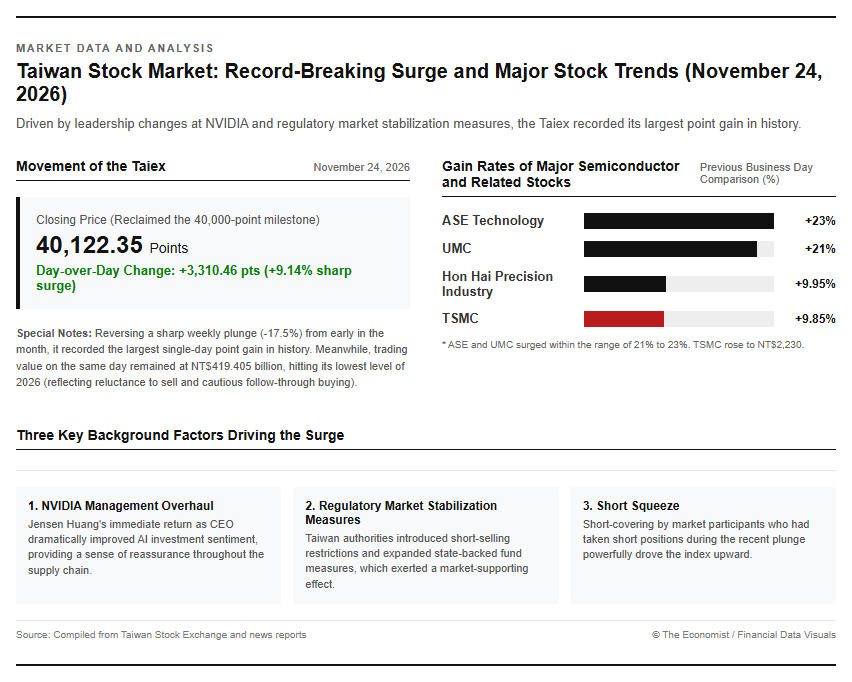
Market participants’ mindset, previously shaken by AI valuation adjustments and capital outflows to alternative investments, improved drastically, reaffirming confidence in the long-term demand for AI infrastructure.
2.2 Financial Authorities Enforce Short-Selling Restrictions and Margin Trading Relaxation
Laying the groundwork for the stock price rebound were robust market stabilization policies implemented step-by-step by Taiwan’s Financial Supervisory Commission (FSC) starting the previous week. Effective November 9, 2026, the FSC drastically reduced the daily limit for stock-lending short sales from 30% to 3% of the average trading volume over the past 30 trading days, and raised the minimum margin requirement for short selling from 90% to 130%, and further to 150%. Furthermore, it comprehensively banned short selling at or below the market price for stocks that fell the previous day as well as across all stocks, effectively capping speculative short-selling pressure. Additionally, starting November 24, the minimum maintenance margin requirement for margin trading was lowered from 130% to 120%, alleviating the pressure of margin calls and forced liquidation caused by excessive stock price declines. This reduction in the maintenance margin requirement is an emergency measure unseen since the 1998 Asian financial crisis, serving as a bulwark to prevent a chain reaction of retail investor bankruptcies.
3. Impact of the National Stabilization Fund Doubling Proposal and Future Outlook and Key Points for Taiwan’s Economy
3.1 The Impact of Expanding the National Financial Stabilization Fund to a Scale of 1 Trillion New Taiwan Dollars
In addition to institutional regulatory tightening, the Taiwanese government has signaled a strong stance to significantly bolster direct market support using public funds. Premier Cho Jung-tai of the Executive Yuan outlined a policy to double the operational scale of the National Financial Stabilization Fund (National Stabilization Fund) from the previous 500 billion New Taiwan Dollars to 1 trillion New Taiwan Dollars (approximately 4.8 trillion yen) to address sharp fluctuations in the stock market. Specifically, legal preparations are underway to raise the borrowing limit from financial institutions—secured by government-held shares and other assets—3.5 times, from 200 billion New Taiwan Dollars to 700 billion New Taiwan Dollars (approximately 3.4 trillion yen). Since its establishment in 2000, the National Stabilization Fund has intervened in the market 10 times in the past, generating a net profit in 8 of those instances, boasting a proven track record. By expanding its funding scale to the 1 trillion New Taiwan Dollar level, a powerful psychological support effect against the turbulent waves of international financial markets has been created.
3.2 Structural Strengths and Future Risk Factors of Taiwan’s Semiconductor Industry
Looking at the future market outlook, the most crucial factor is the structural advantage of Taiwan’s renowned semiconductor ecosystem. According to an analysis by Standard Chartered Bank, more than 90% of advanced process (7nm and below) semiconductor production capacity is concentrated in Taiwan, maintaining a strong competitive advantage (moat) that other countries and companies cannot easily replicate. Global AI capital expenditures are projected to grow at an average annual rate of 32% from 2025 to 2030, and the profits of Taiwanese listed companies are forecast to increase by 51% in 2026 and 28% in 2027. On the other hand, external risks such as tightened U.S. export controls against China, geopolitical tensions, and short-term fluctuations in AI demand still persist. Market caution has not been completely dispelled—evidenced by thinning trading volume even after the surge—and a cautious stance closely monitoring international affairs and earnings trends remains necessary.
Reference Page
- [Taiwan Stock Market Surges 3310 Points in a Single Day, Largest Gain in History] https://finance.biggo.jp/
[#TaiwanStocks #Semiconductors #TSMC #NVIDIA #ShortSellingRegulations #NationalStabilizationFund #EconomicNews]


コメント