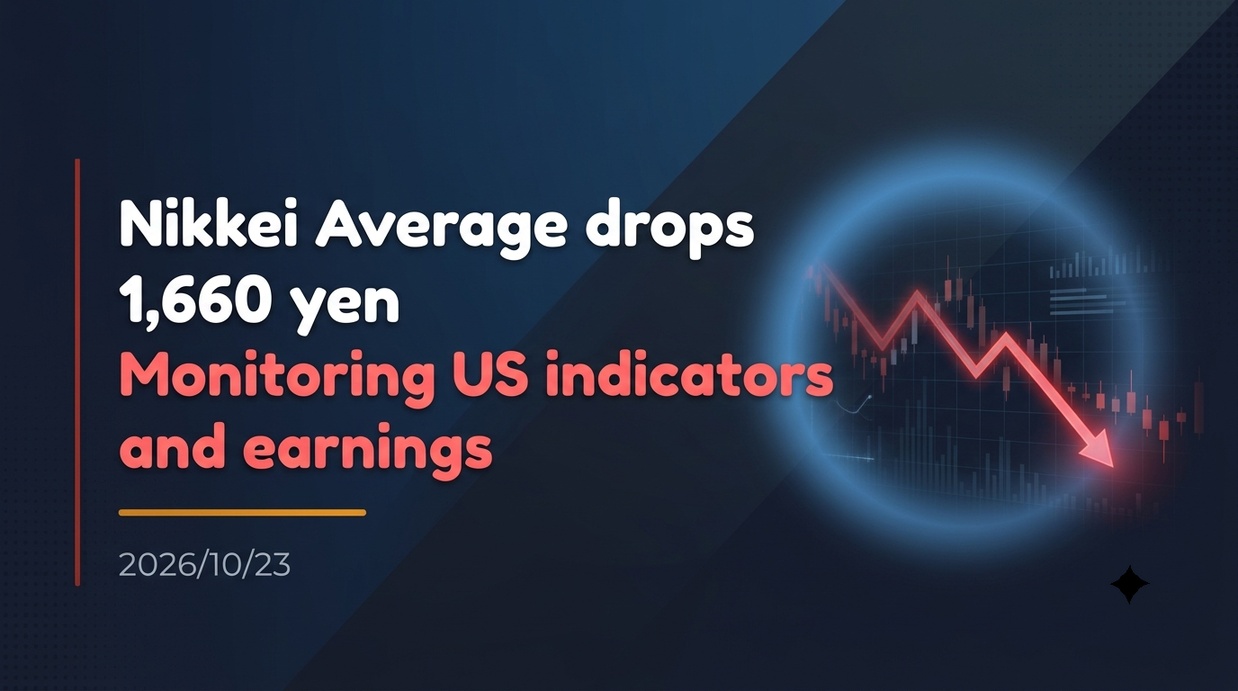
On the Tokyo stock market on October 22, 2026, the Nikkei Stock Average tumbled significantly, dropping 1,713.40 yen from the previous day to 62,907.84 yen. Behind this decline are multiple factors, such as drops in U.S. AI and semiconductor-related stocks, heightened geopolitical risks, and position adjustments ahead of the U.S. midterm elections.
- The Shock of a Sharp Drop of Over 1,600 Yen and Breaking Below 63,000 Yen
- The Stall of U.S. Tech Stocks and the Ripple Effects of Earnings Shocks
- US Tech Giants’ Huge AI Investments and Concerns Over Profitability
- The Psychological Impact of Geopolitical Risks and System Vulnerabilities
- Position Adjustments Before the US Midterm Elections and Historical Patterns
- Corporate Earnings Expansion and Stock Price Scenarios Toward the End of the Fiscal Year
The Shock of a Sharp Drop of Over 1,600 Yen and Breaking Below 63,000 Yen
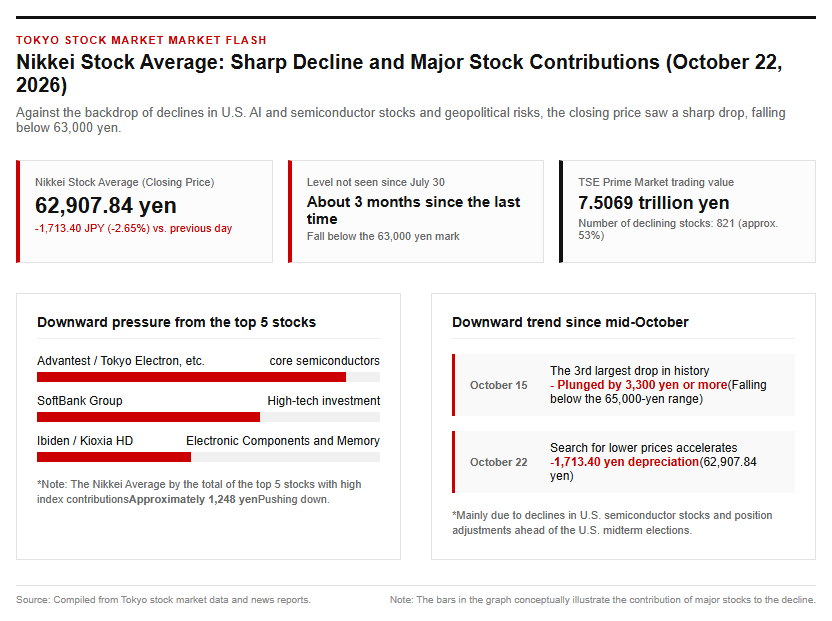
On October 22, 2026, the Tokyo stock market saw a broad-based decline from the morning session, with the Nikkei Stock Average finishing at its low of the day at 62,907.84 yen, down 1,713.40 yen (2.65%) from the previous day. During trading hours, the index briefly fell by over 1,660 yen, marking the first time in about three months since July 30 that it closed below the major 63,000 yen threshold. Estimated trading value on the Tokyo Stock Exchange Prime Market reached 7.0569 trillion yen, with declining issues numbering 821, or about 53% of the total. On October 15, 2026, the index had plummeted by over 3,300 yen—the third-largest drop on record—falling below the 65,000 yen range, but this latest decline has further intensified the search for a bottom.
Leading the recent sharp decline were the major semiconductor and high-tech stocks that had previously driven the market. In terms of individual issues, major semiconductor test equipment manufacturer Advantest, Tokyo Electron, SoftBank Group, Ibiden, and Kioxia Holdings saw their values drop one after another. These five major stocks with high index weightings alone accounted for a total downward pressure of approximately 1,248 yen on the Nikkei Stock Average. Meanwhile, although buying was observed in some domestic demand-oriented and security-related stocks such as Recruit Holdings, Trend Micro, and Sony Group, keeping them resilient, it was not enough to offset the broader market’s decline.
- Nikkei Average closing price: 62,907.84 yen (-1,713.40 yen / -2.65% compared to the previous day)
- Main downward pressure stocks: Advantest, Tokyo Electron, SoftBank Group
- TSE Prime trading value: 7,056.9 billion yen
The following chart shows the sharp decline of the Nikkei Stock Average in the Tokyo stock market.
The Stall of U.S. Tech Stocks and the Ripple Effects of Earnings Shocks
The biggest trigger for the sharp decline in Japanese stocks was the slump in high-tech stocks in the U.S. market the previous day and disappointment over corporate earnings in after-hours trading. As the revenue forecast for the October–December 2026 quarter announced by major U.S. semiconductor manufacturing equipment maker Lam Research failed to meet market expectations, the company’s shares dropped significantly in after-hours trading. Following this trend, selling spread to U.S. peers such as Applied Materials, ultimately dampening investor sentiment across the entire semiconductor manufacturing equipment sector in the Tokyo market.
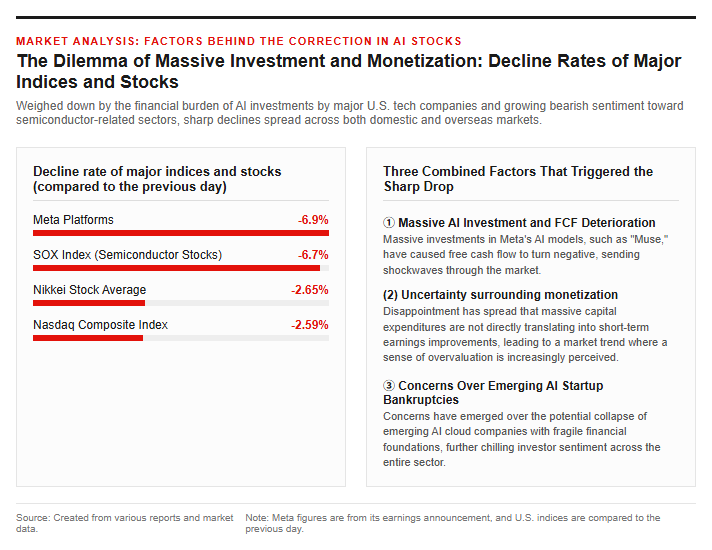
Even in the U.S. stock market itself, the tech-heavy Nasdaq Composite Index plummeted 2.59% from the previous day to 26,008.859 points, recording its largest drop since early June. In addition, the Philadelphia Semiconductor Index (SOX), a key semiconductor-related index, also plunged 6.7%. The three major U.S. indices had risen the previous day on factors such as SpaceX’s strong earnings, but in the Japanese market, those positive factors had already been priced in by the previous day, creating market conditions where profit-taking was prone to take precedence on the 22nd. With growing concerns over a bearish outlook for U.S. tech stocks, the trend toward reducing semiconductor-related positions accelerated in both Japan and the U.S.
- Nasdaq Composite Index: 26,008.859 (-2.59% compared to the previous day)
- SOX Index (Semiconductor Sector Index): -6.7% compared to the previous day
- US Earnings That Made an Impact: Disappointment Over Lam Research’s Outlook
Multiple Factors Behind the Sharp Drop in AI-Related Stocks
US Tech Giants’ Huge AI Investments and Concerns Over Profitability
Behind the global sell-off in AI-related stocks are concerns over the profitability and financial returns of heavy AI investments by major tech companies. In the U.S. market, during its earnings announcement for the July–September 2026 quarter, Meta Platforms revealed that massive capital investments are required for “Muse,” an autonomous AI model it launched in September 2026. As a result, the company’s free cash flow plunged into the red, and its stock price plummeted by 6.9%. While expectations for AI technology remain high, a growing sense of disappointment is spreading through the market as enormous capital expenditures fail to directly translate into short-term earnings improvements or monetization.
These doubts regarding the profitability of AI investments are also rebounding as selling pressure on mega-cap semiconductor stocks like Nvidia. Furthermore, in the U.S. market, reports of fears regarding the bankruptcy of emerging AI cloud companies with remarkably fragile financial foundations have further heightened market uncertainty. That being said, because the targeted company has a small business scale and outstanding financial weakness, the risk of systemic contagion to the entire market is seen as limited; however, it served as a catalyst that made investors acutely aware of the overvaluation of AI-related stocks as a whole, which had been aggressively bought up until now.
- Meta stock decline: -6.9% (Free cash flow turned negative)
- Concerns: Massive investments in AI models like “Muse” and delays in monetization
- Emerging AI Cloud Companies: Concerns Surface Over Potential Collapse Due to Financial Vulnerabilities
The following chart summarizes the overheating trend of AI-related stocks and the factors driving market corrections.
The Psychological Impact of Geopolitical Risks and System Vulnerabilities
The second factor fueling the drop in stock prices was concerns over rising crude oil prices driven by escalating tensions in the Middle East, along with the discovery of a critical system vulnerability in cybersecurity. In the Middle East, tensions heightened between Saudi Arabia and Yemen’s pro-Iran Houthi armed group, leading the U.S. State Department to order the evacuation of certain personnel from the U.S. Embassy in Saudi Arabia. This caused WTI crude oil futures to climb 2.4% amid fears of potential supply disruptions. Persistently high crude oil prices negatively impact the financial performance of Japanese companies that depend on energy imports, serving as a major concern that undermines expectations for further gains in Japanese equities.
Furthermore, reports that a serious vulnerability had been discovered in PHP—the open-source language used by approximately 70% of the world’s websites—shook the market. Amid rising threats of sophisticated AI-driven cyberattacks, companies and government agencies around the world scrambled to respond, contributing to a cooling of investor sentiment. On the other hand, this situation prompted buying back into Japanese cybersecurity-related stocks such as Trend Micro, HENNGE, and SHIFT, making capital inflows and outflows within the market distinct.
- Crude Oil Prices: WTI Crude Futures Surge 2.4% Day-on-Day
- Middle East Situation: Evacuation Order Issued for US Embassy in Saudi Arabia
- System Vulnerability: Critical Flaw Discovered in Programming Language “PHP”
Medium-to-Long-Term Outlook for Japanese Stocks and Future Points of Focus
Position Adjustments Before the US Midterm Elections and Historical Patterns
Amid growing market talk of an “AI bubble burst,” experts suggest that the recent downturn is simply a temporary pre-event position adjustment. According to Yunosuke Ikeda of Nomura Securities, ahead of the upcoming U.S. midterm elections on November 3, 2026, market participants are increasingly unwinding their risk positions. While concerns persist regarding scenarios where the Democratic Party recaptures both houses of Congress in the midterms, as well as potential regulations on AI and data center construction, these risks are reportedly already about 60% priced into the market.
According to historical stock price data, in the past 19 U.S. midterm elections held since 1950, stock prices tend to move sideways to soft prior to the election, whereas a clear tendency can be observed for them to return to an upward trend after the election passes as uncertainty is cleared. Similarly, Japanese stocks (TOPIX) have historically followed a pattern of heading toward higher stock prices on average after the midterm elections. Therefore, once major events such as the July-September earnings announcements of major tech companies and the November midterm elections are digested, the stock market is highly likely to return to a recovery trajectory.
- Featured Event: The US midterm elections to be held on November 3, 2026
- Post-Election Historical Trends: Stock Price Upward Tendency Based on 19 Past Data Points Since 1950
- Market Priced-In Level: 60% Priced-In for the Scenario of AI Regulation Strengthening Due to Democratic Party Regaining Power
Corporate Earnings Expansion and Stock Price Scenarios Toward the End of the Fiscal Year
Examining macroeconomic data of the real economy and corporate earnings reveals that the growth story of the AI and semiconductor industries itself has not been broken. According to an analysis by Koichi Fujishiro of Dai-ichi Life Research Institute, the P/E ratio (price-to-earnings ratio), which indicates how overvalued stock prices are, has dropped to around 20x for the Nikkei Average, showing no bubble-like overheating. Meanwhile, the Nikkei Average’s consensus 12-month forward EPS (earnings per share) has risen sharply by 45%, from 2,185 yen at the beginning of the year to 3,177 yen recently, indicating that corporate earning power is expanding steadily.
Driven by perceived stock undervaluation and robust earnings growth, major securities firms are maintaining their medium- to long-term bullish scenarios for Japanese equities. Nomura Securities predicts that, barring any major negative surprises from the U.S. midterm elections or major corporate earnings reports, Japanese stocks will rebound, supported by solid corporate performance. The firm has set a target of 71,000 yen for the Nikkei Stock Average as its main scenario for the end of fiscal 2026 (the end of March 2027), suggesting that near-term market dips could offer a medium- to long-term investment opportunity.
- Expected EPS (Earnings Per Share): Expanded from 2,185 yen at the beginning of the year to 3,177 yen (+45%)
- PER (Price-to-Earnings Ratio): Declined to around 20x as adjustments progress
- End of FY2026 (End of March 2027) Forecast: Nikkei Average at 71,000 Yen in Nomura Securities’ Main Scenario
Reference Page
- 【Nikkei Average Closing | Sharp Fall, Semiconductor-Related Stocks Sold Off and Falling Below 63,000 Yen (October 22)】 https://kabutan.jp/news/marketnews/?b=n202610221171
【#NikkeiAverage #SemiconductorStocks #AIRelatedStocks #StockMarket #USEconomy #EarningsOutlook】


コメント