
Established US bicycle manufacturer Haro Bicycle has filed for Chapter 11 bankruptcy protection in the United States and embarked on business restructuring. The background putting pressure on management includes lingering excess inventory, increased costs due to US tariff policies, and financial litigation with key manufacturing partners.
- Background of the Chapter 11 filing and breakdown of the .48 million in liabilities
- .86 million remand lawsuit with Taiwan’s Kenstone and supply chain friction
- Post-pandemic demand reversal and layoffs driven by expanded tariffs
- The bullwhip effect and excess inventory striking the entire bicycle industry
- Business Continuity Utilizing D.I.P. Finance and the Fate of Subsidiary Masi
- Key Focus Areas for Corporate Restructuring and Impact on Competitors and the Market
Background of the Chapter 11 filing and breakdown of the .48 million in liabilities
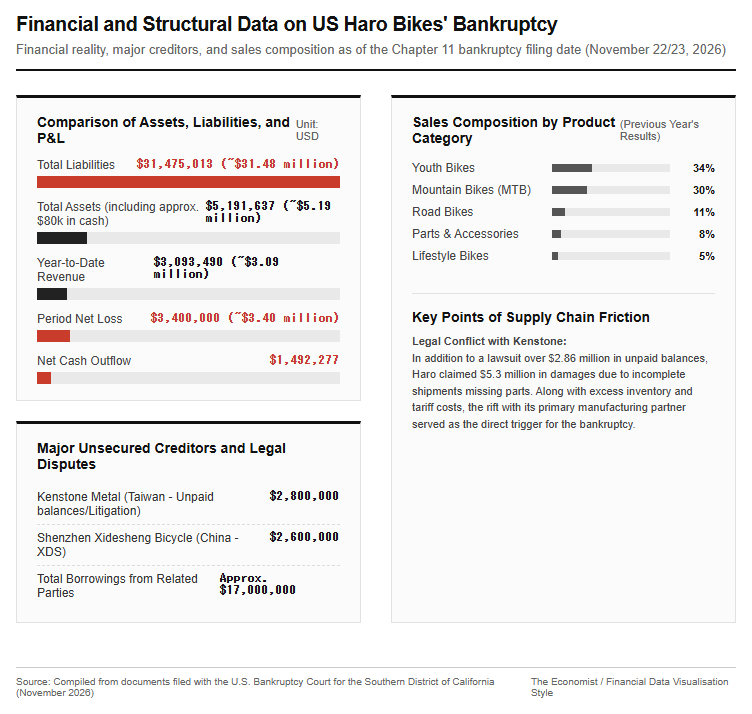
On November 23, 2026, Haro Bicycle Corporation voluntarily filed for Chapter 11 bankruptcy protection at the US Bankruptcy Court for the Southern District of California in San Diego, California. According to bankruptcy petition documents signed by Chief Executive Officer (CEO) Bjarke Rasmussen, the company’s financial state has reached a critical level. As of November 22, 2026, total liabilities amounted to $31,475,013 (approx. $31.48 million), while total assets owned stood at only $5,191,637 (approx. $5.19 million), including roughly $80,000 in cash. Although year-to-date sales for 2026 reached $3,093,490 (approx. $3.09 million), the company experienced a net cash outflow of $1,492,277 during the same period and recorded a net loss of $3.4 million in earnings. The company’s sales composition ratio in the previous year’s results was 34% for junior bicycles, 30% for mountain bikes (MTBs), 11% for road bikes, 8% for parts and accessories, and 5% for lifestyle bikes. Major unsecured creditors include Kenstone Metal of Taiwan with $2.8 million in claims and Shenzhen Xidesheng Bicycle (XDS) of China with $2.6 million in claims, along with borrowings from related parties amounting to approximately $17 million.
.86 million remand lawsuit with Taiwan’s Kenstone and supply chain friction
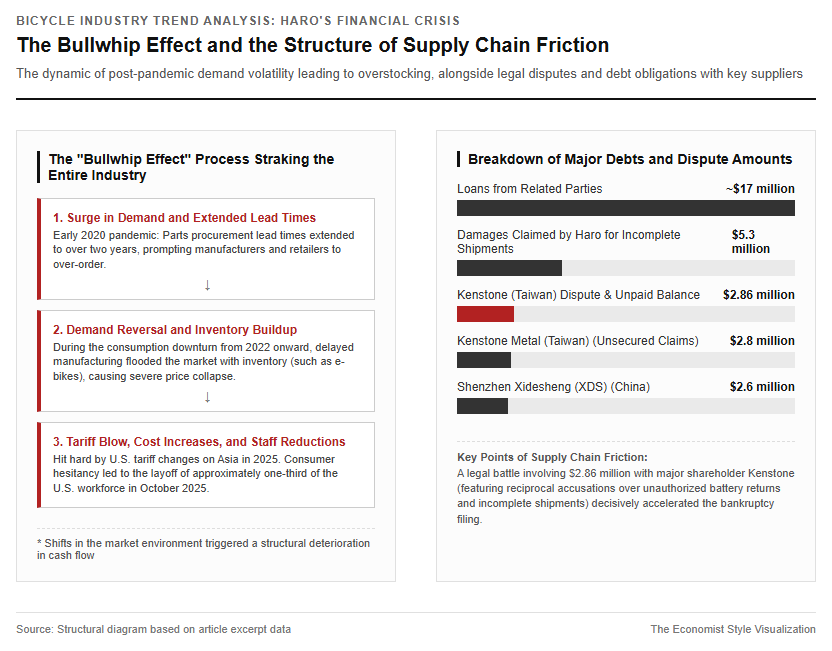
One of the factors that directly accelerated Haro’s business failure is the legal dispute with its long-time manufacturing partner, Kenstone Metal of Taiwan. Kenstone had a complex, close relationship in which Chia-Yu Yang, a member of the company’s founding family, was a major shareholder owning approximately 80% of Haro’s shares. However, in January 2024, Kenstone sued Haro in the US District Court for the Southern District of California over unpaid bicycle and parts invoices totaling $2.86 million (approx. 455 million yen) ordered between January 2020 and March 2023. The complaint alleged that in the early morning of a scorching hot day in July 2023, Haro sent a truckload of e-bike batteries and other items back to the Taiwan factory without permission and disposed of them. In response, Haro filed a counter-claim in March 2024, arguing that Kenstone repeatedly made incomplete shipments—such as batteries alone without enclosing necessary parts like frames—resulting in missed sales opportunities for complete bikes and causing $5.3 million in damages, leading to a clash. As shown in the figure below, the disruption of the supply chain delivered a decisive blow.
A jury trial scheduled for December 2026 has entered a stay procedure due to this bankruptcy filing.
Structural factors of deteriorating management and the crisis in the bicycle industry
Post-pandemic demand reversal and layoffs driven by expanded tariffs
In recent years, Haro has actively promoted expansion into the adult sports bike sector, such as road bikes and gravel bikes, moving beyond its traditional BMX business. In March 2025, the company invited Olympic gold medalist Lasse Norman Leth and others as product marketing heads to develop high-end carbon models. However, changes in US tariff policies against Asia that intensified from the spring of 2025 directly hit the company’s profitability. Due to the structural setup of importing complete bikes from partner factories in Taiwan and Vietnam, consumers refrained from purchasing complete bikes in response to rising tariff costs, leading to a holding-back behavior where they limited spending to upgrading parts. To cope with this changing market environment, Haro implemented large-scale layoffs in October 2025, cutting roughly one-third of its US workforce. Furthermore, it was forced to consolidate its drop-handlebar road bike operations into its historic subsidiary brand Masi, bringing its independent foray into the road bike market to a short-lived end.
The bullwhip effect and excess inventory striking the entire bicycle industry
Haro’s business crisis is not limited to the failure of a single company; it symbolizes the “bullwhip effect,” a structural supply-demand confusion plaguing the entire bicycle industry. At the beginning of the pandemic in 2020, part procurement lead times extended to over two years at most in response to a sudden surge in global bicycle demand. As manufacturers and retailers placed excessive orders to cope with this, inventory manufactured with a delay flowed into the market all at once during the consumer demand decline period starting in 2022. 2023-model e-bikes accumulated in European logistics warehouses, triggering severe price destruction and worsening cash flow. As shown in the industry trend graph below, severe inventory costs bloated across various parts of the industry.
Affected by this market turmoil, emerging brands such as Stella and Qwic in the Netherlands have gone bankrupt, while long-established Italian brand Bianchi has entered business restructuring proceedings (CNC) with approximately 100 million euros in debt, accelerating the contraction and reorganization of the industry worldwide.
Outlook for the Restructuring Plan and the Brand’s Future
Business Continuity Utilizing D.I.P. Finance and the Fate of Subsidiary Masi
A Chapter 11 bankruptcy filing does not mean liquidation; rather, it is a process to reorganize debts while continuing operations under court protection. To address its shortage of cash on hand, Haro secured D.I.P. (Debtor-in-Possession) financing, subject to court approval. As a result, the company continues to ship bicycles to stores and riders, pay employee salaries, and settle accounts with new suppliers even after the filing. CEO Bjarke Rasmussen emphasized that this procedure is a measure to comprehensively resolve past legal disputes and unpaid debts in order to protect the future of the brand. In addition, the European subsidiary based in Germany and overseas operations in New Zealand and elsewhere are not subject to this U.S. filing, and are maintaining normal business operations. Furthermore, product development plans and supply systems through 2027, including the subsidiary road bike brand Masi, are expected to continue.
Key Focus Areas for Corporate Restructuring and Impact on Competitors and the Market
The biggest focus in the upcoming restructuring will be whether an effective repayment plan can be agreed upon with major creditors Kenstone and XDS. Founded in 1978 by Bob Haro, the Haro brand retains a dedicated fan base and brand equity as an icon of the early BMX era. However, the current sports bicycle market has seen advanced standardization of technology and geometry, making differentiation from competitors extremely difficult. Amid intensifying competition with emerging brands and dedicated e-bike manufacturers, streamlining excess SKUs (Stock Keeping Units) and concentrating on core categories will be essential. Although near-term working capital has been secured through D.I.P. financing, the path to restructuring will remain challenging if the recovery in U.S. market demand is delayed and uncertainty in the tariff environment persists. Whether the company can rebuild its revenue foundation following the meeting of unsecured creditors and court rulings will be a point to watch closely going forward.
Reference Pages
- 【U.S. Court of International Trade Docket】https://dockets.justia.com/docket/circuit-courts/cit/1:2026cv02774
- 【U.S. Bankruptcy Court Petition Docket】https://app.bondoro.com/case/Haro_Bicycle_Corporation_A_California_Corporation/key-parties
【#HaroBikes #CyclingIndustry #BankruptcyFiling #Chapter11 #SupplyChain #CorporateRestructuring #Masi】


コメント