
The new lending interest rate announced by the Bank of Japan for September 2026 rose to 2.120%, marking its highest level in about 30 years. This background features rising market rates driven by consecutive interest rate hikes implemented in June and September of the same year, bringing significant changes to corporate and bank management.
- September New Lending Rate Reaches 2.120% and Sharp Increases by Business Category
- Successive Rate Hikes to a 1.25% Policy Rate and Changes in the Yield Curve
- A 3 Trillion Yen Increase in Burden, with 58.5% of Companies Projected to Face Negative Impacts
- Divergence of Risks Across Major Industries Including Real Estate, Retail, and Manufacturing
- Dual Nature of Expanded Loan-Deposit Spreads and Bond Unrealized Losses
- Restructuring of Capital Efficiency and Key Points for Future Monetary Policy
September New Lending Rate Reaches 2.120% and Sharp Increases by Business Category
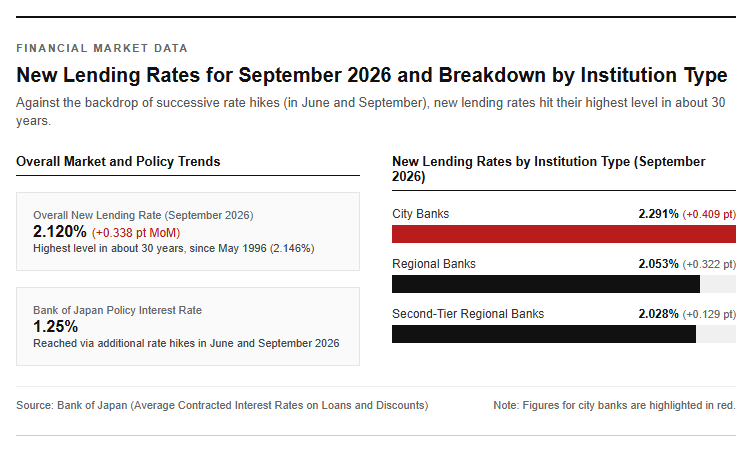
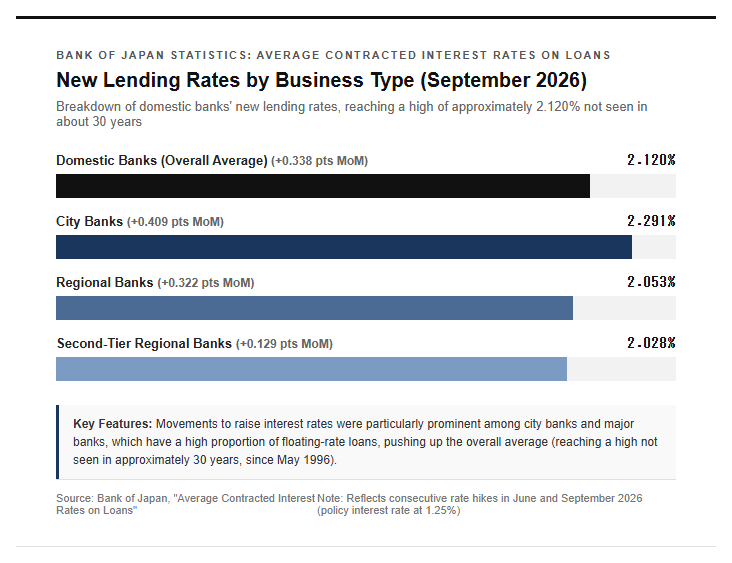
According to the Average Contracted Interest Rates on Loans announced by the Bank of Japan, the average interest rate on new loans executed by domestic banks for corporate clients and others reached 2.120% in September 2026. This represents a significant increase of 0.338 points from the previous month, marking the highest level in about 30 years since May 1996, when it was 2.146%. Looking at the breakdown by financial institution category, city banks rose 0.409 points to 2.291%, regional banks rose 0.322 points to 2.053%, and second-tier regional banks rose 0.129 points to 2.028%. Movements to raise interest rates are particularly prominent among city banks and major banks, which have a large proportion of floating-rate loans that are highly correlated with market interest rates. Behind this sharp rise in lending rates is the BOJ’s implementation of additional rate hikes in June and September 2026, which raised the policy interest rate to 1.25%, a level not seen in about 31 years. Interest rate hikes have begun to permeate rapidly in the field of new lending, visualizing structural changes in the lending market. For trends in the interest rate system of the financial market as a whole, please refer to the figure below.
Successive Rate Hikes to a 1.25% Policy Rate and Changes in the Yield Curve
Amid the ongoing process of monetary policy normalization by the BOJ, not only short-term interest rates but also the 10-year Japanese Government Bond yield, which serves as an indicator for long-term interest rates, exceeded the milestone of 3.0%, reaching its highest level in 30 years since 1996. While the entire yield curve shifts upward, there is a time lag between the rise in benchmark interest rates and its impact on companies’ actual borrowing rates. Financial institutions’ new lending rates tend to be reflected sequentially over a period of about three months following changes in the policy interest rate. On the other hand, it takes several years for interest rate hikes to permeate the entire existing loan balance or corporate bond balance due to the influence of fixed-rate ratios and past procurement periods. Even after the policy interest rate was raised to 1.25%, companies’ willingness to make capital investments remained solid, and banks’ loan balances have maintained an upward trend. However, because the pace of interest rate increases is rapid, there are concerns that the burden on companies will become full-fledged in the future through phases such as the refinancing of existing borrowings.
Blow to Corporate Management and the Degree of Impact by Industry
A 3 Trillion Yen Increase in Burden, with 58.5% of Companies Projected to Face Negative Impacts
According to a survey conducted by Teikoku Databank in October 2026 regarding the impact of rising interest rates on their businesses, 58.5% of companies responded that “the negative impact is greater.” This is a significant increase of 14.2 points from the previous survey, indicating that concerns over the interest rate burden are rising rapidly among companies. Already, 47.7% of companies have received inquiries about interest rate hikes from their main banks, and among these, 28.9% responded that their interest rates were actually raised. According to estimates by Mizuho Research & Technologies, as past policy rate hikes and lending rate increases ripple across total interest-bearing debt, the increase in companies’ interest payment burdens is projected to become full-fledged from fiscal 2026 through fiscal 2028. The downward pressure on ordinary income caused by this interest rate increase is estimated to reach a scale of about 3 trillion yen annually. For information on companies’ cash flow conditions and countermeasures against the increased burden, please refer to the figure below.
Divergence of Risks Across Major Industries Including Real Estate, Retail, and Manufacturing
Perceptions of the negative impact from rising interest rates vary greatly depending on an industry’s financial structure and customer base. The highest proportion of companies concerned about negative impacts is found in the “real estate” sector at 71.4%. Because the real estate industry holds a large amount of interest-bearing debt for development and property acquisition, direct increases in interest payments squeeze profits. Furthermore, they are caught in a double punch of slowing buyer purchases due to rising mortgage rates. Next are “transportation and warehousing” at 66.0%, “retail” at 64.8%, “manufacturing” at 64.6%, and “wholesale” at 59.1%, showing high proportions. In the retail industry, in addition to the burden of their own borrowing rates, they are susceptible to the effects of diminished consumption caused by individuals’ thrift-oriented mindsets and rising interest rates on car loans and the like. Manufacturing and transportation industries are also seeing increased borrowing burdens associated with capital investment and procurement, making cost absorption an urgent issue amid a succession of interest rate hike inquiries.
Structural Changes in Financial Institutions and Future Economic Outlook
Dual Nature of Expanded Loan-Deposit Spreads and Bond Unrealized Losses
Rising interest rates have both positive and negative effects on the earnings structure of banking businesses, including regional financial institutions. On the positive side, due to the characteristic of “sticky deposit rates”—where the increase in the rates of liquid deposits such as ordinary deposits lags behind the rise in lending rates—the loan-to-deposit margin widens, which boosts core business net income. An increase in funding profits has been confirmed at many regional banks in financial results for 2025 and beyond. On the negative side, however, long-term interest rates have surged to nearly 3.0%, causing the market value of government and corporate bonds purchased during the past period of low interest rates to decline, thereby expanding valuation losses (unrealized losses) on bonds. While many banks are seeing unrealized gains on policy-holdings of equities—driven by rising stock prices—offset their bond valuation losses, depending on the future pace of interest rate hikes, these losses could become a factor putting pressure on capital, thus demanding sophisticated ALM (Asset-Liability Management).
Restructuring of Capital Efficiency and Key Points for Future Monetary Policy
In the future Japanese economy, it will be essential for companies to break away from management dependent on conventional low interest rates and transition to management that strongly emphasizes capital efficiency. As a measure to cope with rising interest rates, 33.0% of companies cited “passing on costs to product and service prices,” and a movement is spreading to advance the repayment of excessive borrowings, accumulate cash on hand, and re-screen capital expenditures. Selection and concentration on businesses where Return on Invested Capital (ROIC) exceeds the cost of capital is expected to accelerate. The Bank of Japan (BOJ) judges the current financial environment to still be accommodative and has indicated its policy to continue additional rate hikes going forward while confirming a virtuous cycle of prices and wages. The rise in new lending rates to 2.120% signals a complete transition to a “world with interest rates,” and from here on, the trends in the rising credit risks of small and medium-sized enterprises and the increasing burden of household mortgages will be major points of focus for the overall economy.
Reference Pages
- [Bank of Japan] https://www.boj.or.jp
- [Mizuho Research Institute] https://www.mizuhobank.co.jp/corporate/mhri/research/index.html
- [Teikoku Databank] https://www.tdb.co.jp
[#NewLendingRates #InterestRateHikes #BankOfJapan #CorporatePerformance #RegionalBanks #EconomicNews]


コメント