It has been officially announced that the “ACFTA 3.0” upgrade protocol, a revised version of the free trade agreement between China and the Association of Southeast Asian Nations (ASEAN), will enter into force on December 1, 2026. Against the backdrop of the U.S.-China rivalry and the ongoing restructuring of global supply chains, the move aims to unify regional rules and strengthen cooperation in emerging fields such as the digital economy and green growth.
- Background leading up to the December 1, 2026 entry into force and the core of the developments
- The focus of rule strengthening that sets it apart from conventional FTAs
- Specific measures for cooperation in the digital economy and green industries
- Supply chain resilience and mutual recognition of conformity assessment
- Synergistic Effects with RCEP and Changes in East Asia’s Trade Structure
- Future Schedule and Developments That Japanese Companies Should Monitor
Background leading up to the December 1, 2026 entry into force and the core of the developments
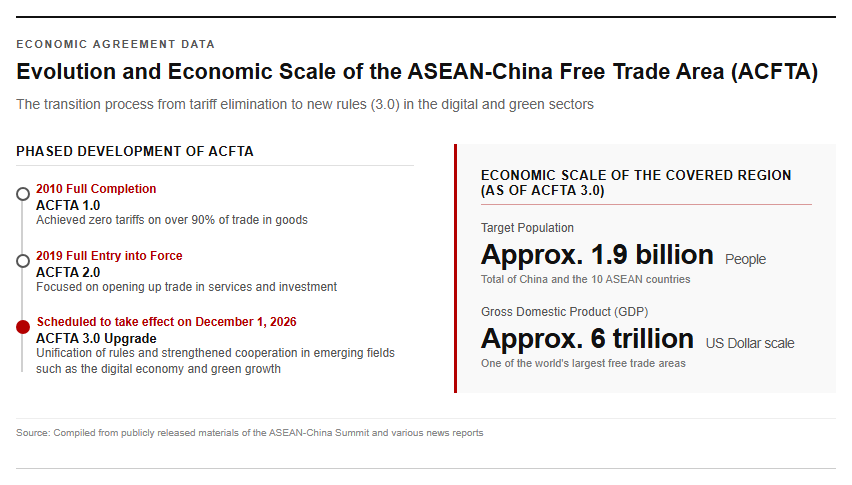
On November 16, 2026, at the 29th China-ASEAN Summit held in Manila, Chinese Premier Li Qiang and the leaders of the 10 ASEAN member states jointly announced that the 3.0 upgrade protocol for the China-ASEAN Free Trade Area (ACFTA) will take effect on December 1, 2026. Negotiations for this 3.0 agreement began in November 2022, reached a conclusion in May 2025, and were signed by both sides in October 2025. Looking back at the historical background, ACFTA 1.0, which was fully completed in 2010, achieved zero-tariff status for over 90% of merchandise trade categories, while 2.0, which fully took effect in 2019, focused on opening up trade in services and investment. This 3.0 version moves beyond the conventional focus on tariff reductions to mark a historic milestone aimed at establishing comprehensive rule-making that responds to the latest trends in the international economy. The combined target region of China and ASEAN reaches a population of approximately 1.9 billion and a gross domestic product (GDP) of around $6 trillion, taking the framework of one of the world’s largest free trade areas to an even higher level. The diagram below shows an overview of the evolution of the ACFTA and regional trade scales.
The focus of rule strengthening that sets it apart from conventional FTAs
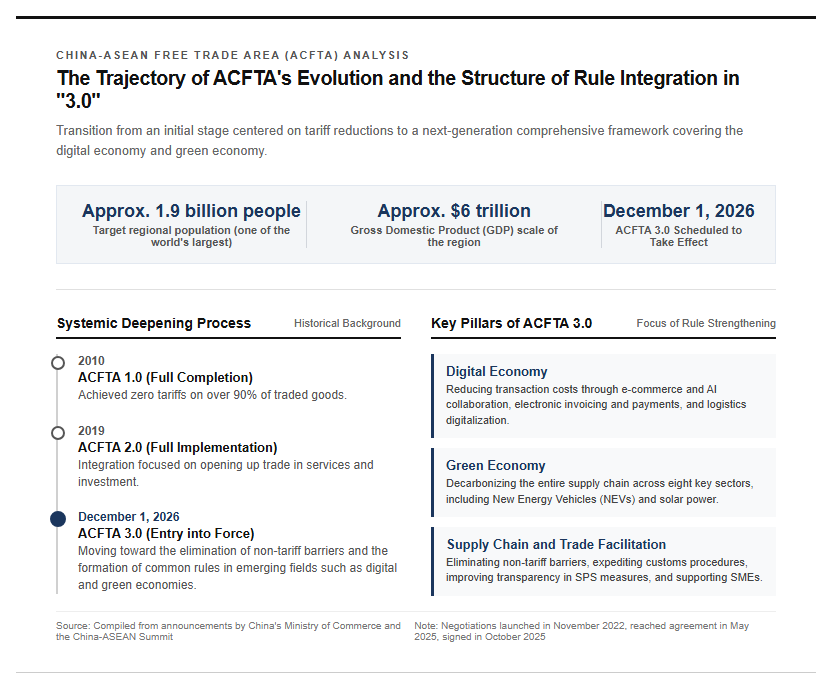
The most distinctive feature of ACFTA 3.0 is that, unlike traditional FTAs whose primary purpose is to reduce new tariffs on goods, it places emphasis on eliminating non-tariff barriers and formulating common rules in next-generation industries. According to announcements by China’s Ministry of Commerce, the protocol newly covers a wide range of emerging fields, including the digital economy, the green economy, supply chain connectivity, standards, technical regulations and conformity assessment procedures, as well as customs procedures and trade facilitation. In particular, strengthening cooperation in the rapidly expanding fields of e-commerce and artificial intelligence (AI), along with the digitalization of cross-border logistics procedures, are positioned as key pillars. While past FTAs spent a significant amount of time on individual tariff rate negotiations, this agreement aims to comprehensively improve the regional business environment and drive institutional openness to drastically reduce transaction costs. Furthermore, provisions to enhance the transparency of sanitary and phytosanitary (SPS) measures and support micro, small, and medium-sized enterprises (MSMEs) in entering value chains are also included, designed as a framework to promote comprehensive and sustainable economic growth throughout the region.
Rule integration in emerging fields and impact on industries
Specific measures for cooperation in the digital economy and green industries
In the field of the digital economy, ACFTA 3.0 will enhance not only hard infrastructure connections but also soft interoperability, such as one-stop services, e-invoices, e-payments, and electronic bills of lading. This is expected to dramatically reduce administrative processing costs for businesses involved in e-commerce. Additionally, the summit declared the designation of 2027 as the “China-ASEAN Year of AI Cooperation,” setting forth a policy to promote the introduction of artificial intelligence across all industrial sectors. Meanwhile, in the field of the green economy, a comprehensive cooperation framework has been established to advance end-to-end collaboration across eight key areas, including green trade and investment, the circular economy, sustainable finance, and the development of renewable energy technologies. Notably, new energy vehicles (NEVs), photovoltaic panels, and electrical and electronic products have been designated as key areas for cooperation. Efforts to decarbonize the entire supply chain from production to consumption and recycling will become a critical factor influencing future industrial competitiveness in Asia. The diagram below illustrates the collaborative scheme for green technology and digital trade.
Supply chain resilience and mutual recognition of conformity assessment
In ACFTA 3.0, “supply chain connectivity” was established as an independent chapter—an extremely rare inclusion for a free trade agreement. This chapter clarifies measures to avoid regional logistics bottlenecks through the promotion of multimodal transport and the resolution of customs clearance bottlenecks at border checkpoints. In addition, groundbreaking rules regarding product specifications, technical regulations, and conformity assessment procedures have been introduced. It stipulates that when both parties formulate their own mandatory specifications or technical standards, they can reference the other party’s standards if no matching international standards exist. Furthermore, the mutual recognition of inspection and conformity assessment results between the two sides is encouraged, with electrical and electronic equipment and new energy vehicles designated as priority areas. This reduces the burden on companies that previously had to obtain duplicate certifications from the other party’s inspection agencies for each exported product, significantly shortening the time required to bring products to market. Such reductions in non-tariff barriers will directly boost the efficiency of the manufacturing network spanning China and Southeast Asia.
Transformation of the Regional Economic Order and Key Points to Watch
Synergistic Effects with RCEP and Changes in East Asia’s Trade Structure
The entry into force of ACFTA 3.0 is also extremely important in terms of deepening a mutually complementary relationship with the Regional Comprehensive Economic Partnership (RCEP) agreement, which includes Japan, South Korea, and Australia. While RCEP is a massive agreement with 15 member countries accounting for approximately 30% of global GDP and population, ACFTA 3.0’s pioneering introduction of advanced digital and green rules will act as a catalyst to drive rule evolution across RCEP as a whole. For China as well, strengthening its economic “internal circulation” with ASEAN, its largest trading partner, aims to counter trade restrictions and tariff risks from Europe and the United States. While Southeast Asian nations welcome huge infrastructure investments and direct investments from Chinese EV manufacturers and others, they also harbor concerns about excessive dependence on any single country and pressure on local industries, requiring the agreement to be implemented while balancing diverse interests. Driven by the integration of advanced non-tariff rules in addition to existing tariff concessions, the restructuring of the entire East Asian supply chain is projected to accelerate.
Future Schedule and Developments That Japanese Companies Should Monitor
Both sides plan to swiftly complete domestic ratification procedures aiming for the agreement to enter into force on December 1, 2026. Following entry into force, specialized subcommittees on “Digital Economy,” “Green Economy,” “Standards,” and “SMEs” will be newly established under the ACFTA Joint Committee to launch concrete rule implementation and practical cooperation in earnest. This agreement is by no means irrelevant to Japanese companies either. Japanese manufacturing companies and trading firms maintain numerous production bases and supply chains in the ASEAN region and China, and local production subsidiaries or joint ventures may be able to leverage ACFTA 3.0’s customs facilitation measures and mutual recognition of conformity assessments. On the other hand, there are concerns that the further enhancement of Chinese products’ price competitiveness in Southeast Asian markets could impact the market share of Japanese companies locally. Re-examining the application status of rules of origin within their own supply chains, quickly grasping changes in customs clearance practices accompanying the launch of the new rules, and conducting strategic base deployment will be crucial challenges moving forward.
Reference Pages
- [China Ministry of Commerce China-ASEAN FTA Special Website] https://fta.mofcom.gov.cn/channel/china_dongmeng_special.shtml
- [Ministry of Foreign Affairs of the People’s Republic of China Official Announcement] https://www.mfa.gov.cn/web/ziliao_674904/1179_674909/202410/t20241010_11505042.shtml
[#FreeTradeAgreement #ACFTA3.0 #ASEAN #ChinaEconomy #DigitalEconomy #SupplyChain #RCEP]


コメント