On October 16, 2026, the Bank of Japan’s Kochi branch left its economic assessment for Kochi Prefecture unchanged from the previous month, stating that the economy is “recovering moderately.” While the recovery in personal consumption and tourism remains solid, the structural trend of high costs and a severe labor shortage acting as a burden persists.
- Key points of the events and background for keeping economic assessment unchanged
- Demand Trends Supporting Private Consumption and Tourism
- Recovery of the manufacturing industry and improvement in business sentiment
- Corporate Struggles with Rising Costs and Price Pass-Through
- The Worsening Labor Shortage and Harsh Employment Environment
- Future Outlook and Key Points
Key points of the events and background for keeping economic assessment unchanged
As a key takeaway of the developments, on October 16, 2026, the Bank of Japan’s Kochi Branch released its financial and economic overview for the period following early September of that same year, maintaining its economic assessment for Kochi Prefecture as “recovering moderately.” This unchanged economic assessment has continued for nearly two years since November 2024. In the Regional Economic Report (Sakura Report) released by the Bank of Japan on October 8, 2026, the economic assessment for Shikoku as a whole was upgraded to “is recovering” against the backdrop of strong performance in the manufacturing and shipbuilding industries, but within Kochi Prefecture, recovery movements remain limited to certain sectors. Specifically, while signs of recovery are observed in personal consumption and tourism demand, rising consumer prices (excluding fresh food) and soaring raw material and fuel costs are squeezing the profits of small and medium-sized enterprises (SMEs). Furthermore, while the nationwide expansion of artificial intelligence (AI)-related demand is beginning to have a positive impact on local manufacturing, it has yet to become a powerful engine capable of driving the regional economy as a whole. The chart below illustrates the trends in key indicators of the prefectural economy.
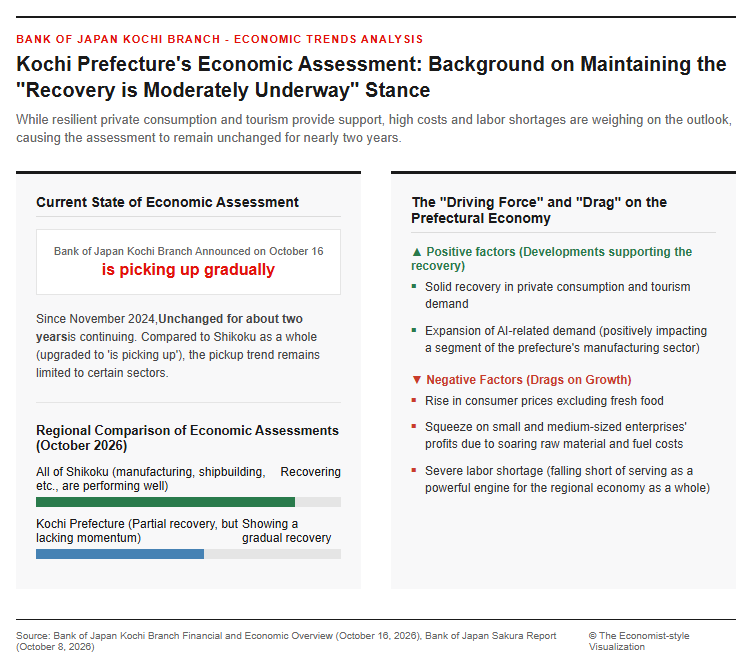
Amid this mix of positive and negative factors, the Bank of Japan’s Kochi Branch maintains its cautious stance in carefully assessing the pace of the economy.
Demand Trends Supporting Private Consumption and Tourism
One of the main pillars supporting the current prefectural economy is resilient private consumption and the increasingly recovering tourism industry. According to an announcement by the Bank of Japan’s Kochi Branch, sales trends at large-scale retailers remain solid, and a clear recovery in demand is also evident at major home electronics retailers. Particularly in the autumn 2026 leisure season, favorable calendar alignment during Silver Week and blessed good weather acted as tailwinds. The number of guests staying at major ryokan and hotels in Kochi Prefecture increased by 3.1 percent compared to the same period of the previous year. The influx of inbound visitors to the prefecture and robust demand from domestic travelers have contributed to higher sales in tourism-related industries. However, as price increases for daily necessities such as food and household goods have been prolonged, a strong frugality mindset among consumers remains deeply rooted, particularly centered around the middle-class and elderly demographics. While somewhat sluggish movements are observed in convenience store sales, hesitation to raise prices is also occurring on the ground to prevent customer outflow to other business formats. A complex consumption trend continues, characterized by a mix of returning demand and spending restraint driven by high prices.
Recovery of the manufacturing industry and improvement in business sentiment
Production activities of companies within the prefecture, starting with the manufacturing sector, are showing signs of a modest pickup. According to the Tankan (Short-Term Economic Survey of Enterprises in Japan) released by the Bank of Japan’s Kochi Branch in September 2026, the business conditions DI, which indicates business sentiment across all industries, stood at plus 18, improving by 2 points from the previous survey in June of the same year, marking the first improvement in three quarters. This improvement was strongly driven by the manufacturing sector as a whole, with businesses handling commercial and general-purpose machinery, in particular, successfully raising product prices and passing on costs, contributing to increased earnings. Furthermore, increased demand for electronic parts and electrical machinery related to data centers and semiconductor manufacturing equipment has also been a factor pushing up the operating rates of manufacturers within the prefecture. In the capital investment plans for fiscal 2026, centering on non-manufacturing industries, an increase of 11.3 percent year-on-year has been planned, indicating a strong willingness to invest in labor-saving and capacity expansion. The chart below shows the production trends by product category for manufacturing industries within the prefecture.
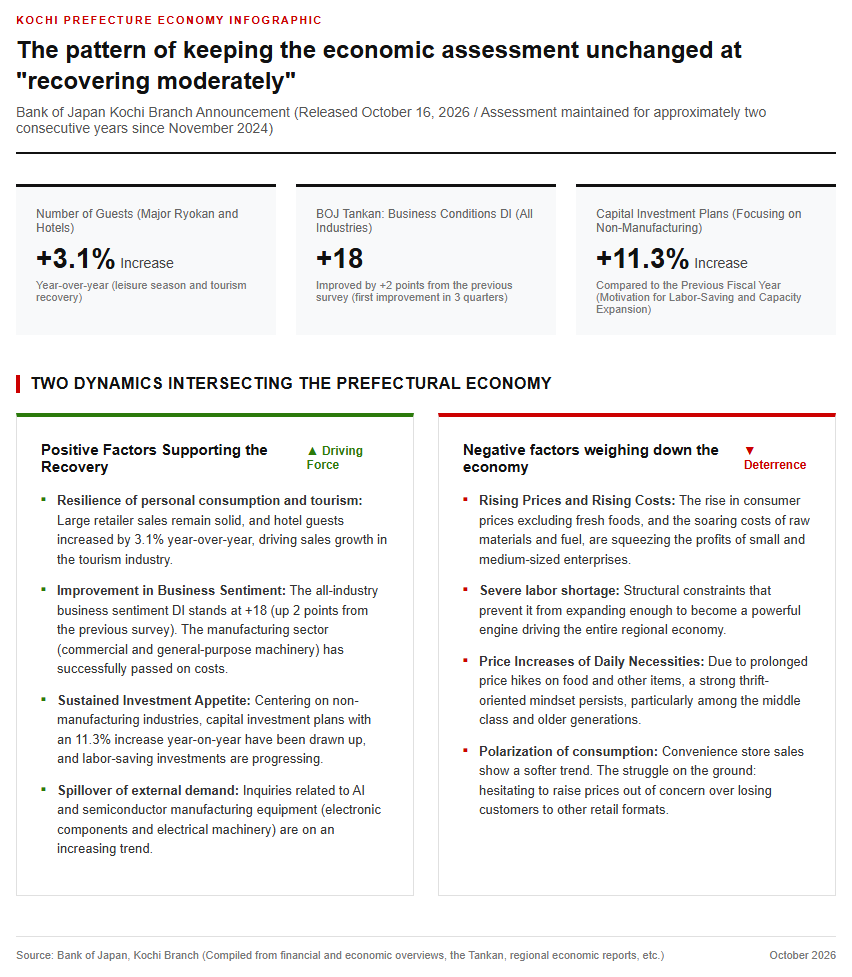
The penetration of price pass-through and the capture of overseas demand are major pillars supporting the earnings recovery of the manufacturing sector.
Challenges Facing the Kochi Prefecture Economy and Future Outlook
Corporate Struggles with Rising Costs and Price Pass-Through
Behind the unchanged economic assessment is the reality that soaring raw material and utility costs continue to weigh heavily on corporate management. Amid intensifying tensions in the Middle East and the ongoing depreciation of the yen, purchase prices and logistics costs are rising at an unprecedented frequency. While large enterprises and manufacturers handling high-value-added products are making progress in passing on costs, small and medium-sized enterprises (SMEs), as well as restaurant and retail businesses, often find themselves unable to implement sufficient price hikes due to fierce price competition and concerns over customer loss. In fact, voices from companies within the prefecture highlight the difficult realities faced by restaurants that are forced to keep their selling prices unchanged despite a nearly 30% increase in raw material and consumable costs, and retailers that have decided to absorb rising labor costs internally. Furthermore, corporate bankruptcies within the prefecture in August 2026 reached 4 cases with total liabilities amounting to 517 million yen, marking a significant increase from 1 case and 10 million yen in the same month of the previous year. The fact that improvements in revenue cannot keep pace with the accelerating rate of costs, raising the risk of bankruptcy and closure, has become a factor dampening the recovery speed of the prefectural economy.
The Worsening Labor Shortage and Harsh Employment Environment
The most serious structural issue in Kochi Prefecture’s economy is the chronic and rapidly worsening labor shortage. In the September 2026 Tankan survey, the employment conditions diffusion index (DI) for businesses stood at minus 37, worsening by another 2 points from the previous survey to reflect a massive “excess of labor shortage.” Within the prefecture, it is difficult to fill vacancies caused by retirement and other factors with new young talent, and a severe hiring crunch persists across all industries. In particular, the aging rate is extremely high in agriculture, construction, medical and welfare, and accommodation and food services, making the acquisition of young workers an absolute imperative. While moves to raise wage levels for regular and part-time employees in response to minimum wage hikes are spreading, many small and medium-sized enterprises (SMEs) are unable to secure sufficient financial resources for wage increases due to competition for talent with large corporations and limits on their earning capacity. There are also cases where the labor shortage acts as a bottleneck, forcing businesses to miss out on order opportunities or scale back services. The figure below shows the proportion of employed workers by age group and the trend of labor shortages in the prefecture.
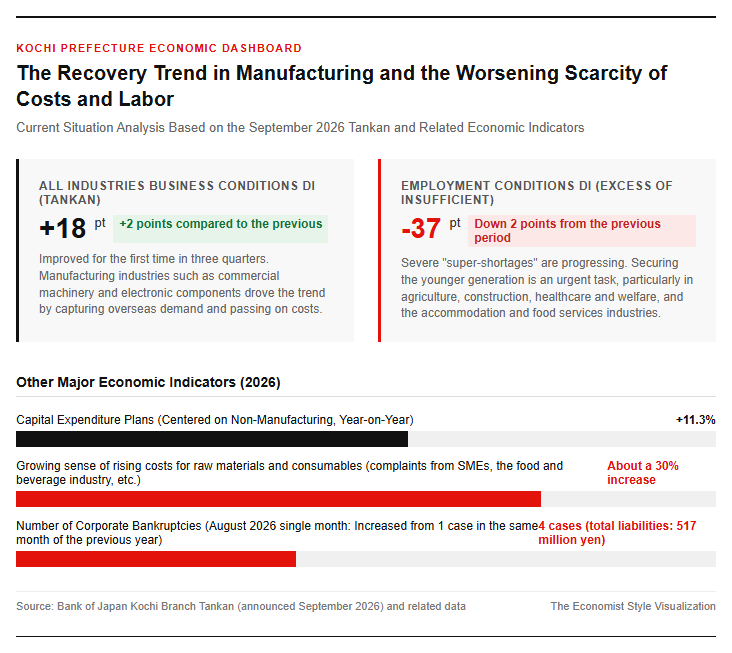
Balancing the improvement of the employment environment with productivity enhancement has become an urgent priority.
Future Outlook and Key Points
As for future developments and key points to watch, the Bank of Japan’s Kochi Branch projects that the prefectural economy will “recover at a moderate pace,” but achieving this requires carefully assessing multiple uncertainties. The first key point is the balance between the progress of passing on cost increases to prices and consumer trends. Amid persistent inflation, the question is whether the wave of wage hikes will reach all employees of small and medium-sized enterprises in the prefecture and lead to the expansion of personal consumption through improved real incomes. The second key point is the response to labor shortages and the success or failure of labor-saving and digitalization investments. To compensate for labor shortages stemming from the declining birthrate and aging population, how far the introduction of labor-saving equipment and the efficiency of business processes progress will hold the key to corporate survival. The third key point is risk factors in overseas economies, including the situation in the Middle East and currency fluctuations. We must closely monitor the impact that a resurgence in energy prices and global demand changes will have on the prefecture’s manufacturing and tourism industries. Toward the sustainable growth of the regional economy, the promotion of structural reforms through public-private collaboration is strongly required.
Reference Page
- [Bank of Japan Kochi Branch] http://www3.boj.or.jp/kochi/
- 【Bank of Japan: Regional Economic Report (Sakura Report)】https://www.boj.or.jp/research/brp/rer/rer261008.htm
【#BankOfJapanKochiBranch #KochiEconomy #EconomicAssessment #PersonalConsumption #LaborShortage】

コメント