OpenAI has released 722 mathematics papers generated using an unreleased AI model. While the move is aimed at showcasing the AI’s advanced reasoning capabilities, a backlash is growing within the mathematics community over concerns such as the disregard for human understanding and the impact on the research ecosystem.
- Key Points of the Event and Background of Publication
- The Contents of the Paper and the Proof Verification Mechanism
- Statement of Criticism and Suspension of Cooperation by Mathematician Organization
- The Challenges of Human Understanding and Escalating Verification Costs
- Leadership and Access Disparities Between AI Companies and Academia
- Future Developments and Key Points
Key Points of the Event and Background of Publication
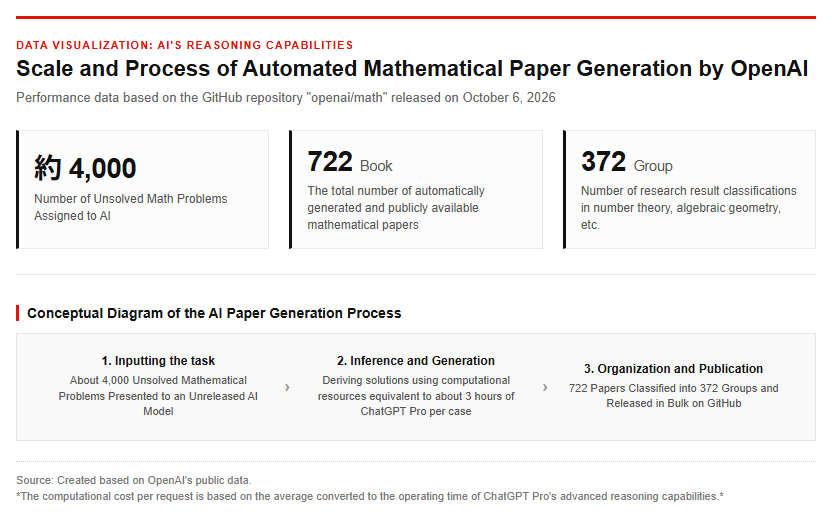
On October 6, 2026, OpenAI released a batch of 722 mathematical papers automatically generated by an unreleased internal AI model on the public GitHub repository “openai/math”. These papers address unsolved problems across a wide range of fields, such as number theory, algebraic geometry, probability theory, and theoretical computer science, and are organized into 372 groups based on related research outcomes.
For this massive release, OpenAI tasked its internal state-of-the-art AI models with approximately 4,000 unsolved mathematical problems, having them attempt to derive solutions. The computational resources spent on generating a single research result are equivalent, on average, to running ChatGPT Pro’s advanced reasoning capabilities for about three hours. The following diagram is a conceptual illustration showing the process of AI-driven paper generation.
The published materials include not only the PDF file of the paper, but also the LaTeX source code, build instructions, BibTeX data for citation, and even a summary encapsulating the inference process. Unlike conventional demo presentations, a major feature is the provision of detailed information designed to enhance the reproducibility and verifiability of the research. However, the specific name of the AI model used in the research, the number of parameters, and the full text of the prompts are not disclosed, and it is explained that the output was generated in a single pass from a single instruction.
The Contents of the Paper and the Proof Verification Mechanism
The 722 published papers include highly advanced research themes, such as research on the zero-free region of the zeta function related to the Riemann Hypothesis, which is the most important problem in mathematics; verification of the Hodge Conjecture for CM-type abelian varieties; and claims regarding the Kakeya Conjecture in 4-dimensional space.
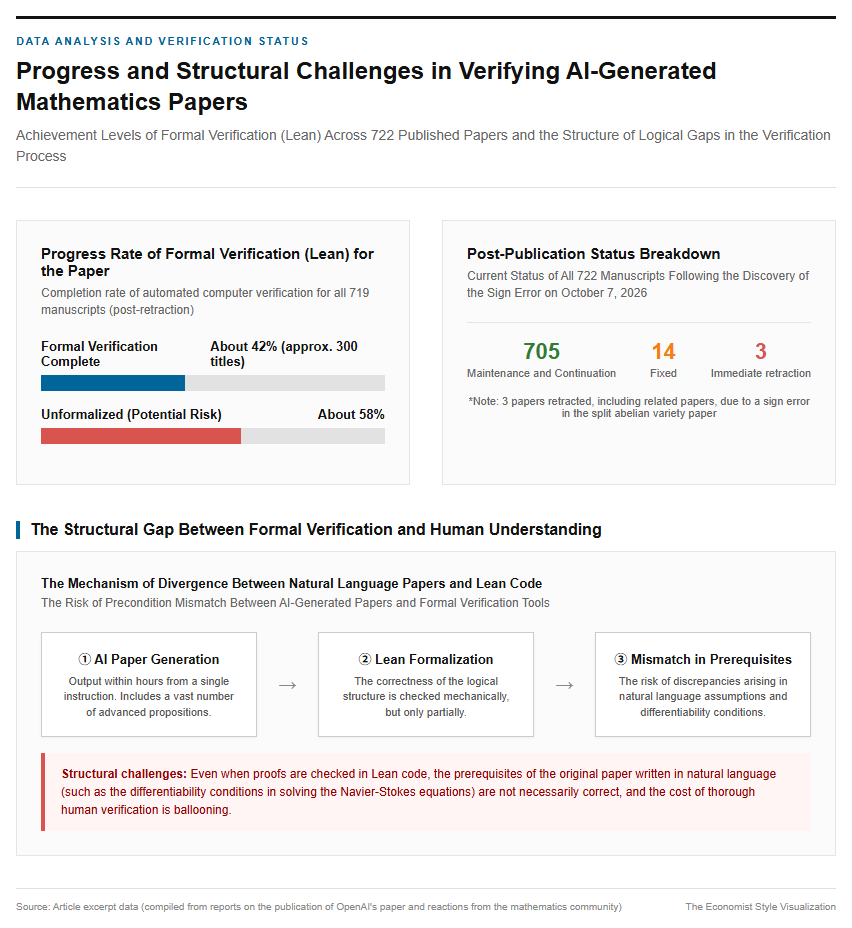
To ensure the reliability of the results, OpenAI also simultaneously released proof data using “Lean,” a formal verification tool based on a programming language. Out of a total of 719 manuscripts (after retraction), Lean formalization has been completed for nearly 300 of them—accounting for about 42%—making it possible to verify the correctness of their logical structures on a computer. However, the remaining approximately 58% remain unformalized, leaving open the possibility that they may contain potential logical flaws.
In fact, on October 7, 2026, the day after the publication, a sign error in a mathematical formula was discovered in a paper concerning split abelian varieties. This error undermined the preconditions of the proof, leading to the immediate retraction of a total of three papers—the paper in question and two related ones—while corrections were made to 14 other manuscripts. This once again highlights the deep dependency relationships in mathematical proofs and the indispensable nature of rigorous verification work.
The Growing Backlash and Concerns in the Mathematical Community
Statement of Criticism and Suspension of Cooperation by Mathematician Organization
In response to the massive publication of academic papers by AI, the mathematical community has raised not only praise, but also fierce opposition out of concern for research ethics and the negative impacts on the academic ecosystem. Professor Terence Tao, a Fields Medalist, published a statement by the Association for Humans in Mathematics (AHM) on his blog, calling on mathematicians worldwide to suspend their research collaborations with OpenAI.
In a statement, AHM strongly criticized the practice of companies using their own computational resources to mass-produce papers on a commercial scale, arguing that it threatens the long-standing human practice of “mathematical research that emphasizes deep understanding and dialogue.” Additionally, in its guidelines dated September 29, 2026, AGMAI, an advisory group at the Institute for Advanced Study (IAS) in the U.S., called for halting experiments that attempt to solve unsolved problems using proprietary models unavailable to general researchers.
Furthermore, 25 Fields Medalists, including Terence Tao, issued a joint statement criticizing the development stance of AI companies that simply pursue the speed of problem-solving. They argue that the true value of mathematics lies not only in solving difficult problems, but also in creating new concepts and sharing deep understanding through human discussion.
The Challenges of Human Understanding and Escalating Verification Costs
As the bottleneck in mathematical research has shifted from the traditional “discovery of theorems” to the “verification and understanding of proofs,” a peer-review saturation problem has emerged that human researchers cannot keep up with. It takes an immense amount of time and effort for humans to read through the vast volume of papers generated by AI in mere hours and verify their correctness.
Furthermore, even when a proof is checked in the formal verification language Lean, there is a structural challenge in that the original paper written in natural language is not necessarily correct. According to an investigation by researcher Alexander Bastounis and others, it has been pointed out that discrepancies exist between OpenAI’s September 2026 paper on the solution to the Navier-Stokes equations and the Lean code, such as in the required differentiability conditions. The following diagram illustrates the gap between formal verification and human understanding.
Against this background, Professor Tao proposes a new research vision called “Math 2.0.” A shift in the evaluation system is required—one that places high value not simply on whoever produces a proof first, but on individuals who clearly explain the reasoning behind a proof and share and develop it with others.
The Future Vision of Academic Publishing and AI Research
Leadership and Access Disparities Between AI Companies and Academia
Currently, a serious gap in research opportunities is emerging between giant AI companies that monopolize cutting-edge frontier models and ordinary universities and research institutions that lack access to them. While AI companies monopolize high-performance computing resources to solve challenges one after another, there are growing concerns that human mathematicians will be relegated to the role of “verifiers of AI results.”
To address this issue, Anthropic, a competitor to OpenAI, has introduced an approach where researchers are paid to explain AI breakthroughs in accessible terms, though critics point out that the company retains the authority to vet the researchers. Building a neutral research infrastructure that does not rely on specific corporations is essential to maintaining the academic community’s initiative.
The AGMAI guidelines propose a mechanism in which a non-profit organization independent of AI companies makes decisions on fund allocation and research support, as well as granting fair model access to all researchers. There is an urgent need to establish a sustainable ecosystem that allows the benefits of AI-driven discoveries to be shared across the entire academic community rather than limiting them to a select few companies.
Future Developments and Key Points
OpenAI has announced plans to fund workshops, international conferences, and special research programs to deepen human understanding of AI-generated papers. How to establish the vast mathematical achievements brought by AI as shared human knowledge will be the primary focus moving forward.
Important focal points moving forward include the following elements:
- Progress of Formal Verification Using Lean and Others and Error Correction Processes for Unformalized Papers
- Disclosure of prompts used for paper generation, all trial logs, and failed problem sets
- Verification status management on a claim-by-claim basis by an independent academic community
- Realizing Open Access to Advanced Mathematical AI Models for General Mathematicians
If humans cannot correctly interpret the complex proofs presented by AI and apply them to education and new applications, technological evolution will not directly translate to academic progress. Whether or not we can develop verification infrastructure and reconstruct human-centric research norms will greatly influence the future of mathematics.
Reference page
- 【Sharing AI progress in mathematics | OpenAI】https://openai.com/index/sharing-ai-progress-in-mathematics/
- 【GitHub – openai/math】https://github.com/openai/math
【#OpenAI #ArtificialIntelligence #MathPaper #AIEthics #LeanFormalization #AcademicPublishing】


コメント