In China’s economic indicators for September 2026, growth in both industrial production and retail sales accelerated, and third-quarter GDP also showed a solid trend. While the resilience of exports, centered on high-tech industries, contributed, challenges in domestic demand, such as the sluggishness in real estate development investment, also continue to remain evident.
- Acceleration of growth in industrial production and retail sales
- Q3 GDP Trends and Status of Government Target Achievement
- Manufacturing PMI Recovery Above the Threshold and the Contribution of the High-Tech Industry
- Transformation of Consumer Behavior and Leading Service Consumption
- The Decline in Fixed Asset Investment and the Drag on the Real Estate Market
- Trends in Fiscal and Monetary Policy and the Medium- to Long-Term Economic Outlook
Acceleration of growth in industrial production and retail sales
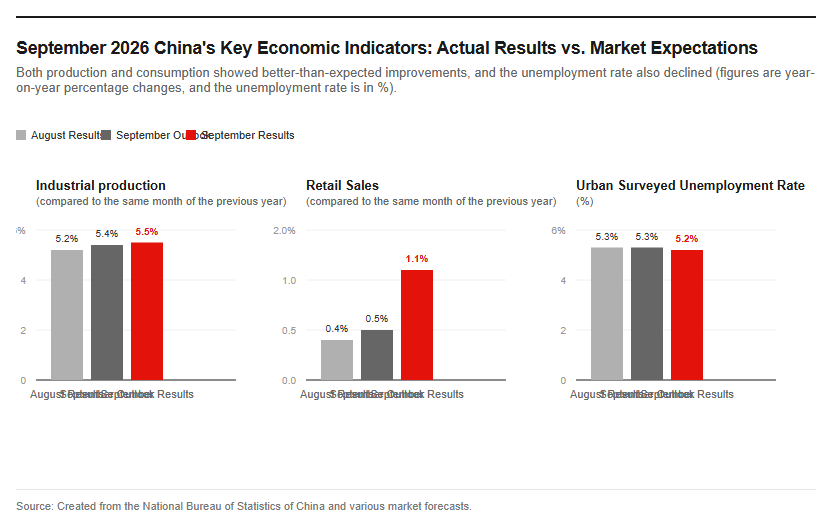
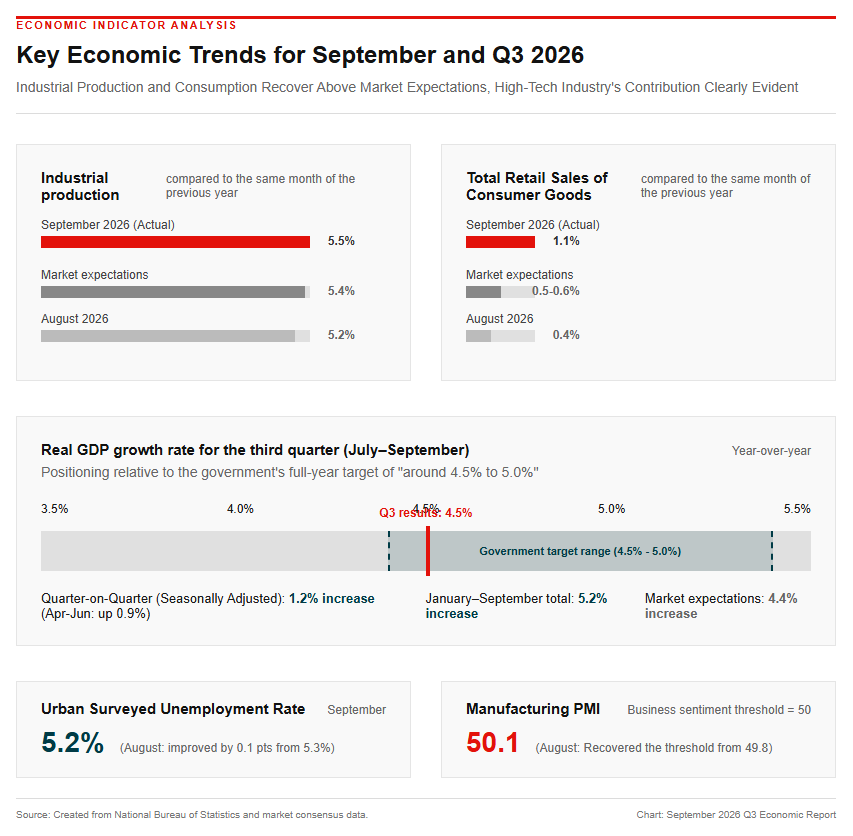
According to major economic indicators for September 2026 released by the National Bureau of Statistics of China, both production and consumption exceeded market expectations, indicating an improvement in economic activity momentum. Industrial production in September 2026 recorded a 5.5% increase compared to the same month of the previous year, expanding its growth rate by 0.3 percentage points from August 2026’s 5.2% increase. This level exceeded economists’ pre-release market expectations of a 5.4% increase, confirming that manufacturing production activity is steadily recovering.
Meanwhile, total retail sales of consumer goods in September 2026, an indicator of personal consumption trends, rose 1.1% year-on-year, accelerating from the 0.4% increase in August of the same year. While market expectations had pointed to a modest growth rate of 0.5% to 0.6%, the actual figure significantly outperformed forecasts, signaling a gradual recovery in consumer demand. It has also been pointed out that a temporary boost came from travel and shopping demand associated with the autumn holiday period (the Mid-Autumn Festival and National Day).
Additionally, the surveyed urban unemployment rate for September 2026, reflecting labor market trends, came in at 5.2%, a 0.1 percentage point improvement from 5.3% in August of the same year. This was better than the market expectation of 5.3%, indicating that employment stability is playing a certain role in underpinning personal consumption.
Q3 GDP Trends and Status of Government Target Achievement
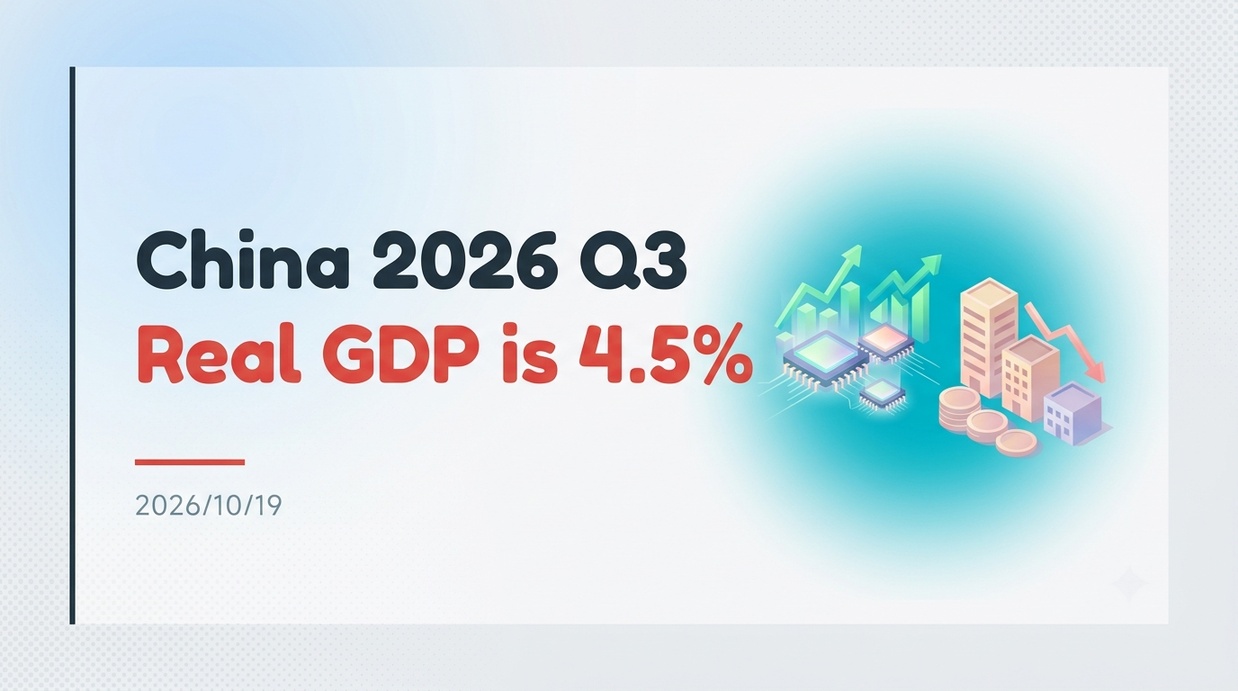
The improvement in various indicators in September 2026 also contributed to the overall growth of gross domestic product (GDP) for the July–September quarter (third quarter) of 2026. Real GDP growth for the July–September quarter of 2026 came in at 4.5% compared to the same period of the previous year, accelerating from the 4.3% growth seen in the April–June quarter of 2026. This exceeded market expectations of 4.4% growth, fitting well within the “around 4.5% to 5.0%” target range set by the Chinese government for the full year of 2026.
Looking at the growth rate on a seasonally adjusted quarter-on-quarter basis, the July–September 2026 period also saw an increase of 1.2%, expanding from the 0.9% growth recorded in the April–June 2026 period. As a result, the cumulative GDP growth rate for the January–September 2026 period secured a 5.2% increase compared to the same period of the previous year, confirming that the economic support measures implemented since the beginning of the year are yielding certain results.
However, while the current pace of growth shows stability, it remains at a modest level compared to past periods of high growth. It is analyzed that in order to steadily achieve the full-year growth target for 2026, it is essential to sustain the improving trends in production levels, employment, and consumption in major industries heading into the fourth quarter.
Factors Supporting Economic Recovery and Changes in Consumption Structure
Manufacturing PMI Recovery Above the Threshold and the Contribution of the High-Tech Industry
One of the primary factors driving the acceleration of industrial production in September 2026 was the improvement in the manufacturing Purchasing Managers’ Index (PMI). The manufacturing PMI for September 2026, released by the National Bureau of Statistics, reached 50.1, rising 0.3 points from 49.8 in August of the same year. Returning above the 50 mark—the threshold separating business sentiment expansion from contraction—reflects an improvement in orders and production appetite across the broader manufacturing sector.
Looking at trends by industry, the strength of high-tech industries is particularly noticeable, led by AI (artificial intelligence)-related equipment, electronic components, and electric vehicles (EVs), for which global demand is growing. The expansion of global demand for computing infrastructure and the growth in exports of high-value-added products have directly contributed to higher domestic factory shipments and improved operating rates on production lines.
In terms of external demand, support was provided by moves toward easing tensions in US-China trade negotiations and an increase in shipments of high-performance products, particularly to emerging markets. Although some uncertainty remains regarding demand for conventional manufactured goods in developed countries, a pattern is increasingly taking root where export growth of high-value-added products incorporating advanced technology underpins the resilience of the manufacturing sector as a whole.
Transformation of Consumer Behavior and Leading Service Consumption
The recovery of retail sales in September 2026 is not merely an expansion in goods purchases, but rather signals a structural shift in consumption patterns. While total retail sales of consumer goods for the January–September 2026 period edged up just 1.1% year-on-year, overall consumption expenditure—combining both goods and services—recorded a 2.6% year-on-year increase. Within this, service consumption sales demonstrated robust growth, surging 5.0% year-on-year and far outpacing the 1.0% growth seen in goods sales.
Behind this lies the shift in consumer interest from purchasing tangible “goods,” such as durable consumer goods, to “experience”-based consumption, such as travel, entertainment, dining, and healthcare. Although sales of durable goods like automobiles and home appliances have shown some stagnation, robust demand in dining out and leisure-related sectors has driven overall consumption.
That said, cautious views among households regarding future income growth and the negative wealth effect associated with sluggish real estate prices still persist, meaning consumer sentiment has yet to show full strength. It has been pointed out that further improvements in the income environment and the enhancement of the social security system are crucial to achieving sustained consumption growth.
Real Estate Slump and Future Policy and Market Outlook
The Decline in Fixed Asset Investment and the Drag on the Real Estate Market
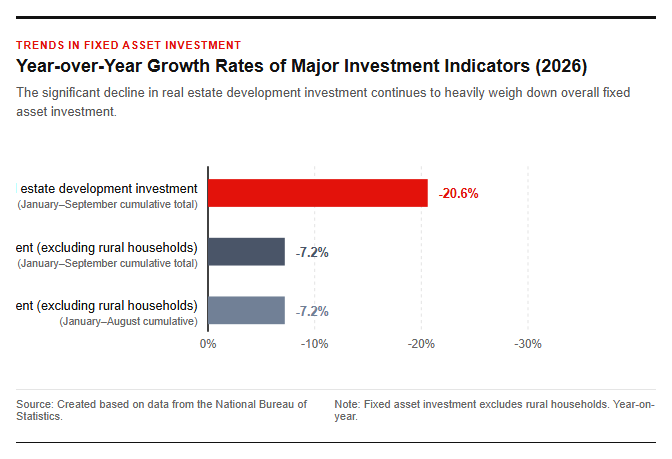
Among major economic indicators, fixed asset investment continues to face a severe environment. Cumulative nationwide fixed asset investment (excluding rural households) for the January–September 2026 period dropped 7.2% year-on-year, remaining at the same rate of decline as the cumulative January–August 2026 period. Although it slightly outperformed the market expectation of a 7.3% decrease, it remains unable to break out of significant negative growth.
The major factor weighing heavily on investment is the prolonged real estate slump. Cumulative real estate development investment for the January–September 2026 period decreased by 20.6% year-on-year, continuing a sharp downward trend. Sluggish housing sales floor area and ongoing cash flow difficulties for real estate developers continue to linger, leaving the cautious stance toward new construction starts and development investment unchanged.
Furthermore, the worsening fiscal balances of local governments and the issue of hidden debt are limiting their ability to allocate funds to infrastructure investment, which has traditionally been the mainstay of economic stimulus measures. This has also led to a stagnation in investment overall. Private companies’ willingness to invest lacks momentum against the backdrop of uncertainty in domestic demand, making the recovery of fixed-asset investment a future challenge for the economy as a whole.
Trends in Fiscal and Monetary Policy and the Medium- to Long-Term Economic Outlook
Amid the intertwining of a modest economic recovery and structural challenges, Chinese authorities continue to implement flexible policy responses. On the monetary policy front, the People’s Bank of China has implemented cuts to the Loan Prime Rate (LPR) and adjustments to the reserve requirement ratio, aiming to supply liquidity to the market and reduce financing costs. The maintenance of the monetary easing stance in September 2026 worked to improve the corporate funding environment.
Regarding fiscal policy, the central government is advancing support measures through the issuance of government bonds and special local government bonds. While trade-in support measures and fund allocation for infrastructure development are being implemented, some point out that a larger-scale fiscal stimulus is necessary to make up for the decline in local government revenues caused by the real estate slump. In the market, attention is focused on whether further economic stimulus measures will be introduced depending on future economic trends.
As a medium-to-long-term outlook, the Chinese economy is in a transitional phase from the conventional growth model reliant on real estate and large-scale infrastructure investment to high-quality development centered around AI and green industries (environment and energy-related fields). Whether it can create a synergistic effect between structural reform and the expansion of domestic demand while overcoming short-term cyclical economic waves holds the key to future sustainable growth.
Reference page
- Please provide the Japanese text you would like translated, as I cannot access external URLs directly.
【#ChinaEconomy #IndustrialProduction #RetailSales #GDP #FiscalPolicy】

コメント