On October 14, 2026, the Ministry of Land, Infrastructure, Transport and Tourism announced the 247 recipients of the FY2026 Minister’s Commendation for Automobile-Related Contributors, and held an award ceremony on October 21, 2026. Behind the recognition of the achievements of business operators and drivers who have long supported the frontline lies the critical challenge of maintaining regional transportation and logistics infrastructure amidst labor shortages and technological innovation.
- Overview of the Award Program and Background of the Ceremony
- Achievements of Key Award Winners Supporting Transportation and Logistics Operations
- Organizations Contributing to Statistical Surveys and Contribution to Regional Infrastructure
- Sharp Increase in Bankruptcies and Business Closures in the Automotive Maintenance Industry
- The Double Burden of Technological Advancement and the Mechanic Shortage
- The Impact of the Two Trucking Optimization Acts and the Business License Renewal System
- Paradigm Shift from Securing Mobility to Regional Value Creation
Overview of the Award Program and Background of the Ceremony
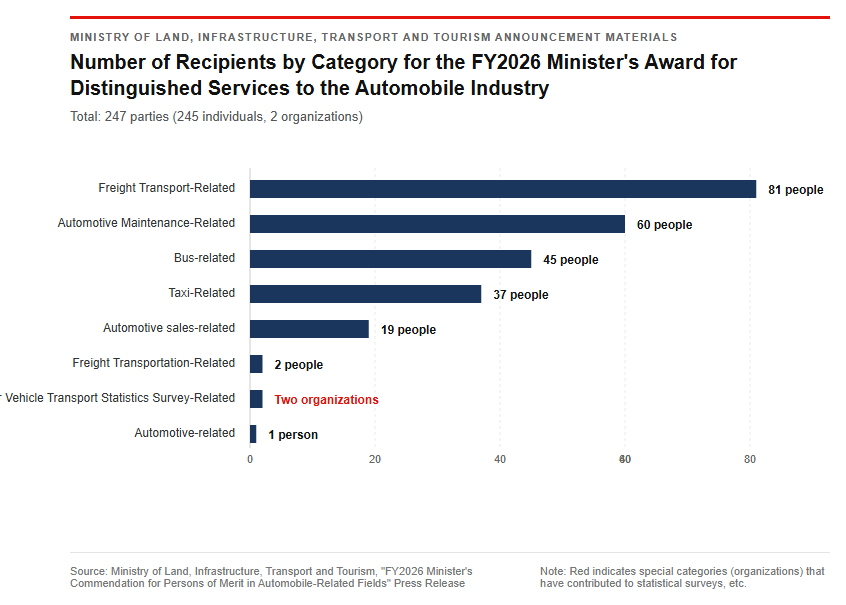
The Ministry of Land, Infrastructure, Transport and Tourism announced on October 14, 2026, the recipients of the “2026 Minister’s Commendation for Automotive-Related Contributors,” which honors individuals and organizations that have contributed to business promotion and safe operations in areas such as motor vehicle transport and maintenance. The award ceremony was held starting at 11:00 a.m. on Wednesday, October 21, 2026, in the 10th-floor Joint Conference Room of the Ministry of Land, Infrastructure, Transport and Tourism in Kasumigaseki, Chiyoda-ku, Tokyo. This year’s awardees total 247 (245 individuals and 2 organizations). The breakdown of the number of awardees by category is as follows.
- Bus-related: 45 people
- Taxi-related: 37 people
- Freight transport-related: 81 people
- Automotive maintenance-related: 60 people
- Automotive sales-related: 19 people
- Automotive-related: 1 person
- Freight transportation: 2 people
- Automobile Transport Statistical Survey-related: 2 organizations
This award broadly honors achievements ranging from on-site staff who have strived for years as commercial vehicle drivers with zero accidents and zero violations, as well as diligent service, to executives who have contributed to the promotion of regional transportation as officers of industry organizations. At the venue, pre-registration-based photography and coverage took place, and certificates of commendation were awarded in a solemn atmosphere.
Achievements of Key Award Winners Supporting Transportation and Logistics Operations
In the rail freight forwarding category, Mitsuru Saito, former Representative Director and President of Nippon Express Co., Ltd. and current Chairman of the National Freight Forwarding Federation, received the Ministerial Commendation. Mr. Saito was recognized for his many years of dedication to fostering and developing the rail freight forwarding business, as well as his contributions to promoting the use of railway freight transport and building a sustainable logistics system. In the freight transport category, 81 individuals were awarded, including Nagatoshi Endo, Chairman of the Saitama Trucking Association and Representative Director of Toei Logistics, and Yoshifusa Wada, Board Member of the Hokkaido Trucking Association and Representative Director and President of Kowa Haiso. In the bus industry category, 45 people were commended; in addition to corporate executives, this group includes many long-serving bus drivers, such as Mitsuhiro Sugawara of JR Hokkaido Bus and Masao Takizawa of Nemuro Kotsu. In the taxi category, 37 individuals were selected, featuring Junichi Yamada, Vice Chairman of the Tokyo Hire-Taxi Association and Representative Director and President of Eishin Jidosha, and Kimihide Takano, Representative Director and President of Green Cab. In the automobile maintenance category, 60 people were also recognized, honoring business owners and automobile mechanics who have worked hard for many years to promote the local automobile maintenance industry and maintain advanced maintenance technologies. The presence of awardees across these various fields speaks to the reality of how they have fundamentally supported Japan’s mobility and logistics amidst severe working conditions.
Organizations Contributing to Statistical Surveys and Contribution to Regional Infrastructure
A notable highlight of this year’s awards is the recognition of two transport operators that received the Minister’s Award in connection with the Motor Vehicle Transport Statistics Survey. The award-winning organizations are Toyotetsu Midai Co., Ltd., headquartered in Tahara City, Aichi Prefecture, and Kyodo Bus Co., Ltd., headquartered in Gyoda City, Saitama Prefecture. Over many years, these organizations have deeply understood the importance of the Motor Vehicle Transport Statistics Survey conducted by the Ministry of Land, Infrastructure, Transport and Tourism, and have made significant contributions to the formulation of national transport policies by consistently providing accurate and prompt data reports. They were highly praised not only for their daily safe operation of fixed-route buses and tour buses as public transport operators, but also for fulfilling the public role of improving the accuracy of administrative statistics. Accurate transport performance data submitted from the front lines serves as essential foundational material when developing measures for maintaining regional bus routes and eliminating transportation gaps. The following figure shows an image of the award ceremony and regional transport infrastructure.
Sincere cooperation with statistical surveys and the provision of transportation services in the field are extremely important for maintaining and developing regional mobility infrastructure.
Structural Challenges and Labor Shortage Facing the Auto Transport and Maintenance Industry
Sharp Increase in Bankruptcies and Business Closures in the Automotive Maintenance Industry
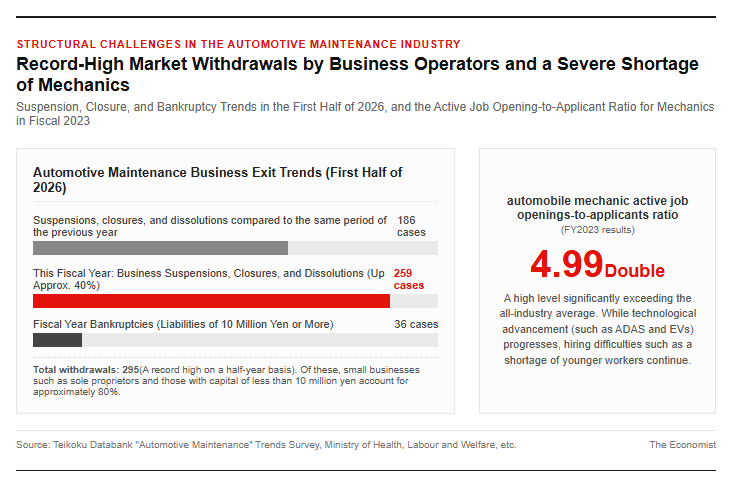
While long-standing achievements are being honored with ministerial commendations, the business environment surrounding the fields of motor vehicle transport and maintenance is in an extremely severe situation. According to a survey on bankruptcy, suspension, and dissolution trends (First Half of 2026) in the “Automobile Maintenance” sector released by Teikoku Databank on July 8, 2026, business suspensions and dissolutions of automobile maintenance operators reached 259 cases during the six-month period from January to June 2026. This is a sharp increase of about 40% from the 186 cases in the same period of the previous year. Combined with 36 bankruptcies that underwent legal liquidation with liabilities of 10 million yen or more, a record-high total of 295 operators on a half-year basis exited the market. Looking at the breakdown of the operators that withdrew, 115 cases (about 40% of the total) had capital of 1 million yen or more and less than 10 million yen, while 107 cases (38.4%) had capital of less than 1 million yen, including sole proprietors. Small-scale automobile maintenance shops account for about 80% of the total. Although there are tailwinds such as property and casualty insurance companies raising repair labor rates, micro-enterprises are often unable to sufficiently pass on surging material costs and rising labor costs to prices, driving them into operating at a loss. Due to labor shortages, the processing capacity of maintenance shops has declined, resulting in long maintenance waiting times at automotive supply stores and dealerships. Consequently, the hollowing out of regional infrastructure that ensures vehicle safety and the emergence of “maintenance refugees” have become realistic concerns.
The Double Burden of Technological Advancement and the Mechanic Shortage
Another major challenge facing the automotive maintenance industry is the rapid evolution of vehicle technology and a severe shortage of skilled workers. With the spread of Advanced Driver Assistance Systems (ADAS) and electric vehicles (EVs), the establishment of advanced maintenance systems capable of handling precision diagnostics for electronic control systems and aiming (calibration of electronic control units) is required. However, on-site shortages of skilled mechanics are becoming extremely acute due to younger generations turning away from cars and the impact of working conditions. According to statistics from the Ministry of Health, Labour and Welfare and other sources, the active job opening-to-applicant ratio for automobile mechanics hovered at a high level of 4.99 for the 2023 fiscal year, and hiring difficulties far exceeding the all-industry average continue. In response to this situation, the Logistics and Motor Car Bureau of the Ministry of Land, Infrastructure, Transport and Tourism held the 33rd “Committee on the Advancement of Automobile Maintenance Technology” at AP Shimbashi on October 13, 2026. Experts, representatives from the Japan Automobile Maintenance and Inspection Association, and other stakeholders gathered to discuss productivity improvements through the utilization of electronic inspection records and support for the introduction of scan tools, alongside measures to secure human resources. The following figure illustrates the concept of technological advancement and equipment in maintenance operations.
Furthermore, starting January 1, 2027, a new automobile mechanic qualification system aligned with the new curriculum is scheduled to be implemented, and structural reforms at maintenance sites are progressing at a rapid pace.
Policy Shift and the Future Vision of Regional Mobility
The Impact of the Two Trucking Optimization Acts and the Business License Renewal System
To ensure the sustainability of the automotive transport and logistics industry, government-led public regulations and market optimization measures are being strengthened. The “FY2026 Transport Policy White Paper,” published by the Ministry of Land, Infrastructure, Transport and Tourism (MLIT) on July 10, 2026, outlines strict operational policies based on the two trucking optimization acts enacted in June 2025 (the revised Trucking Business Act and the Business Optimization Act). Shifting away from the conventional approach centered on administrative guidance, a 5-year “business license renewal system” and a “fair cost system” are scheduled to be fully implemented by June 2028. This establishes a framework in which non-compliant operators who engage in price-cutting at rates below fair costs will be denied license renewals and weeded out of the market. Furthermore, monitoring and corrective guidance by truck and logistics G-men have been drastically reinforced against shippers who impose prolonged loading/unloading wait times or unreasonable incidental operations. A transition is underway from the traditional structure dependent on excessive price competition to an infrastructure-style industry rooted in strict compliance and data management, making the securing of appropriate freight rates and the improvement of drivers’ working conditions mandatory.
Paradigm Shift from Securing Mobility to Regional Value Creation
In Japanese society, which is facing an aging population and declining birthrate, maintaining means of transportation is not merely a traffic issue, but a critical challenge that dictates the survival of local communities. The Ministry of Land, Infrastructure, Transport and Tourism has set a policy to make significant progress toward eliminating transportation deserts nationwide by fiscal year 2027, and is rushing to rebuild regional mobility in cooperation with multiple fields such as medical care, welfare, and education. A shift from the conventional business model of “selling new vehicles” to mobility services that “efficiently utilize vehicles” is required, and the perspective of redefining regional transportation not as a cost, but as a growth investment in the region is essential. As a specific successful example, the initiative of the free demand-responsive transportation “Genki Bus” operated in Tamaki Town, Mie Prefecture, can be cited. By designing the means of transportation and destinations in an integrated manner, it was demonstrated that the number of usages and participants in preventive care classes increased about fourfold, and outpatients’ medical expenses for users were reduced by about 20,000 yen per year. Supported by the dedication of frontline contributors symbolized by ministerial commendations, the realization of a sustainable, high-value-added regional mobility society is expected by promoting the social implementation of autonomous driving technology and the utilization of digital infrastructure.
Reference page
- [Ministry of Land, Infrastructure, Transport and Tourism Press Release: “Regarding the 2026 Minister’s Awards for Distinguished Service to Automobile-Related Fields”] https://www.mlit.go.jp/report/press/kanbo03_hh_000426.html
【#MinistryOfLandInfrastructureAndTransport #MinistersCommendationForDistinguishedServicesToAutomotiveSector #Trucking #AutomotiveMaintenance #TransportPolicy】

コメント