
The Ministry of Land, Infrastructure, Transport and Tourism has released the results of a questionnaire survey regarding corporate evaluation systems in the construction industry. The results have revealed a strong emphasis on sociality and other factors (W-score) in the Comprehensive Construction Industry Evaluation (Keishin), the expanded utilization of the Construction Career Up System (CCUS), and a high demand for evaluation systems spanning across business types.
- Key points of the event: Overview of corporate evaluation survey results
- Background and Purpose of the Survey: New Evaluation Metrics for Companies That Stand Out
- Emphasis on W-Scores in Keishin and the Transition of CCUS into a Public Platform
- Challenges of the Specialized Construction Visualization System and the Need for Cross-Industry Evaluation
- Human Capital Investment, Improvement of Treatment, and Information Visualization Utilizing DX and AI
- Future Developments and Key Points: Aiming to Compile the Direction within Fiscal 2026
Key points of the event: Overview of corporate evaluation survey results
On October 21, 2026, the Ministry of Land, Infrastructure, Transport and Tourism held the second meeting of the “Corporate Evaluation Working Group,” which was established under the expert committee “Committee on the Future of the Construction Industry as a Sustainable Growth Industry,” and announced the results of a questionnaire survey targeting construction companies. This survey was conducted among member companies through seven major organizations, including the Japan Federation of Construction Contractors and the National Association of General Contractors, to gather the raw voices from the field regarding how corporate evaluation should be conducted beyond traditional classifications such as public and private construction works, or primary contractors and subcontractors. The tabulated results highlighted a growing sense of limitation regarding the conventional evaluation criteria used in public works bidding and a strong industry-wide need to establish new evaluation metrics adapted to changing times. In particular, expectations are rising for a mechanism that fairly evaluates non-financial information—such as human resource development, improved working conditions, and the adoption of digital technologies—rather than relying solely on financial figures or past construction performance.
Background and Purpose of the Survey: New Evaluation Metrics for Companies That Stand Out
In the construction industry, the rapid decline and aging of the working-age population are accelerating, making it an urgent priority to break free from traditional structural challenges such as long hours of heavy labor and low wages. Starting in April 2024, caps on overtime work have been applied, and management styles that view the traditional workforce merely as a cost have reached their limits. Amid intensifying competition with other industries for talent, a mindset reform to reframe people as investment targets is essential in order to evolve into an industry chosen by society and the labor market. Although current corporate evaluation systems exist—such as the Comprehensive Assessment System for Construction Enterprises (Keishin) for public works prime contractors and general construction permits—they have been insufficient as mechanisms to ensure that companies earnestly working to improve their working environments and digital transformation are not disadvantaged in terms of cost. This survey was conducted to overcome the structural limitations of existing systems and create a cycle where legitimate efforts are rewarded. Please refer to the following figure regarding the industry-wide awareness toward reforming the evaluation system.
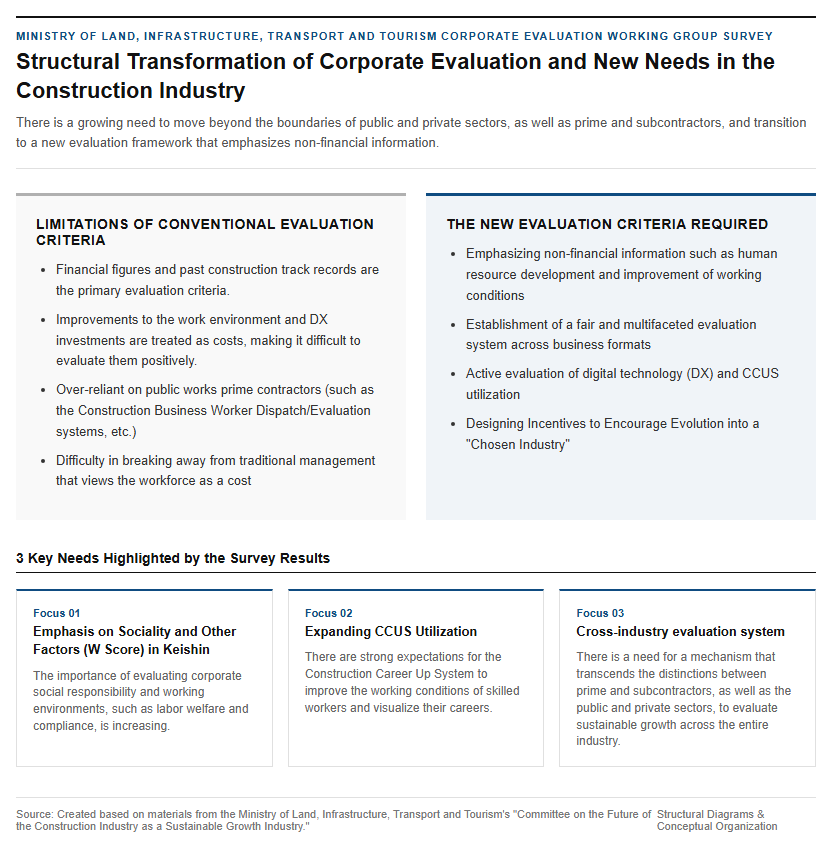
Limitations of Existing Evaluation Systems and Urgent Demands from the Industry
Emphasis on W-Scores in Keishin and the Transition of CCUS into a Public Platform
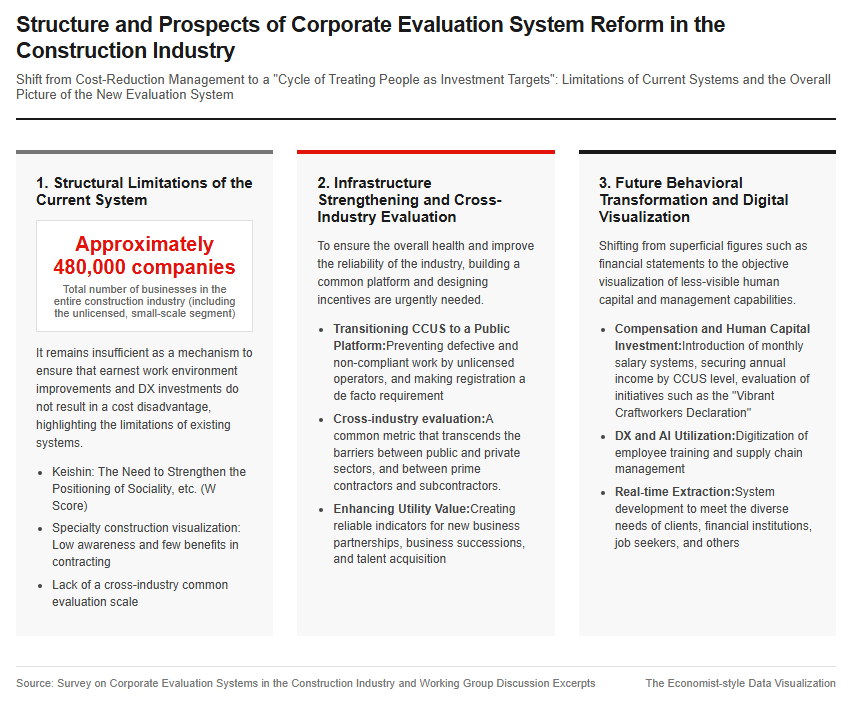
In the survey results, while a certain level of evaluation was shown for the Comprehensive Assessment of Construction Businesses (Keishin), which is used to assess bidding eligibility for public works, the majority of opinions stated that the positioning of sociality and other factors (W points)—which are policy-driven evaluation items—should be further strengthened. There is a demand to more directly reflect corporate social responsibility and initiatives for the working environment into scoring additions. On the other hand, great expectations were placed on the role of the Construction Career Up System (CCUS) as a foundation covering the entire construction industry, which consists of approximately 480,000 companies. Specific proposals were raised by multiple organizations to make CCUS registration a de facto requirement and a public platform in order to prevent substandard and unqualified construction by operators who perform only small-scale work and do not hold a construction business license. Officials from the Ministry of Land, Infrastructure, Transport and Tourism (MLIT) and experts also support the concept of positioning CCUS as a common foundation, linking it to the sound development and improved reliability of the entire industry.
Challenges of the Specialized Construction Visualization System and the Need for Cross-Industry Evaluation
It has been revealed that the capability visualization evaluation system targeted at specialized contractors is struggling to gain traction due to low awareness among project owners and job seekers, as well as a lack of concrete business benefits in contracting for prime contractors. It has been pointed out that designing practical incentives for companies that obtain the evaluation is essential to promote its utilization. Furthermore, it was found that there is extremely high latent demand for a cross-industry evaluation scale that breaks down traditional barriers—such as public versus private sectors and prime versus subcontractors—and can be universally utilized across the entire construction industry. If such cross-cutting evaluation standards are established, they are expected to serve as a reliable indicator not only for developing new business partners, evaluating companies during business succession, and optimizing the entire supply chain, but also for job seekers and foreign talent when choosing their employers.
Future Behavioral Transformation and Prospects for Institutional Design
Human Capital Investment, Improvement of Treatment, and Information Visualization Utilizing DX and AI
In future corporate evaluations, a shift is required toward a system that fairly evaluates tangible actions—such as the introduction of monthly salary systems, securing salary levels based on CCUS (Construction Career Up System) skill levels, and the “Artisans’ Well-being Declaration,” which promises to improve the treatment of skilled workers. Rather than focusing solely on superficial figures like sales and financial statements, importance is placed on objectively visualizing intangible human capital and management capabilities, such as staff training, the adoption of DX and AI, and supply chain management. In the working group discussions, it was proposed to build a digital system that not only expresses the collected abundance of evaluation data in a single score, but also extracts necessary information in real time according to the needs of diverse stakeholders, such as private clients, financial institutions, and job seekers. Please refer to the following figure for an image aimed at information visualization and improved searchability.
Future Developments and Key Points: Aiming to Compile the Direction within Fiscal 2026
Moving forward, based on the results of this survey, the Ministry of Land, Infrastructure, Transport and Tourism (MLIT) plans to successively conduct detailed hearings with public and private project owners, construction organizations, educational institutions, and job seekers. By delving deeply into specific opinions from the field, needs in the private market, and the perspectives of students and others in their job-hunting activities, the ministry aims to enhance the effectiveness of the system design. Ultimately, it plans to compile the overall direction regarding the ideal form of the new corporate evaluation system within the 2026 fiscal year. For construction companies, rather than simply waiting for the system to be implemented, actively investing in human resources, improving the work environment, and promoting DX from now on will be crucial keys to becoming a chosen company in the future. Whether the public and private sectors can work together to create a virtuous cycle in the industry structure will be the greatest point of focus moving forward.
Reference Page
- [Ministry of Land, Infrastructure, Transport and Tourism: Survey on Corporate Evaluation and Multi-layered Subcontracting Structures, etc. in the Construction Industry] [suspicious link removed]
【#MinistryOfLandInfrastructureTransportAndTourism #ConstructionIndustry #CorporateEvaluationSurvey #ConstructionBusinessEvaluation #ConstructionCareerUpSystem #DX】


コメント