The open-source “llm-d 1.0” for distributed AI inference was officially released in October 2026. This comes amid a strong demand to balance stable operations and cost reduction in production environments, as human conversational AI and automated processing by AI agents share the same GPU resources.
- Official Release of Distributed AI Inference Infrastructure and Key Feature Highlights
- Challenges of Stateful Inference in Traditional Kubernetes Environments
- Flow Control and Operational Features Enabling Priority Control and Zero-Downtime Updates
- Efficiency Improvement Through KV Cache Reuse and Tiering
- Significant Cost Reduction Effects Seen in Case Studies by IBM Research and Others
- Issues to Consider for Implementation, Future Developments, and Key Focus Areas
Official Release of Distributed AI Inference Infrastructure and Key Feature Highlights
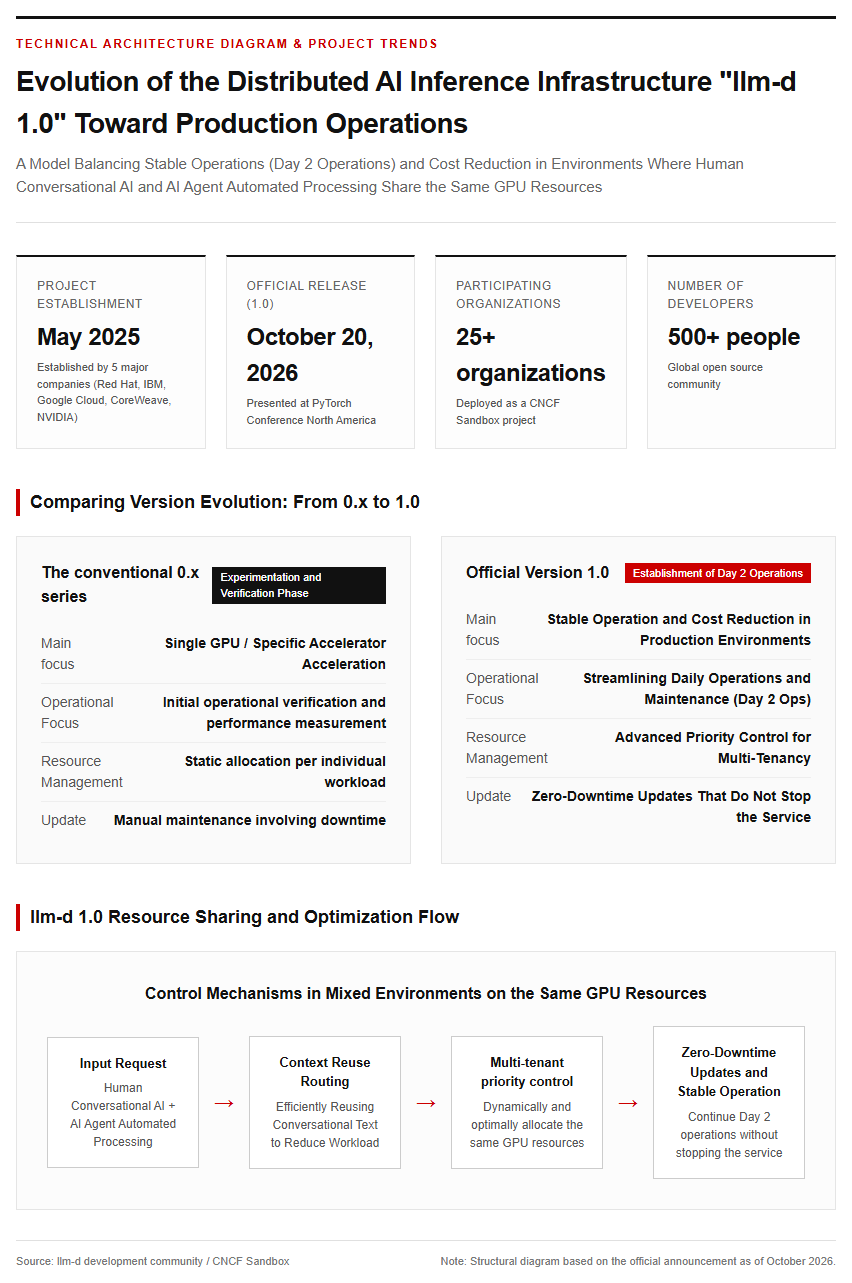
The llm-d development community, an open-source distributed AI inference stack project, officially released “llm-d 1.0” on October 20, 2026, at PyTorch Conference North America. The project was established in May 2025 by Red Hat, IBM, Google Cloud, CoreWeave, and NVIDIA, and currently, as a Cloud Native Computing Foundation (CNCF) Sandbox project, it involves over 500 developers from more than 25 organizations. While previous 0.x versions focused primarily on accelerating processing on a single GPU or specific accelerators, version 1.0 places its primary focus on establishing “Day 2 Operations”—referring to daily operation and maintenance. Specifically, anticipating environments where human conversational usage and heavy background processing by AI agents share the same infrastructure, features such as multi-tenant priority control, zero-downtime updates, and context-reuse routing for conversations have been significantly enhanced. This will dramatically improve the stability and cost efficiency of Large Language Model (LLM) production operations. Please refer to the architectural diagram below for a better understanding.
Challenges of Stateful Inference in Traditional Kubernetes Environments
The biggest bottleneck in scaling LLM inference has been the divergence between the standard behavior of Kubernetes—the container orchestration platform—and the stateful nature of inference processing. Kubernetes basically treats all Pods equally and statelessly, allocating requests using methods like round-robin. However, LLM inference holds prompts and past conversation history in GPU memory (VRAM) as a Key-Value (KV) cache, making it extremely stateful. If a continuation of the same conversation or a similar prompt is sent to a different Pod, past calculation results are not reused, and a massive amount of computation (the prefill phase) occurs redundantly every time. While this would only result in a latency difference of a few percent in a web application, in LLM inference, the cache hit rate determines response time and computational cost by a factor of several times. llm-d 1.0 fundamentally resolves this architectural gap by leveraging Kubernetes Gateway API extensions to intelligently route requests to the appropriate Pod based on input hash values and context information of the requests.
Technical Features and Architecture Supporting Large-Scale Operations
Flow Control and Operational Features Enabling Priority Control and Zero-Downtime Updates
Conversational processing, which requires immediate responses from humans, and AI agent processing, which repeats external tool calls and long thinking routines, have vastly different response requirements. If these are processed on the same inference infrastructure as-is, there is a risk that human conversations will experience significant delays when a large volume of requests from agents concentrates. To address this, llm-d 1.0 introduces a flow control feature that assigns independent queues for each user identifier and priority tier. While prioritizing the highest-priority requests, it performs fair round-robin scheduling within the same priority level, thereby preventing resource monopolization by specific users. Furthermore, it is equipped with a function to make requests wait on the router side during system overloads and perform probabilistic traffic control. In terms of operations, for configurations where input processing (prefill) and generation processing (decode) are separated, it implements “DisaggregatedSet”—which routes requests while verifying version compatibility between the two—and a hot standby function that provides a standby router. This enables safe system updates without any service downtime.
Efficiency Improvement Through KV Cache Reuse and Tiering
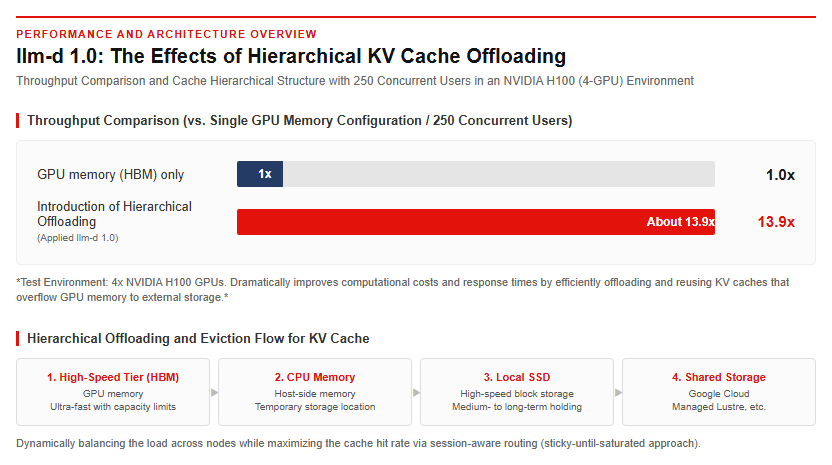
Since AI agents repeatedly read the same system instructions and reference documents, context reuse efficiency largely dictates overall processing performance. Session-aware routing in llm-d 1.0 adopts a “sticky-until-saturated” approach that preferentially routes requests to execution targets holding the KV cache corresponding to past conversation history. When an execution target reaches saturation, requests are automatically redistributed to another node, maintaining a high cache hit rate while preventing excessive load concentration on a single node. In addition, it supports hierarchical cache offloading, which offloads KV caches overflowing from capacity-limited GPU memory (HBM) to host CPU memory, local SSDs, and even high-speed shared storage such as Google Cloud Managed Lustre. In verification tests using an environment with four NVIDIA H100 GPUs, it was confirmed that introducing hierarchical offloading improves throughput for 250 concurrent users by approximately 13.9 times compared to a configuration using only GPU memory. The overall system architecture is shown in the conceptual diagram below.
Case Studies, Cost Effectiveness, and Future Outlook
Significant Cost Reduction Effects Seen in Case Studies by IBM Research and Others
The economic impact of introducing llm-d 1.0 has already been demonstrated in multiple early case studies. In an AI design exploration experiment for quantum error correction hardware conducted by IBM Research, a configuration combining an open model with llm-d achieved an extremely high prefix cache hit rate of approximately 98%. As a result, the inference serving cost per 1 million tokens was kept to about $0.11, successfully reducing inference costs to approximately 1/11.5 compared to using a commercial proprietary model for an equivalent number of exploration tasks. Additionally, in a test operating GLM-5.2, a 744-billion-parameter Mixture of Experts (MoE) model, across 544 NVIDIA H100 GPUs, it simultaneously processed up to 3,000 coding agents and kept processing interruptions (preemptions) to zero while recording an output of over 6.6 million tokens per minute at peak. Furthermore, achievements in various commercial production environments have been reported, such as achieving a 75–80% prefix cache hit rate at Snap and a 4x improvement in inference throughput at ZenteiQ.
Issues to Consider for Implementation, Future Developments, and Key Focus Areas
llm-d 1.0 provides a highly practical, software-driven solution to the hardware constraint of VRAM capacity limits. However, there are some points to keep in mind upon deployment. Priority control and inter-tenant fairness settings are not enabled by default, requiring adopting companies to explicitly write configuration parameters tailored to their operational policies. In addition, since cost reduction through KV cache reuse is most prominent in agent processing and multi-turn conversations with significant shared input, the effect may be limited for workloads centered on single, independent queries. The development community’s roadmap includes full automation of active-active configurations running multiple routers simultaneously, and the expansion of failover functions to safely hand over in-flight inference requests to another node in the event of a failure. Furthermore, plans are underway to expand support for Wide Expert Parallelism—which distributes Mixture-of-Experts (MoE) models across multiple nodes—as well as support for multimodal and voice inference, drawing significant attention to its evolution as a standard AI inference infrastructure.
Reference page
- 【llm-d Official Blog】https://llm-d.ai/blog/llm-d-v1.0-state-of-the-art-inference-ready-for-day-2
- [llm-d GitHub Repository] https://github.com/llm-d/llm-d
- [IBM Research Official Announcement] https://research.ibm.com/blog/llmd-1-0-is-ready-for-production-inference-serving
- [Google Cloud Official Blog] https://cloud.google.com/blog/topics/ai-infrastructure/llm-d-1-0-open-source-stack-for-distributed-inference
【#AI #LLM #OpenSource #Kubernetes #CloudNative #llmd #AIAgent】


コメント