NVIDIA has announced the “Vera CPU,” a datacenter processor specialized for agentic AI. This move is driven by the need to meet surging CPU processing demands resulting from shifting AI workloads.
- Key Takeaway: The emergence of processors equipped with proprietary cores and overwhelming specs
- Architecture Refresh: Pursuing Single-Core Performance and Bandwidth
- The Paradigm Shift in AI Workloads: Eliminating the CPU Bottleneck
- Rapid Market Expansion to a 0-Billion Scale and the Battle for Supremacy with the x86 Camp
- Advanced Manufacturing and a Powerful Ecosystem with Key Partners
- Future Outlook and Key Points: The True Value of the Vertically Integrated AI Factory
Key Takeaway: The emergence of processors equipped with proprietary cores and overwhelming specs
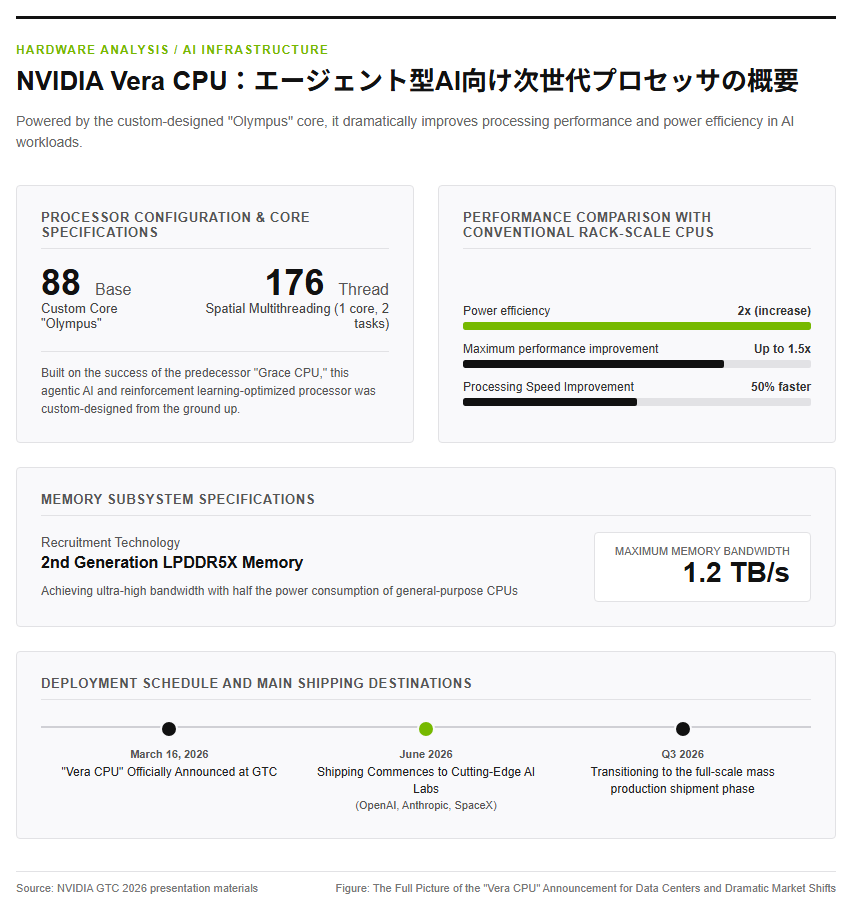
At the GTC conference on March 16, 2026, NVIDIA announced the “Vera CPU,” a data center processor designed for agentic AI and reinforcement learning operations. Building on the success of its predecessor, the NVIDIA Grace CPU, this product features 88 custom-designed “Olympus” cores built from the ground up by the company. Each core adopts NVIDIA Spatial Multithreading technology, enabling the simultaneous processing of two tasks per core to achieve parallel execution of up to 176 threads. In terms of performance, compared to traditional rack-scale CPUs, it achieves twice the power efficiency and is 50 percent faster, confirming up to a 1.5x performance improvement. Furthermore, its memory subsystem adopts second-generation LPDDR5X memory, delivering an ultra-high bandwidth of up to 1.2 TB/s at half the power consumption of general-purpose CPUs. Shipments to cutting-edge AI labs such as OpenAI, Anthropic, and SpaceX already began in June 2026, transitioning to full-scale mass production in the third quarter of 2026. As shown in the system configuration diagram below, advanced system integration has been achieved.
Architecture Refresh: Pursuing Single-Core Performance and Bandwidth
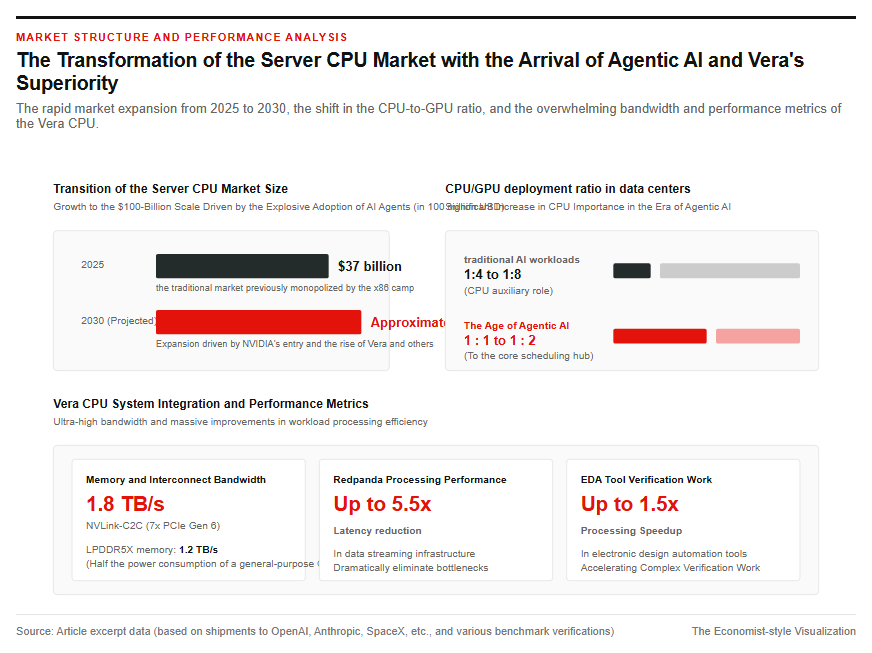
In traditional server CPU development, increasing throughput through a higher core count has been the mainstream approach, but the Vera CPU fundamentally reinvents this design philosophy. Rather than simply increasing the number of cores, an architecture has been built that specializes in three key areas: single-core processing speed, high memory bandwidth, and low latency. In AI agent processing, round-trip computations occur continuously, where the CPU receives inference results from a GPU, makes the next operational decision or executes a tool, and then sends the processing back to the GPU. To solve the problem of the CPU becoming a bottleneck during this round-trip processing, the Vera CPU accelerates operations armed with superior single-thread performance and per-core bandwidth. It adopts NVIDIA NVLink-C2C as a system-level interconnect technology, linking with the GPU at a coherent bandwidth of 1.8 TB/s—equivalent to seven times that of PCIe Gen 6. This enables ultra-fast, latency-free data sharing between the CPU and GPU, dramatically boosting the performance of complex script execution and data analysis pipelines.
The Transition to the Agentic AI Era and the Restructuring of the Server CPU Market
The Paradigm Shift in AI Workloads: Eliminating the CPU Bottleneck
The technological trends in artificial intelligence are shifting in earnest from mere text generation and model training stages to “agentic AI,” which autonomously plans, verifies, and executes tasks. Along with this, the structure of computational processing in data centers has changed, and the role of the CPU has been elevated from an auxiliary presence to a core scheduling hub that oversees the entire system. While the deployment ratio of CPUs to GPUs in conventional AI data centers was about 1:4 to 1:8, it is predicted that in the era of agentic AI, the demand ratio for CPUs will rise to nearly 1:1 to 1:2. Even in actual benchmark tests, the Vera CPU has demonstrated results such as reducing the processing latency of Redpanda, a data streaming infrastructure, by up to 5.5 times, and speeding up verification work in electronic design automation (EDA) tools by up to 1.5 times. This highlights that improving CPU processing capabilities has become an indispensable factor in the overall optimization of computing infrastructure.
Rapid Market Expansion to a 0-Billion Scale and the Battle for Supremacy with the x86 Camp
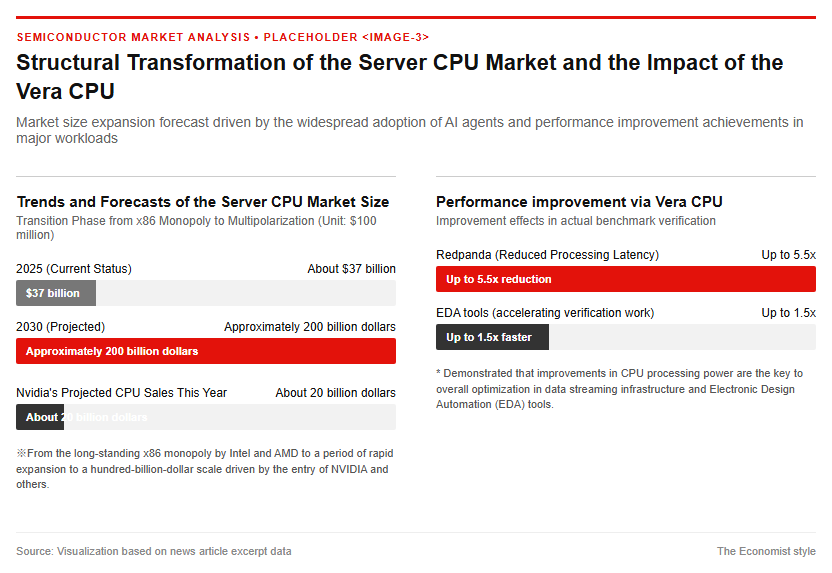
The server CPU market was valued at approximately $37 billion as of 2025, but it is analyzed that it will grow to nearly $200 billion by 2030, driven by the explosive adoption of AI agents. For years, the market has been dominated by the two x86 architecture giants, Intel and AMD, but the landscape is undergoing a major shift with the introduction of the Vera CPU. NVIDIA expects about $20 billion in revenue from its standalone CPU business this year, establishing its position as a major server CPU supplier. While competing x86 vendors race to increase core counts, NVIDIA provides a vertically integrated rack system format that combines its proprietary Arm-based cores, GPUs, and high-speed networking. The figure below illustrates the structural changes of key players in the server CPU market.
Supply Chain Collaboration, Future Developments, and Key Focus Areas
Advanced Manufacturing and a Powerful Ecosystem with Key Partners
Supporting the stable supply and performance of the Vera CPU is a world-class semiconductor supply chain network. TSMC’s 3nm and 5nm process technologies and advanced CoWoS packaging technology are fully utilized in its manufacturing. Furthermore, to expand advanced packaging capacity, a long-term contract totaling approximately $3 billion has been signed with Amkor Technology, while collaborations with SPIL, Kinsus, and Samsung Electro-Mechanics aim to strengthen substrate and board manufacturing capabilities. Major system manufacturers such as Foxconn, Dell Technologies, HPE, Lenovo, and Supermicro have joined the manufacturing ecosystem, establishing mass-production systems for liquid-cooled rack systems. In addition, cloud service providers such as Oracle Cloud Infrastructure, Alibaba, ByteDance, Meta, and CoreWeave have successively decided to adopt it, rapidly driving the standardization of the platform for developers and enterprises.
Future Outlook and Key Points: The True Value of the Vertically Integrated AI Factory
The focus going forward is on how much return on investment (ROI) the vertically integrated “AI Factory” system incorporating the Vera CPU can generate in actual enterprise operations. NVIDIA is accelerating its transition from standalone GPU sales to a business model that provides CPUs, GPUs, switches, and cooling mechanisms on a rack-by-rack basis. Looking ahead, the market will be focusing on the following three points:
- The scale of additional Vera CPU orders and the pace of replacement at major cloud providers and cutting-edge AI labs
- The Impact of Tight Supply and Demand for TSMC’s Advanced Processes and CoWoS Packaging on Product Shipments
- The intensification of performance and price competition with competing processors offered by the x86 camp, such as Intel and AMD.
As full-scale adoption in data centers progresses from the latter half of 2026 through 2027, the growth rate of the overall ecosystem and the unfolding of capability unlocking will determine new growth trends in the semiconductor industry. The figure below shows the cooling rack configuration of a next-generation data center.
Reference Page
- [NVIDIA Announces Vera CPU Designed for Agentic AI] https://prtimes.jp/main/html/rd/p/000000593.000012662.html
- NVIDIA Strengthens Collaboration with Supply Chain Partners Supporting AI Infrastructure Construction
- NVIDIA Vera CPU Official Product Information
[#NVIDIA #VeraCPU #Semiconductors #AIAgents #DataCenter #TSMC #GenerativeAI]

コメント