It has been revealed that approximately 8,997,106 pieces of customer personal information were leaked at low-cost carrier (LCC) Peach Aviation due to unauthorized access to a contracted email delivery service. Behind this incident are the rise of supply chain attacks targeting external SaaS providers and outsourced vendors, as well as structural challenges in corporate security management centered around traditional perimeter defense.
- Key Points of the Incident: Unauthorized Access to the Contractor’s Server and Overview of the Damage
- Details of Leaked Data and Practical Impact on Customers and Operations
- Security Blind Spots via Third-Party Vendors and Governance Challenges
- Past Data Breach Incidents in the Airline Industry and the Risks Lurking Behind Digitalization
- Stricter Enforcement of the Act on the Protection of Personal Information and Legal Risks and Penalties Imposed on Companies
- Future Outlook and Key Points: Building a Proactive Prevention System and the Secrets of Supply Chain Management
Key Points of the Incident: Unauthorized Access to the Contractor’s Server and Overview of the Damage
On November 20, 2026, it was announced that a large-scale personal information leak had occurred at Peach Aviation, a low-cost carrier (LCC) of the All Nippon Airways (ANA) Group. The cause was unauthorized access by a third party to an outsourced service used by the company for distributing customer e-mail magazines and various notifications, as well as notices regarding expired points. The affected target system was the server environment of the email distribution service “Cuenote FC” provided by Yumirink Inc. The unauthorized access occurred on October 18, 2026, and the scope of the damage was confirmed on November 6. The number of leaked personal information records reached 8,997,106 (approximately 9 million), making it an extremely large-scale incident even among data breach cases involving domestic airlines. The following figure shows an overview of this unauthorized access and information leak.
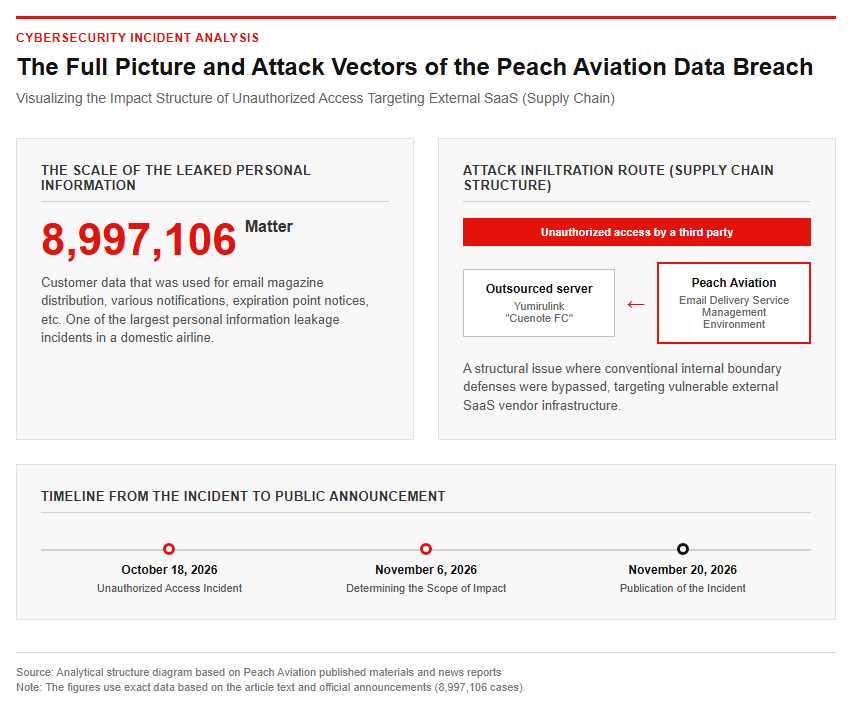
Following the discovery, the company promptly suspended part of its system operations and is proceeding with an investigation into the facts and reporting to relevant authorities.
Details of Leaked Data and Practical Impact on Customers and Operations
The information leaked in this incident includes customers’ names, dates of birth, genders, addresses, phone numbers, and email addresses, as well as their boarded itinerary information. The affected individuals span a wide range, including email newsletter subscribers, recipients of expired point notifications, and users of the refund and reimbursement forms for cancellations and delays due to circumstances on the airline’s part. Meanwhile, it has been confirmed that highly sensitive information such as credit card details and passport numbers was not stored on the contractor’s server and has not been leaked at all. In addition, there has been no impact on the reservation system or actual aircraft operations, and flights are being maintained as usual. However, as an emergency measure, the operation of the refund/reimbursement forms and various automated email services has been suspended, causing some disruptions in customer support operations. Peach is strongly urging caution against phishing scams, suspicious SMS messages, and impersonation attempts that exploit the leaked email addresses and phone numbers.
Outsourcing (Supply Chain) Risk and the Vulnerability of the Aviation Industry
Security Blind Spots via Third-Party Vendors and Governance Challenges
Low-cost carriers (LCCs) thoroughly streamline operations and cut costs to offer low-priced fares, and they tend to rely heavily on external SaaS, cloud services, and specialized IT vendors for many of their systems. Peach itself had been working to strengthen governance free from preconceived notions, implementing advanced proactive prevention solutions (such as Chrome Enterprise Premium) to control and prevent browser-based threats as part of its internal security measures. However, even if the robustness of internal systems is enhanced, the risk of data leaking past those defenses becomes apparent when an external contractor—where customer data is exchanged—becomes the target of a cyberattack. This is a classic method of “supply chain attacks,” which have been running rampant in recent cybercrime. It highlights a serious modern challenge: companies must maintain comprehensive audits and governance that extend beyond their own systems to include the security management frameworks of external partners and contractors.
Past Data Breach Incidents in the Airline Industry and the Risks Lurking Behind Digitalization
The aviation industry is built upon a vast, highly networked IT infrastructure that handles reservation management, boarding procedures, and mileage operations. As a result, it easily becomes a concentrated hub of personally identifiable information (PII) that holds high value for cyber attackers. Major information leaks have repeatedly occurred in the aviation industry in the past. In June 2018, an employee of Peach Aviation fell victim to a laptop snatching incident while commuting home outside the office, resulting in the theft of passenger personal information (including passport numbers, etc.) for 6 international flights and 917 passengers. Furthermore, in March 2021, unauthorized access to SITA, an international passenger systems company used by approximately 90% of the world’s airlines, led to a situation where data for approximately 920,000 frequent flyer members of Japan Airlines (JAL) and approximately 1 million members of All Nippon Airways (ANA) was leaked. The following diagram illustrates the correlation between digital networks and information leakage risks in the aviation industry.
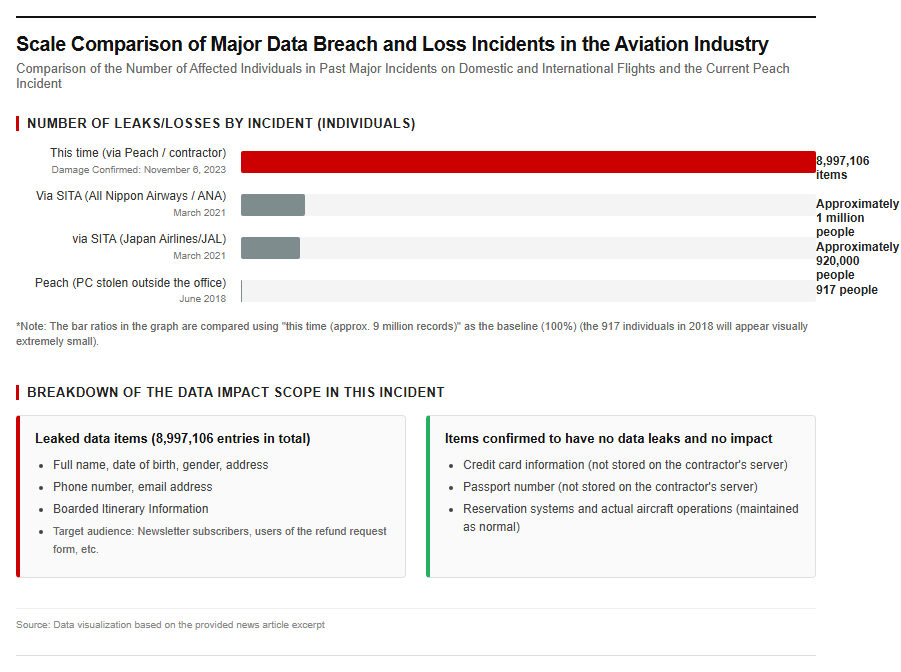
Behind the convenience of digitalization, system interconnectivity is amplifying risks.
Strengthening Legal Frameworks and Future Defense Measures Demanded of Companies
Stricter Enforcement of the Act on the Protection of Personal Information and Legal Risks and Penalties Imposed on Companies
Japan’s Act on the Protection of Personal Information (APPI) has been revised in phases in response to a recent surge in improper handling and data breach incidents, significantly strengthening corporate obligations and penalties. Under the revised APPI, if a data leak occurs due to unauthorized access or involves a large-scale breach exceeding 1,000 records, companies are legally required to promptly report the incident to the Personal Information Protection Commission (a preliminary report within 3 to 5 days and a definitive report within 30 to 60 days) and notify the affected individuals. Following the discovery, Peach also submitted a report to the Personal Information Protection Commission. For violations of orders, provisions are in place to impose imprisonment or fines on the individuals responsible, alongside fines of up to 100 million yen for corporations. Moreover, the actual penalties faced by companies—not only administrative dispositions, but also the risks of class-action lawsuits and claims for damages from affected customers, as well as business losses due to a damaged reputation—have reached a level that can threaten the very foundation of a company’s management.
Future Outlook and Key Points: Building a Proactive Prevention System and the Secrets of Supply Chain Management
Following this massive data leak involving approximately 9 million records, the focus moving forward will be on recurrence prevention measures by Peach Aviation and its parent company, ANA Holdings, as well as the restructuring of their security management systems, including third-party vendors. As pointed out in the Liberal Democratic Party’s cybersecurity recommendations, conventional “perimeter defense” and “post-incident response” are inadequate to handle AI-driven attacks, creating a strong demand for a shift toward “prevention” based on zero-trust principles and “supply chain defense” (such as the introduction of SCS evaluation systems). Immediate challenges for Peach include how to safely restore customer service operations and email delivery during flight disruptions using alternative methods, and whether it can prevent secondary damage caused by the misuse of leaked information. In today’s business environment, which makes heavy use of external services, how companies can visualize the security standards of their contractors and continuously audit them is putting the state of supply chain governance across the entire industry to the test.
Reference Page
- [Peach: Approximately 9 Million Customer Personal Information Records Leaked Due to Unauthorized Access to Outsourced Email Delivery Service] https://sky-budget.com/2026/11/20/peach-news-nov/
[#DataLeak #Peach #Cybersecurity #SupplyChainAttack #ActOnTheProtectionOfPersonalInformation #ITRisks]

コメント