The average price of newly built condominiums in the Tokyo metropolitan area fell for the third consecutive month, reaching 93.08 million yen in October 2026. The background includes a deterioration in buyers’ financial planning due to rising mortgage interest rates and a slowdown in purchasing appetite driven by caution over high prices.
- Figures for Three Consecutive Months of Decline and Price Adjustments Seen in Tokyo’s 23 Wards
- Market Cooling: Units Remain Unsold Despite Record-Low Supply
- Decline in purchasing power among real-demand buyers and increased loan burdens due to rising interest rates
- High Construction Costs and Developers’ Strategic Shift
- The polarization of central Tokyo and suburbs, new and used properties, and the rise of the stock market
- What to Watch For and How to Choose Properties Amid Persistently High Prices
Figures for Three Consecutive Months of Decline and Price Adjustments Seen in Tokyo’s 23 Wards
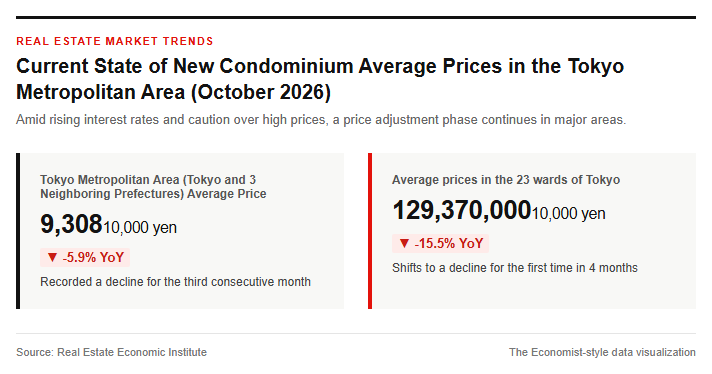
According to market trends for October 2026 released by the Real Estate Economic Institute, the average price per newly built condominium sold in the Tokyo metropolitan area (Tokyo and the three surrounding prefectures) was 93.08 million yen, a 5.9% decrease from the same month of the previous year. As a result, the average price of newly built condominiums in the Tokyo metropolitan area recorded a year-on-year decline for the third consecutive month. Furthermore, the average price in the 23 wards of Tokyo, which has driven the market, also fell 15.5% year-on-year to 129.37 million yen, turning downward for the first time in four months. In the background of such price adjustments, consumers’ sense of caution against the historically high prices that have continued up to now, as well as the impact of rising interest rates associated with changes in monetary policy, are clearly reflected. As shown in the graph below, a clear change has appeared in the trend of average prices.
However, it has also been pointed out that one of the factors behind this decline is a skewed supply pattern, specifically a low single-month supply ratio of large tower condominiums and ultra-luxury properties in central Tokyo. Therefore, it cannot be concluded that the market as a whole has immediately entered a period of rapid price collapse; rather, the situation is analyzed as the combined result of localized price corrections and temporary compositional shifts.
Market Cooling: Units Remain Unsold Despite Record-Low Supply
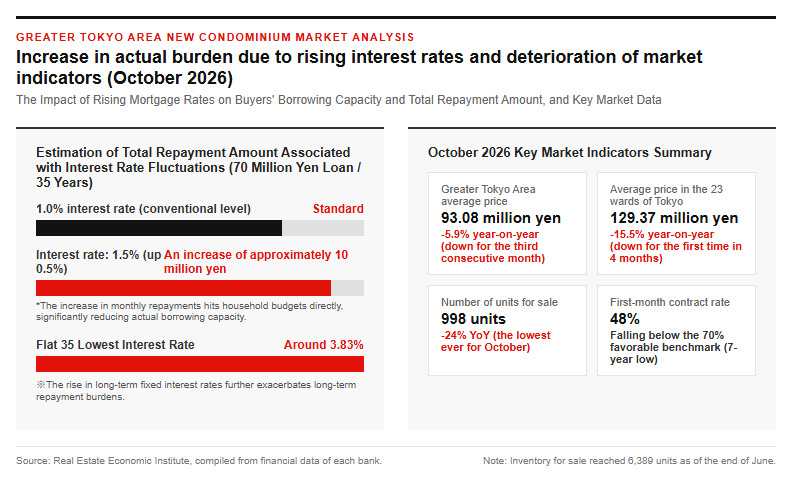
In October 2026, the number of newly built condominium units released for sale in the Tokyo metropolitan area remained at just 998 units, representing a significant 24% decrease compared to the same month of the previous year. This figure of 998 units marks the smallest supply scale for the month of October since the Real Estate Economic Institute began its surveys in 1973. Normally, a restricted supply tends to increase property scarcity, which helps maintain same-day sell-outs and high contract rates. However, the initial contract rate for that month plummeted to 48%, falling well below the 70% threshold considered a benchmark for strong sales, and even dipping below 50%. A contract rate below 50% is an unusual phenomenon not seen in seven years, indicating an abnormal situation where buyers are failing to keep pace despite sellers intentionally limiting supply. In fact, unsold inventory reached 6,389 units as of the end of June 2026, confirming an accumulation compared to the same period of the previous year. Due to waning purchasing enthusiasm among actual-demand buyers for newly built properties, an increasing number of units are experiencing prolonged sales periods even after completion, further exacerbating the mismatch in supply and demand.
Two Structural Factors Behind the Coexistence of Price Adjustments and High Price Levels
Decline in purchasing power among real-demand buyers and increased loan burdens due to rising interest rates
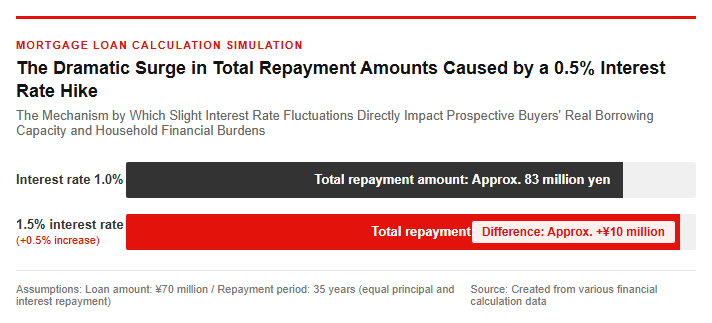
The biggest factor behind the downward pressure on prices is the rise in mortgage interest rates associated with the Bank of Japan’s normalization of monetary policy. Following the BOJ’s gradual hike of the policy rate to around 1.00% to 1.25%, major banks’ preferential variable interest rate plans have exceeded 1%, and the minimum interest rate for the long-term fixed-rate mortgage Flat 35 has also risen to around 3.83%. Because rising interest rates directly increase monthly repayment amounts, they significantly reduce prospective buyers’ actual borrowing capacity. For instance, when purchasing a property for 70 million yen with a 35-year loan, estimates show that just a 0.5% increase in the interest rate from 1% to 1.5% will increase the total repayment amount by about 10 million yen. Households that utilized joint couple loans or large borrowings—which have become mainstream in recent years—are increasingly holding off on purchases due to concerns that rising interest rates will strain their household budgets. As the schematic diagram below shows, fluctuations in the interest burden are directly linked to shrinking purchasing budgets.
As growth in household incomes fails to keep pace with rising property prices, higher interest rates are becoming a barrier to the purchasing power of end-users, cooling the market’s demand base.
High Construction Costs and Developers’ Strategic Shift
On the other hand, a major factor preventing a dramatic crash in newly built condominium prices is the stubbornly high level of construction costs. The Tokyo Construction Cost Index for reinforced concrete (RC) apartment buildings, published by the Construction Price Research Institute, has reached 147.7, driven by soaring material prices, a severe shortage of skilled labor, and rising labor costs resulting from stricter regulations on overtime work. For real estate developers on the selling side, land acquisition costs, material expenses, and labor costs are all on the rise, leaving them with almost no financial margin to significantly lower selling prices. As a result, the traditional high-volume, low-margin business model of “keeping construction costs down, building in bulk, and selling off quickly at low prices” is no longer viable. Major developers, in particular, are shifting toward strategies that maintain high gross profit margins and selling prices—even if it means intentionally limiting the number of units supplied and extending the sales period to two or three years. In this way, downward pressure on prices due to declining purchasing power on the demand side and upward pressure due to soaring costs on the supply side are colliding head-on.
Polarization of the Housing Market and Future Outlook for the Acquisition Environment
The polarization of central Tokyo and suburbs, new and used properties, and the rise of the stock market
In the current real estate market, rather than uniform price movements, a clear polarization based on “location” and “property type” is progressing. While station-close redevelopment areas in Tokyo’s 23 wards and premium tower condominiums continue to maintain high price levels—supported by affluent buyers’ equity and demand for asset preservation—price corrections are becoming evident for suburban properties located far from stations and locations with weaker conditions. Furthermore, as economic analysis by the Cabinet Office indicates, skyrocketing housing prices that outpace wage growth have made it difficult for first-time buyers to purchase newly built homes. As a result, demand is shifting toward relatively affordable secondhand condominiums and resale-renovation properties. With the supply of new construction being restricted, the importance of utilizing existing housing stock—specifically by renovating and making use of older properties in prime locations—is surging rapidly. However, according to data from REINS East Japan, declines in closed contracts and increases in inventory are beginning to emerge even in the secondhand condominium market, indicating that price scrutiny and selectivity influenced by rising interest rates are intensifying within the stock market as well.
What to Watch For and How to Choose Properties Amid Persistently High Prices
As the Real Estate Economic Institute’s analysis shows, given that there are no factors driving down construction costs, it is premature to conclude that the new condominium market has entered a full-scale downward trend based solely on this three-month consecutive decline. In the upcoming market, the traditional metric of “how much can I borrow for a mortgage” will be replaced by strict financial planning focused on whether one can “comfortably keep repaying even if interest rates rise by 1% to 2% in the future.” Perspectives on property selection are also shifting; rather than simply insisting on a property being new or spacious, it is essential to adopt an attitude that emphasizes asset value, such as ease of future resale, the presence of rental demand, and the quality of building management. As shown in the conceptual diagram below, housing options are diversifying.
As the overall housing market undergoes a full-scale structural shift from quantity to quality, accurately assessing long-term and substantial residential value in response to changes in the interest rate environment will become the most crucial factor for consumers in their future home search.
Reference Page
- [Real Estate Economic Institute] Greater Tokyo Area Newly Built Condominium Market Trends: https://www.fudousankeizai.co.jp/
- [Cabinet Office] Recent Supply and Demand Structures in the Housing Market and Changes in the Housing Acquisition Environment: https://www.e-gov.go.jp/
- [Real Estate Information Network for East Japan] Trends in the Greater Tokyo Area Real Estate Distribution Market: https://www.reins.or.jp/
【#TokyoMetropolitanAreaCondominiums #NewCondominiums #MortgageInterestRates #RealEstatePrices #MarketTrends】


コメント