
At the House of Representatives Committee on Financial Affairs on November 4, 2026, Finance Minister Satsuki Katayama announced a policy to temporarily suspend the expert panel on the valuation methods for unlisted shares that had been promoted by the National Tax Agency, and to restart discussions from a blank slate at the Liberal Democratic Party’s Tax Research Commission without taking the National Tax Agency’s proposal as a given. The background to this decision is the widespread and serious concern that the new valuation method would cause a sudden surge in inheritance tax burdens for small and medium-sized enterprises, significantly hindering business succession and growth investment.
- Finance Minister Katayama Announces “Temporary Halt” to Expert Panel
- The Background of the Review Initiated by the Board of Audit’s Findings
- The Mechanism of the “Residual Profit Method” Where Growing Companies Face Heavier Tax Burdens
- Voices of strong concern raised one after another from the business community and the front lines of small and medium-sized enterprises
- The Increase in CEOs in Their 70s and the Current State of Business Succession Facing Rising Risks of Closure and Liquidation
- Zero-Base Discussions at the Ruling Party’s Tax Commission and Preparations SMEs Should Take
Finance Minister Katayama Announces “Temporary Halt” to Expert Panel
Finance Minister Satsuki Katayama stated clearly at the meeting of the House of Representatives Committee on Financial Affairs held on November 4, 2026, that the deliberation work by the National Tax Agency’s “Expert Panel on the Valuation of Unlisted Stocks” would be “temporarily suspended.” Emphasizing that the panel is not a statutory council and that no conclusions or directions for revision have been finalized at this point, she indicated her intention that discussions will henceforth be advanced from a “blank slate” (zero-base) in the Liberal Democratic Party’s Research Commission on the Tax System (LDP Tax Commission), without presupposing the National Tax Agency’s revision proposal. Please refer to the figure below.
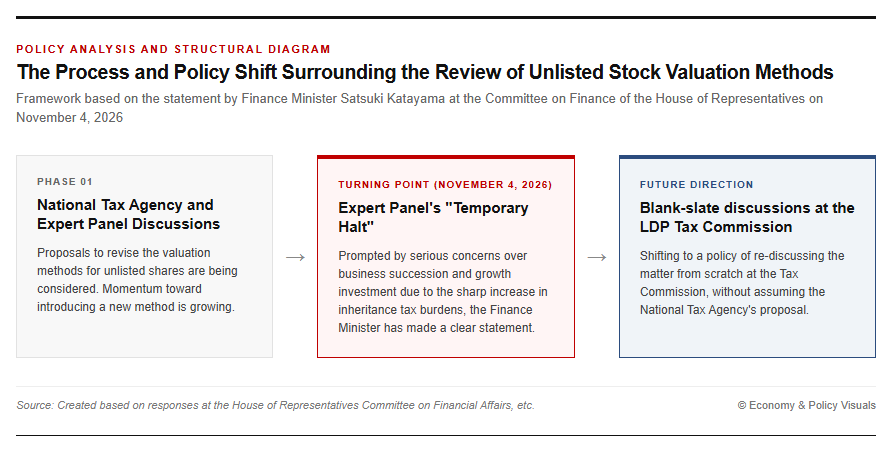
This statement was made in response to the Liberal Democratic Party’s (LDP) Japan Growth Strategy Headquarters adopting an emergency resolution on October 29 stating that “discussions should be held without using the current proposal as a premise for consideration,” as well as a surge of strong opposition from within the Diet and the business community. In the draft proposal presented by the National Tax Agency at its 5th expert meeting (held on August 20, 2026), a policy was outlined to abolish the current “comparable industry similarity method” and completely overhaul it into a “residual income method” that focuses on a company’s earning power (income approach). However, concerns grew that if this revision plan were implemented, the stock valuation of growing, high-performing small and medium-sized enterprises would skyrocket, making business succession extremely difficult. With the Finance Minister’s remarks, the introduction of the revision plan led by the National Tax Agency has effectively been scrapped or frozen.
- Finance Minister Katayama mentioned “considering with a blank slate” at the House of Representatives Committee on Financial Affairs on November 4, 2026.
- Discussions at the National Tax Agency’s expert panel (which held a total of 6 sessions) have been temporarily suspended.
- The main battleground for the debate has shifted to the LDP’s Tax System Research Commission.
The Background of the Review Initiated by the Board of Audit’s Findings
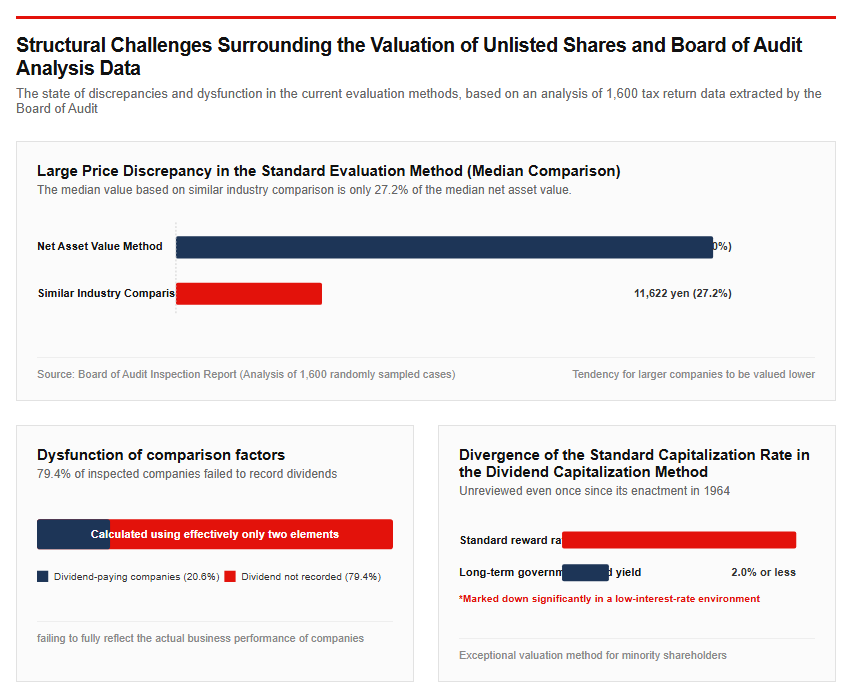
The current debate over reviewing the valuation of unlisted shares was originally triggered by a stern issue raised in the FY2023 settlement inspection report published by the Board of Audit in November 2024. The Board of Audit analyzed randomly sampled tax return data for 1,600 cases concerning the valuation of unlisted shares acquired through inheritance and other means, pointing out a lack of fairness due to company size and shareholder classification.
The main issues revealed in the inspection report are as follows.
– Divergence in the Principal Evaluation Method: The median comparable industry comparison value (11,622 yen) stands at just 27.2% of the median net asset value (42,648 yen), indicating an extremely wide gap between the two. Large companies with a higher application ratio of the comparable industry comparison method are assessed at lower values, creating unfairness with small companies.
– Dysfunction of comparison factors: 79.4% of the inspected companies do not record dividends, and because it is effectively calculated using only two factors, it does not adequately reflect the actual business performance of the companies.
– Obsolescence of the exceptional valuation method (dividend-reduction method): The 10% standard reduction rate used in the dividend-reduction method for minority shareholders has not been revised even once since the directive was issued in 1964. In the recent low-interest-rate environment where long-term government bond yields have remained below 2%, the 10% reduction rate is excessively high, significantly depressing valuation amounts.
In response to these criticisms, the National Tax Agency is set to establish an “Expert Panel on the Valuation of Unlisted Shares” in April 2026 and embark on a fundamental review of the system.
The National Tax Agency’s Proposed “Residual Profit Method” and Its Repercussions
The Mechanism of the “Residual Profit Method” Where Growing Companies Face Heavier Tax Burdens
The draft revision proposal presented by the National Tax Agency at the 5th expert meeting on August 20, 2026, included a major institutional reform—the first of its kind since the establishment of the Basic Directive on Property Valuation in 1964 (Showa 39). Its main pillar was the complete abolition of the traditional company size classifications of large, medium, and small enterprises, and the application of a single “residual profit method” to virtually all unlisted companies in principle.
The residual income method is an income approach technique for calculating share valuation by adding the present value of residual income that a company is expected to generate in the future (profit calculated by subtracting the cost of equity capital relative to net assets from current net income) to the book value of net assets on the balance sheet. By introducing this method, the National Tax Agency aimed to abolish the similar industry comparison method—which relies on easy comparisons with listed companies—and relegate the net asset value method, which represents liquidation value assuming dissolution, exclusively to “specified evaluation companies” such as real estate holding companies. Additionally, it was intended to block various tax avoidance schemes, such as earnings manipulation through operating leases and temporary high executive retirement benefits, as well as asset transfers to subsidiaries utilizing the group corporate tax system.
However, this residual income calculation formula was structured in such a way that companies which faithfully conducted their business activities and continuously improved their profits were assessed with significantly higher valuations.
- Abolishing company size categories (large, medium, small) and applying a single evaluation method
- Abolishing the comparable industry comparison method and making the “residual income method” (book value of net assets + residual income) the standard.
- Preventing profit manipulation by evaluating on a “normal profit” basis that excludes non-recurring gains and losses.
Voices of strong concern raised one after another from the business community and the front lines of small and medium-sized enterprises
When the National Tax Agency’s review proposal was made public, cries of distress and strong opposition arose in unison from small and medium-sized enterprise associations, tax practitioners, and the business community. This was because the new method highlighted the possibility that stock valuations could swell several times over—particularly for companies that have actively pursued wage increases and capital investment to enhance their earning power, as well as well-managed companies that have accumulated retained earnings through years of solid management.
Unlike listed stocks, unlisted stocks are difficult to liquidate on the market, meaning that a sudden surge in their valuation weighs heavily as an excessive inheritance and gift tax burden on the individual successor. Please refer to the figure below.
From corporate workplaces, the following serious concerns have been successively raised.
– To secure funds for tax payments, they are forced to sell company shares or sell off fixed assets necessary for the business.
– Out of fear of rising valuations, companies are incentivized to curb growth investments and wage hikes.
– Unable to bear the tax burden, successors give up on business succession and are forced to suspend or close their businesses, resulting in the loss of local jobs.
At the House of Representatives Committee on Economy, Trade and Industry on October 23, 2026, Tsukasa Abe, a member of the House of Representatives from the Japan Innovation Party (Nippon Ishin no Kai), pursued this issue, and the Ministry of Economy, Trade and Industry side also fully shared the concern that “companies that have continued to make growth investments are at risk of experiencing disruptions in business succession.” This judgment—that it could become a tax revision that directly conflicts with the government’s policy of “realizing a robust regional economy through wage increases and growth investments”—became the deciding factor in the decision to postpone it.
Challenges of Business Succession and Key Focus Points in the Upcoming Ruling Party Tax Commission
The Increase in CEOs in Their 70s and the Current State of Business Succession Facing Rising Risks of Closure and Liquidation
Behind the immense confusion triggered by the recent debate over valuation reviews lies the extremely severe business succession problem facing Japanese small and medium-sized enterprises (SMEs). According to surveys by Teikoku Databank and other organizations, the age distribution of business owners continues to age, leaving a heavy concentration of individuals in their 70s—for whom business succession is an urgent necessity—as well as a large cohort in their 60s who will face the issue in earnest going forward. Furthermore, the number of business suspensions, closures, and dissolutions driven by aging executives and a lack of successors has been increasing year by year, reaching 62,695 cases in 2024 and 67,210 cases in 2025. Alarmingly, more than 50% of the companies that closed or suspended operations were profitable, resulting in the loss of valuable businesses and technologies without proper succession ever taking place.
To intensively promote such generational shifts, the government established the “Tax System for Corporate Business Succession (Special Measures)” in the FY2018 tax reform. The special measure is a 10-year limited-time measure and a powerful support policy that defers 100% of gift and inheritance taxes for all shares. Companies that have applied the special measures have demonstrated remarkable policy effects, such as achieving an average labor productivity improvement rate of 6.1% (compared to 0.1% for non-applying companies) and a 5-year employment retention rate reaching 96.6%.
The deadline for submitting the “Special Succession Plan” to qualify for the special measures is the end of September 2027, and the actual application deadline is approaching at the end of December 2027. The introduction of a revision proposal to raise share valuations during such a sensitive period has brought intense uncertainty and confusion to the front lines of business succession.
- The aging of SME business owners is progressing, with a large number of operators in their 70s and older remaining.
- Over 50% of companies close or dissolve while still profitable, with over 60,000 exiting the market annually
- Turmoil surrounding the system as the deadline for submitting the special business succession plan (end of September 2027) approaches
Zero-Base Discussions at the Ruling Party’s Tax Commission and Preparations SMEs Should Take
Although the National Tax Agency’s expert panel has been effectively frozen due to remarks by Finance Minister Katayama, the issue of reviewing the valuation of unlisted shares has not disappeared altogether. Criticisms by the Board of Audit regarding the “divergence in scale classifications” and “excessively high dividend-reduction rates” still remain, and the Ministry of Finance, as well as the government and the ruling coalition, have not changed their stance that “some kind of response is necessary” to ensure fairness in the tax burden.
From here on, the arena for debate will shift to the Liberal Democratic Party’s (LDP) Research Commission on the Tax System (LDP Tax Commission), and discussions will accelerate toward the “FY2027 Tax Reform Outline” to be compiled in December 2026. Within the LDP Tax Commission, there will be strong calls for institutional designs that do not inhibit companies’ willingness to grow, wage hikes, or regional employment. In particular, a key focus will be the stance of comprehensively considering the revision of valuations for tax burden leveling separately from the business succession tax system (such as the extension or permanent implementation of special measures).
Small and medium-sized enterprise (SME) owners and successors are recommended to proceed with the following practical measures in preparation for future changes in the situation.
- Recalculate the company’s stock price (comparable industry-based value and net asset value) based on the latest financial results in accordance with the current Basic Circular on Property Valuation.
- Advance fundamental succession preparations that are unaffected by changes to evaluation systems, such as consolidating dispersed shares and organizing voting rights.
- Closely monitor the announcement of the tax reform outline to be released in December 2026, and develop multiple business succession scenarios with experts.
Reference page
- 【Future Perspectives on the Valuation of Unlisted Stocks – National Tax Agency, National Tax College】https://www.nta.go.jp/about/organization/ntc/kenkyu/ronsou/61/03/pdf/61-3.pdf
- [Regarding the Evaluation of Shares Without Quoted Market Prices Among Property Acquired Through Inheritance, etc. – Board of Audit] https://www.jbaudit.go.jp/report/new/summary05/pdf/fy05_tokutyou_13.pdf
【#UnlistedStocks #InheritanceTaxEvaluation #BusinessSuccession #FinanceMinisterKatayama #TaxReformOutline #LDP_TaxCommission #ResidualIncomeMethod】


コメント