
The International Energy Agency (IEA) has released its annual report, “World Energy Outlook 2026.” The backdrop features a deepening global energy crisis, driven by factors such as the Strait of Hormuz crisis stemming from the Middle East conflict, a doubling of electricity demand due to AI expansion, and the risks associated with the uneven distribution of critical minerals.
- One of the largest supply shocks in history brought about by the Strait of Hormuz crisis
- Oil Supply Surplus Forecast for the Second Half of 2026 and the Long-Term Security Premium
- Data Center Power Consumption to Double to 1,000 TWh by 2030
- Power Grid Expansion and Electrical Equipment Supply Chain Constraints
- Electrification Rate of 35% Initiative and the Concentration of Refining and Processing Capacity in Specific Countries
- Japan’s Diversification of Procurement Sources and Structural Shift to “Just-in-Case”
One of the largest supply shocks in history brought about by the Strait of Hormuz crisis
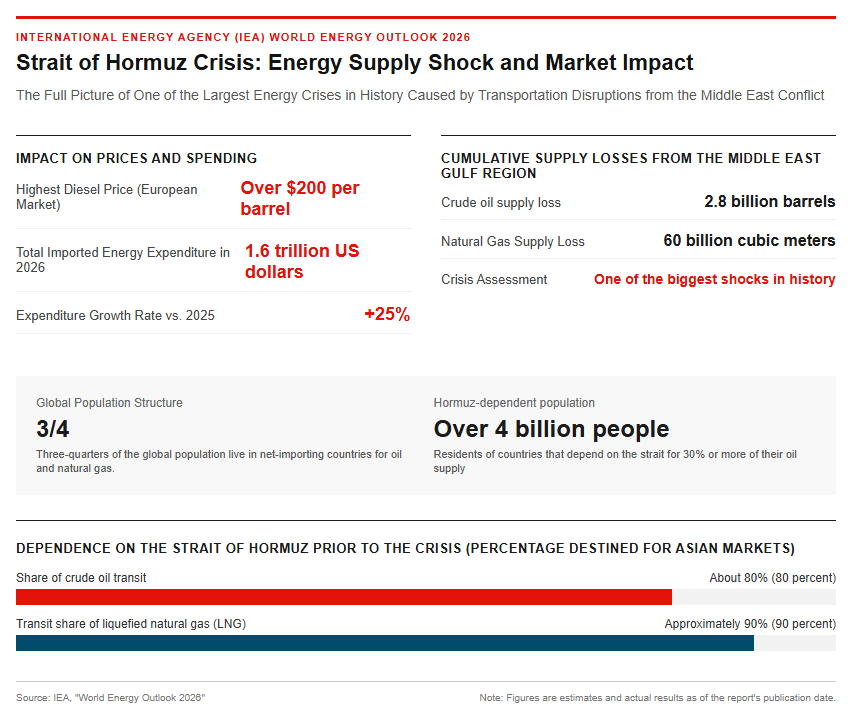
On November 19, 2026, the International Energy Agency (IEA) released its flagship report, the World Energy Outlook (WEO) 2026. The report characterizes the disruption of energy transport through the Strait of Hormuz that occurred in 2026 as “the largest energy supply shock the world has ever faced.” Cumulative supply losses from the Middle East Gulf region reached 2.8 billion barrels of crude oil and 60 billion cubic meters of natural gas, and diesel prices in markets such as Europe hit record highs exceeding $200 per barrel.
Currently, three-quarters of the global population reside in countries that are net importers of oil and natural gas, and more than 4 billion people live in countries that rely on shipments through the Strait of Hormuz for over 30% of their oil supply. Prior to the crisis, approximately 80% of the crude oil and about 90% of the liquefied natural gas (LNG) passing through the strait were destined for Asian markets. Global spending on imported oil and natural gas in 2026 is projected to reach $1.6 trillion, representing a 25% increase compared to 2025.
Please refer to the following figure.
In response to such supply disruptions, the 32 IEA member countries carried out a coordinated release of a record 400 million barrels of emergency oil reserves to help mitigate the shock. However, as the risk of disruptions to major transport routes has become apparent, global energy trade faces a situation where it cannot easily return to its conventional low-cost structure.
Oil Supply Surplus Forecast for the Second Half of 2026 and the Long-Term Security Premium
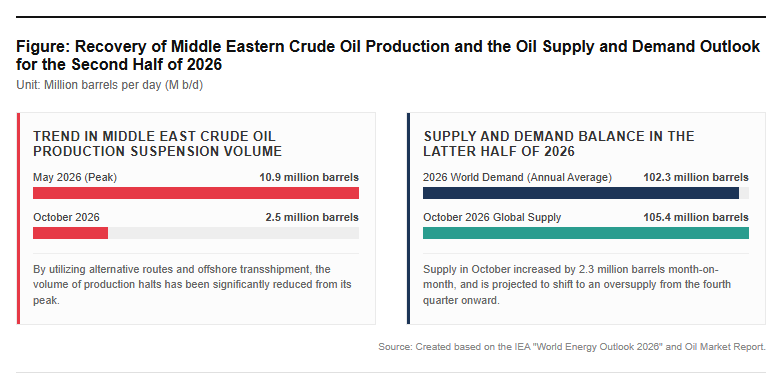
According to the IEA’s oil market report, suspended crude oil production in the Middle East shrank from its peak of 10.9 million barrels per day in May 2026 to 2.5 million barrels per day in October, driven by the use of alternative routes and offshore transshipment. Global oil supply in October reached 105.4 million barrels per day, an increase of 2.3 million barrels per day from the previous month, showing a recovery trend in supply capacity.
The IEA forecasts that the global oil market will shift to an oversupply in the fourth quarter of 2026, with the supply surplus expanding further in 2027. Global oil demand in 2026 is expected to decrease by 2.7 million barrels per day year-on-year to 102.3 million barrels, but is projected to shift back to an increase of 2 million barrels per day in 2027. However, the analysis indicates that about 80% of the demand increase in 2027 will come from petrochemical feedstock, while growth in road transport fuels will be restrained by vehicle electrification and improved fuel efficiency.
Please refer to the following figure.
Meanwhile, global onshore oil inventories remain at their lowest levels since 2016, and concerns regarding stubbornly high tanker freight rates and tight gas oil supplies persist. Even if supply and demand are balanced on paper in the market, the costs of securing safety inventories and detour routes to address geopolitical risks are being added on, and a long-term “security premium” is becoming entrenched in energy prices.
The Doubling of Power Demand Due to Rapid AI Growth and Transmission Infrastructure Challenges
Data Center Power Consumption to Double to 1,000 TWh by 2030
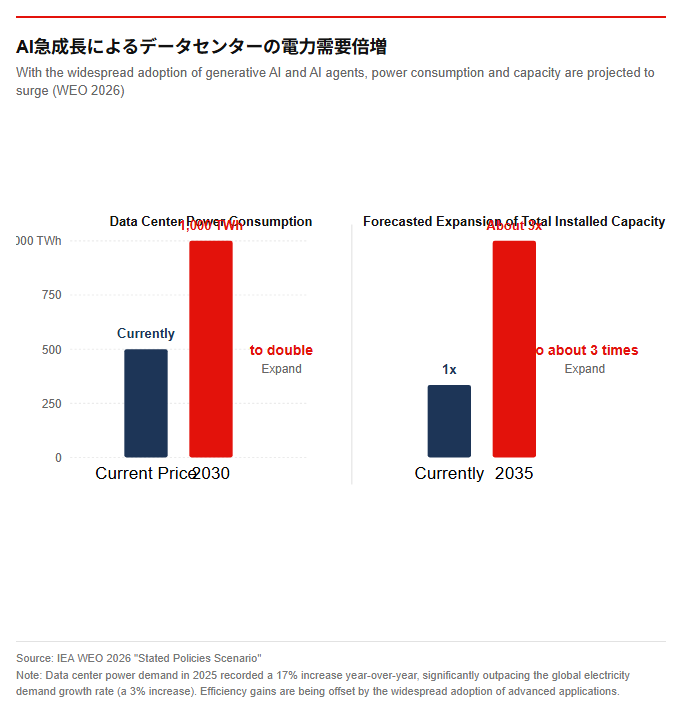
In the Stated Policies Scenario (STEPS) of WEO 2026, driven by the rapid expansion of artificial intelligence (AI) and digital services, global electricity consumption by data centers is projected to double from current levels, reaching 1,000 terawatt-hours (TWh) per year by 2030. Total data center capacity is expected to expand to approximately three times its current level by 2035.
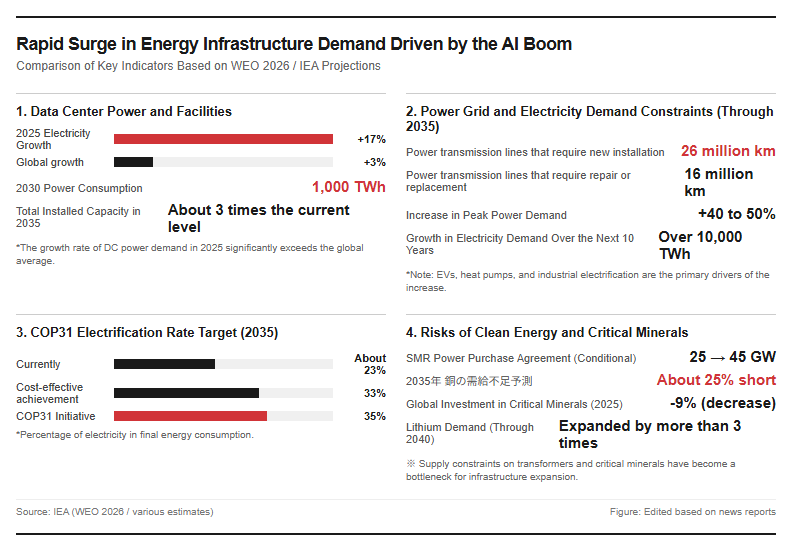
In 2025, data center power demand recorded a 17% increase year-over-year, significantly outpacing the global electricity demand growth rate of 3%. Although computational efficiency per AI task has improved, the widespread adoption of advanced applications such as generative AI and AI agents has caused the overall system power consumption to surge, offsetting the gains from efficiency improvements.
Please refer to the following figure.
Major tech companies are stepping up their efforts to secure power, with IT companies accounting for approximately 40% of corporate renewable energy power purchase agreements (PPAs) signed in 2025. Furthermore, conditional contracts for data center operators to purchase power from small modular reactors (SMRs) have rapidly expanded from 25 gigawatts (GW) at the end of 2024 to 45 GW.
Power Grid Expansion and Electrical Equipment Supply Chain Constraints
The greatest limiting factor in expanding AI infrastructure is no longer computing performance itself, but is shifting toward delays in connecting to the power grid and tight supply chains for electrical equipment. According to IEA estimates, by 2035 it will be necessary to newly lay 26 million kilometers of power lines worldwide, while at the same time requiring the replacement and renovation of approximately 16 million kilometers of existing power lines.
Global electricity demand will increase by more than 10,000 terawatt-hours over the next decade, with electric vehicles (EVs), heat pumps, industrial electrification, and data centers as the main drivers of growth. Furthermore, because peak electricity demand will increase by 40% to 50% by 2035, the expansion of a resilient power grid and battery storage systems that ensure flexibility is essential.
However, core equipment such as transformers, high-voltage cables, gas turbines, and advanced semiconductors are facing global supply shortages, leading to planning and regulatory delays in various regions. While private power generation initiatives—such as on-site natural gas generation—are underway, effectively responding to the load fluctuations of data centers strongly requires the strategic deployment of energy storage systems integrated with smart grids, alongside appropriate regulatory frameworks.
COP31 Electrification Goals and Critical Mineral Resource Competition Risks
Electrification Rate of 35% Initiative and the Concentration of Refining and Processing Capacity in Specific Countries
At the 31st Conference of the Parties to the United Nations Framework Convention on Climate Change (COP31), the initiative to increase the share of electricity in global final energy consumption from the current approximately 23% to 35% by 2035 became a major issue. IEA analysis indicates that achieving a 33% electrification rate by 2035 is cost-effectively feasible based on existing technologies and economic conditions.
With the promotion of electrification, demand for critical minerals such as copper, lithium, graphite, and rare earths is surging. According to IEA projections, lithium demand is expected to expand more than threefold by 2040, and estimates suggest that copper will face a shortfall of approximately 25% relative to projected 2035 requirements based solely on existing and announced mine development plans. However, global investment in critical minerals declined by 9% in 2025 due to the impact of price volatility and geopolitical risks.
Please refer to the following figure.
The essence of the issue surrounding mineral resources is not a shortage of underground reserves, but rather the extreme concentration of processing capacity in a few countries to separate and refine mined ore into battery materials and magnets. Even if mining interests are secured in other countries, as long as the refining process depends on a specific nation, the risk of supply disruptions caused by export controls and logistical restrictions cannot be eliminated.
Japan’s Diversification of Procurement Sources and Structural Shift to “Just-in-Case”
For Japanese companies, the difficulty in procuring critical minerals is an issue that goes beyond rising import prices, threatening the overall sales of the domestic manufacturing industry through disruptions in component procurement and delivery delays for automobiles, industrial machinery, air conditioning equipment, and more. When China tightened export controls on rare earth magnets in April 2025, Japan-bound magnet exports plummeted to 25.7 tons in May of the same year, with actual cases showing that it took three months or more to obtain export permits.
In response to this, Japan is also strengthening its countermeasures, accelerating the diversification of supply sources through such measures as an agreement by Sojitz and JOGMEC to secure heavy rare earths from Australia’s Lynas (up to 65%), and an investment and financing of up to 110 million euros by JOGMEC and Iwatani Corporation in France’s Caremag, as well as a 50% long-term supply contract. Additionally, responding to soaring material costs in domestic power grid reinforcement and renewable energy connections is an important issue.
As IEA Executive Director Fatih Birol points out, the global energy market is being forced to undergo a structural shift from the efficiency-first “just-in-time” model to a “just-in-case” model that ensures supply redundancy and spare capacity. Japanese industry is also required to break away from price-driven import dependency and build sustainable investment and procurement frameworks to prevent supply disruptions.
Reference Page
- 【World Energy Outlook 2026 – IEA】https://www.iea.org/reports/world-energy-outlook-2026
- 【Executive summary – Global Critical Minerals Outlook 2026 | IEA】https://www.iea.org/reports/global-critical-minerals-outlook-2026/executive-summary
- 【COP31 Cover Decision Draft | UNFCCC】https://unfccc.int/sites/default/files/resource/dt_cop31_cover_decision.pdf
[#IEA #WorldEnergyOutlook2026 #EnergySecurity #DataCenters #CriticalMinerals #ElectrificationRate]
コメント