The US Federal Communications Commission (FCC) has conditionally approved SpaceX’s deployment plan for up to one million orbital AI data center satellites, named “Starmind.” This marks the full-scale emergence of a next-generation infrastructure that resolves terrestrial power and cooling water shortages while leveraging continuous solar power generation in outer space.
- FCC Approval and Timeline for SpaceX’s “Starmind” Project
- Technical Architecture and Performance of the “AI1” Orbital AI Data Center Satellite
- Economics of Space Computing and the Transition from Terrestrial Data Centers
- Thermal Management, Power Supply Structures, and Engineering Challenges in Outer Space
- Regulations and Objections Surrounding Debris, Environmental Pollution, and the Impact on Astronomy
- Expansion of Launch and Manufacturing Infrastructure and the Future Vision of Space AI
FCC Approval and Timeline for SpaceX’s “Starmind” Project
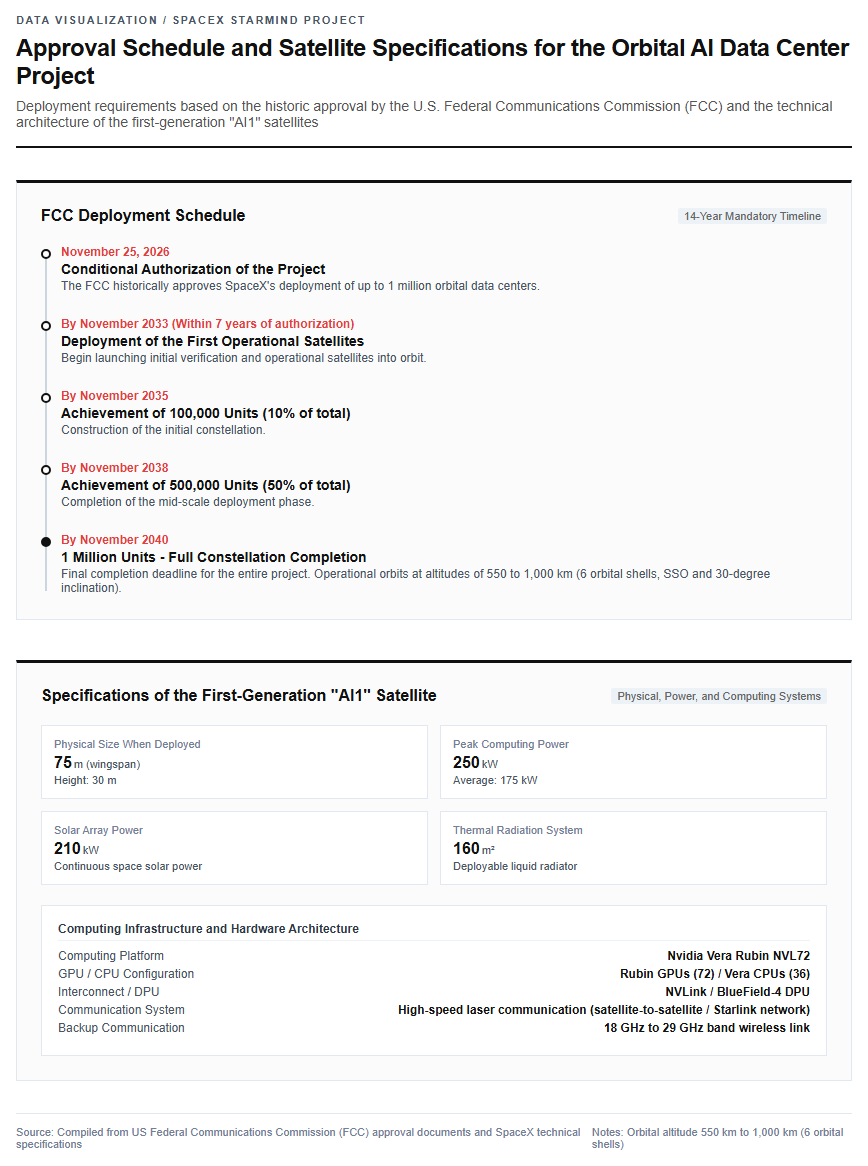
On November 25, 2026, the US Federal Communications Commission (FCC) conditionally approved SpaceX’s application to launch and operate up to one million orbital data center satellites known as “Starmind.” This is the first time in history that a US regulatory body has approved the deployment of large-scale AI data centers in outer space. In its approval decision, the FCC set a 14-year deployment schedule for SpaceX. The company must place its first operational satellites into orbit within 7 years of approval (by November 2033), and is required to complete the full constellation of one million satellites by November 2040, with interim milestones of 100,000 satellites (10% of the total) by November 2035, and 50% by November 2038. The operational orbits consist of six orbital shells located at altitudes ranging from 550 kilometers to approximately 1,000 kilometers, planned for deployment in Sun-synchronous orbits (SSO) and orbits with a 30-degree inclination. FCC Chairman Brendan Carr emphasized that this initiative opens a new frontier in the computing infrastructure supporting US AI leadership and economic growth.
Technical Architecture and Performance of the “AI1” Orbital AI Data Center Satellite
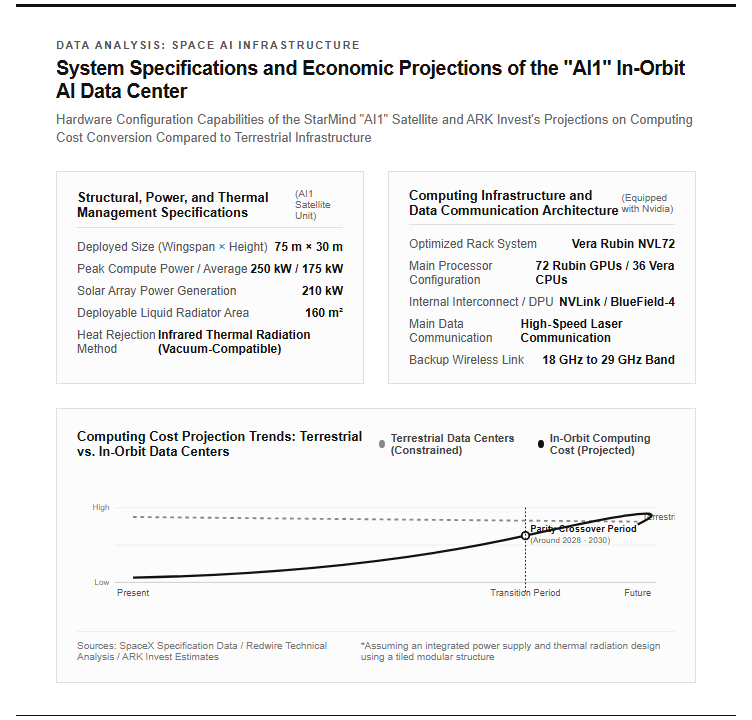
The first-generation Starmind satellite, “AI1,” currently under development by SpaceX, features an extremely massive structure and advanced semiconductor systems. Each satellite is designed to reach a wingspan of 75 meters and a height of 30 meters when deployed, delivering a peak computing power of up to 250 kilowatts (averaging 175 kilowatts) per unit. The internal computing infrastructure is optimized with Nvidia’s “Vera Rubin NVL72” rack system. This includes 72 Rubin GPUs, 36 Vera CPUs, an NVLink interconnect mechanism, and a BlueField-4 data processing unit (DPU), enabling terrestrial-grade high-performance AI processing in space. Power is supplied by a 210-kilowatt solar array per satellite, and generated heat is dissipated into space via a 160-square-meter deployable liquid radiator. For data communication, high-speed laser links are used to connect with neighboring satellites and the Starlink communication network, while 18GHz to 29GHz radio links are secured as backups. Please refer to the system configuration diagram below.
Economics and Engineering Approaches of Space AI Computing
Economics of Space Computing and the Transition from Terrestrial Data Centers
In recent years, terrestrial AI data centers have faced severe challenges regarding massive power consumption, securing cooling water, and procuring vast tracts of land, leading to local opposition and power grid strain. In contrast, utilizing Sun-synchronous orbits where satellites remain out of Earth’s shadow allows for the direct acquisition of nearly uninterrupted solar energy, offering the advantage of being completely liberated from terrestrial power grid and land constraints. According to estimates by Brett Winton and other analysts at ARK Invest, dramatic reductions in heavy-lift rocket launch costs and the mass production of satellites will make orbital computing costs equal to or lower than terrestrial data centers around 2028 to 2030, and it is projected that orbital facilities will eventually surpass terrestrial counterparts in economic efficiency. Furthermore, given the ongoing global supply shortages and soaring rental prices for AI semiconductors, it has been pointed out that the early establishment of space infrastructure could allow for a rapid return on invested capital.
Thermal Management, Power Supply Structures, and Engineering Challenges in Outer Space
While transferring computing to outer space holds significant technological potential, it also comes with unique physical and engineering hurdles. Because space is a vacuum, ground-specific heat exchange methods such as heat transfer to the atmosphere, air cooling, or water cooling cannot be used, and all generated waste heat must be dissipated solely via infrared thermal radiation. Processing data-center-grade waste heat requires a vast radiator area, making thermal transport networks and increased weight major challenges. According to a technical analysis by Redwire, adopting a “tiled modular structure” that integrates power supply, compute nodes, and thermal radiation surfaces is considered an effective approach to suppress long-distance wiring resistance losses and harness mass increases while enhancing system scalability. Additionally, practical and robust designs are required to withstand the degradation of solar cells over time caused by high-energy radiation, as well as fluctuations in thermal load driven by sunlight and Earth’s infrared radiation. Please refer to the waste heat and power supply structure model below.
Regulatory and Environmental Challenges and the Future Outlook of Space AI Infrastructure
Regulations and Objections Surrounding Debris, Environmental Pollution, and the Impact on Astronomy
The Starmind project has faced strong concerns and objections from competing companies like Amazon (Kuiper) and Viasat, as well as research institutions such as the American Astronomical Society (AAS) and the Secure World Foundation. The primary concerns include an increase in space debris and on-orbit collision risks associated with the deployment of millions of satellites, light pollution affecting astronomical observations, atmospheric emissions from frequent rocket launches, and the impact on the ozone layer caused by aluminum oxide generated when retired satellites re-enter the atmosphere. In granting this deployment authorization, the FCC determined that atmospheric emissions during launch and impacts on astronomy fall outside its regulatory authority, thereby dismissing many of the environmental objections. However, the FCC rejected SpaceX’s request for a rule waiver—which would have allowed retired satellites at altitudes of 600 kilometers or higher to be stationed in a graveyard orbit rather than re-entering the atmosphere—citing insufficient information, meaning the company must resubmit an appropriate disposal plan for future operations.
Expansion of Launch and Manufacturing Infrastructure and the Future Vision of Space AI
To mass-produce Starmind satellites, SpaceX is proceeding with the construction of a massive manufacturing facility called the “Gigasat Factory” in Bastrop, Texas. Furthermore, for solar cell procurement, the company has signed a supply agreement with Germany’s Singulus Technologies for an annual 100-gigawatt-scale heterojunction (HJT) solar cell manufacturing equipment, with production lines scheduled to begin operation in the first half of 2027. To efficiently deploy these satellite constellations into orbit, the company is establishing a launch system centered around its heavy-lift reusable rocket currently in development, “Starship,” and is planning a second spaceport in Louisiana in addition to Starbase in Texas. Space AI data centers are expected to form a synergistic ecosystem that shares data storage and AI model training and inference tasks while cooperating with ultra-large-scale compute clusters on Earth, such as Colossus.
Reference Pages
- FCC Authorization Decision Document (Memorandum Opinion and Order and Authorization)
- SpaceX Official Starmind Overview
- U.S. Government Accountability Office (GAO) Space Data Center Report
- IJFMR Academic Paper (Legal and Environmental Impacts of Space Data Centers)
[#SpaceX #FCC #SpaceDataCenter #Starmind #ArtificialIntelligence #NVIDIA #Starship #SpaceDevelopment]


コメント