Kioxia and NVIDIA have launched an AI-focused proof-of-concept experiment utilizing SSDs to expand the effective capacity of GPU memory to the 1.1-petabyte scale. The goal is to resolve HBM capacity constraints associated with the rapid surge in AI datasets and make large-scale processing more efficient at a lower cost.
- Overview of the AI Memory Expansion PoC by Kioxia and NVIDIA
- Technical Specifications of the GB200 NVL72 PoC System Achieving the 1.1 Petabyte Scale
- HBM Capacity Limits and Cost Challenges Accompanying the Growth of Generative AI
- Roles of the NVIDIA SCADA Library and Storage-Next Architecture
- Processing a 2-Trillion Vector Database and the Evolution of Next-Generation Ultra-High-Speed SSDs
- Surging Demand for Data Center NAND and Fundamental Changes in Its Role
- Key Focus Areas for Future Technological Development and Commercialization, and Ripple Effects on the Industry
Overview of the AI Memory Expansion PoC by Kioxia and NVIDIA
On November 26, 2026, Kioxia Corporation announced that it has launched a joint proof-of-concept (PoC) for AI with U.S.-based NVIDIA, utilizing solid-state drives (SSDs) to expand the effective capacity of GPU memory to the petabyte (PB) scale. This initiative aligns with NVIDIA’s promoted “Storage-Next” initiative and the dedicated software “NVIDIA SCADA.” With the recent scaling-up of generative AI models, the shortage of High Bandwidth Memory (HBM) capacity required to hold processing data has become a critical technical challenge. When processing growing datasets using HBM alone, it has been necessary to subdivide workloads and frequently transfer data to and from slower storage systems. In response, by combining Kioxia’s high-performance NVMe SSDs and NVIDIA SCADA, the companies are verifying the practicality of a system that overcomes HBM capacity constraints and allows for more efficient, low-latency referencing of large-scale datasets during AI generation. This has garnered significant attention as a groundbreaking attempt to expand the application of flash memory—traditionally centered around smartphones and PCs—to the forefront of AI data centers.
Technical Specifications of the GB200 NVL72 PoC System Achieving the 1.1 Petabyte Scale
This proof-of-concept experiment utilizes NVIDIA’s “GB200 NVL72” rack-scale system, which consists of 18 server nodes. Each node is connected to eight Kioxia “KIOXIA XD8 Series” E1.S NVMe SSDs with a capacity of 7.68TB each, bringing the total to 144 SSDs equipped across the entire system. This has built a grand resource pool reaching approximately 60TB per node and a total flash-expanded memory capacity of approximately 1.1 petabytes (PB) for the entire system. The greatest feature of this system is that it enables random access in extremely fine data units of 512 bytes. In the verification tests, testing is underway to determine whether a database consisting of approximately 2 trillion vector data points can be processed at high speed in 512-byte units across the entire system. Please refer to the configuration image below.
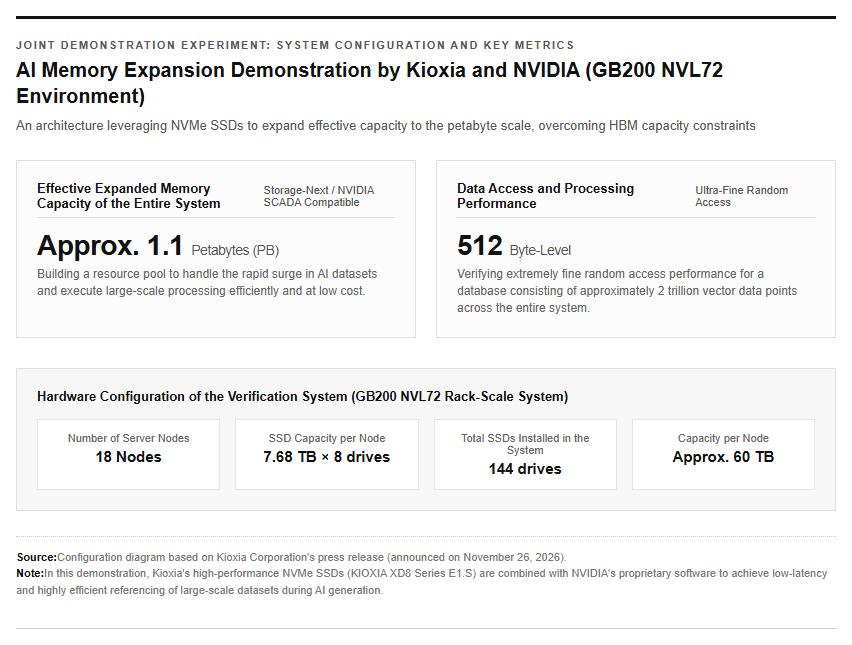
This control technology for ultra-small access units directly translates not only to vector database searches in large language models, but also to speeding up next-generation AI workloads such as Graph Neural Networks (GNNs), which handle complex data correlations.
Technical Background and Software Integration Breaking Through the HBM Capacity Wall
HBM Capacity Limits and Cost Challenges Accompanying the Growth of Generative AI
With the evolution of AI models, context lengths are expanding year by year, and the depletion of HBM (High Bandwidth Memory) capacity mounted directly on GPUs has become a performance bottleneck for systems. For example, while the unit price of the next-generation HBM4 standard is expensive at approximately $16 (approx. 2,500 yen) per gigabyte, enterprise SSDs (eSSDs) have a dramatic cost difference of 40 to 50 times, priced at approximately $0.3 to $0.4 (approx. 47 to 63 yen) per gigabyte. Keeping all infrequently accessed warm data and working memory (KV Cache) resident on expensive HBM is an extremely extreme resource allocation mistake from the perspective of a data center’s TCO (Total Cost of Ownership) and return on investment (ROI). Because KV Cache generated during long-text inference consumes massive amounts of power and GPU compute time to recalculate once lost, the importance of utilizing SSDs as a storage vault for working memory (so to speak, a token battery) has rapidly emerged.
Roles of the NVIDIA SCADA Library and Storage-Next Architecture
The core that makes this vast SSD tier function as an extension of GPU memory is NVIDIA’s software library, “NVIDIA SCADA.” SCADA physically expands the GPU’s effective memory capacity to the petabyte scale utilizing NVMe SSDs and realizes fine-grained block access. Furthermore, by applying GPUDirect Storage (GDS) technology, it has established a path for direct high-speed data transfer between SSDs and GPU memory without passing through the CPU or system DRAM. In NVIDIA’s proposed hierarchical memory architecture, the G1 tier ultra-fast HBM and G2 tier system DRAM are followed by the G2.6 Storage-Next and G3 local SSDs. Please refer to the hierarchical conceptual diagram below.
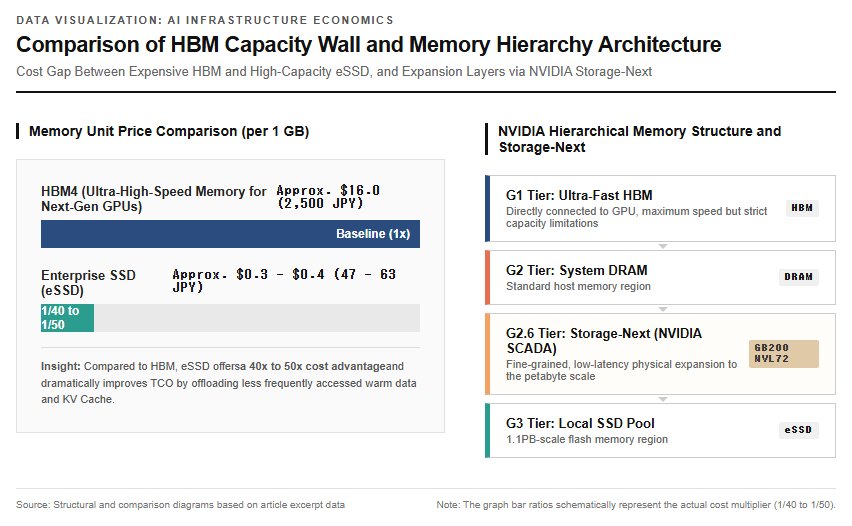
This achieves flexible memory scalability that dramatically improves the overall computational efficiency of AI servers.
Processing a 2-Trillion Vector Database and the Evolution of Next-Generation Ultra-High-Speed SSDs
Processing 2 trillion vectors, the target of this joint verification, is an essential element for improving accuracy in AI search (RAG) and real-time inference. To meet this demand, Kioxia is actively developing the “KIOXIA GP Series,” which specializes in direct-to-GPU ultra-high-speed processing, in addition to the “XD8 Series” for data centers used in this verification. The latest “GP2 Series” adopts the third-generation storage-class memory “XL-FLASH,” achieving over 18 million IOPS in 512-byte unit random read performance—approximately double that of the previous generation. The company plans to start shipping evaluation samples by the end of 2027 and aims for a maximum of 100 million IOPS in the future. By fusing the high speed of HBM with the large capacity and low cost of SSDs, petabyte-scale data processing capabilities are becoming a reality.
Impact on the Memory Market and Future Prospects for AI Storage
Surging Demand for Data Center NAND and Fundamental Changes in Its Role
Driven by the explosive increase in AI inference workloads, the demand structure of the NAND flash memory industry is facing a historical turning point. In 2026, the demand share for data center NAND will reach approximately 45%, surpassing smartphones (approximately 23%) for the first time to become the largest end market. According to Kioxia’s projections, data center NAND demand will surge at a compound annual growth rate of 34% from 286 EB in 2025 to 1,686 EB in 2031, with demand growth driven by AI inference expected to reach five times that of training applications. Once a volatile commodity, NAND flash memory has been elevated to an indispensable core component on the compute path. The fact that SSDs have changed their role from mere external storage to “AI expansion memory” underscores this shift in the demand structure.
Key Focus Areas for Future Technological Development and Commercialization, and Ripple Effects on the Industry
The progress of the joint verification by Kioxia and NVIDIA is expected to have a profound impact on future AI server designs and the competitive landscape of the semiconductor memory market. Advanced memory technologies such as 10th-generation BiCS FLASH, scheduled for sample shipments starting in the summer of 2026, and the commercialization roadmap for ultra-high-speed SSDs toward 2027 will become crucial options for data center infrastructure investment. On the other hand, there are issues that require close monitoring, such as product commercialization, performance comparisons with competitor models, and the supply-demand cycles of the NAND market. For cloud providers struggling with soaring HBM prices, whether tiered storage architectures utilizing SSDs will become a trump card that balances AI cost reduction and improved processing capacity is a matter of intense global interest, as we await future verification data and commercialization trends.
Reference Pages
- [Kioxia and NVIDIA Collaborate to Launch AI Proof of Concept to Expand Effective HBM Capacity Using SSDs] https://www.kioxia.com/ja-jp/business/news/2026/20261126-1.html
[#AI #Semiconductors #Kioxia #NVIDIA #SSD #HBM #DataCenters]
コメント