In November 2026, Alexey Fateev announced “asm-llm-os.elf,” a 24KB LLM-dedicated OS that eliminates Linux and Windows. This was driven by the growing demand to eliminate the runtime overhead of conventional OSs to the absolute limit and directly and rapidly execute large language model inference processing in local environments.
- Extreme Lightweight Design via Pure Assembly
- Blazing-Fast Boot Times and a Simple Interactive Interface
- Comparison Experiments with llama.cpp and Quantitative Performance
- Memory Access Optimization via the Utilization of 2MiB Huge Pages
- The Overall Picture and Open Sourcing of the “llm.asm” Trilogy Project
- Applicability and Challenges Facing Bare-Metal AI Infrastructure
Extreme Lightweight Design via Pure Assembly
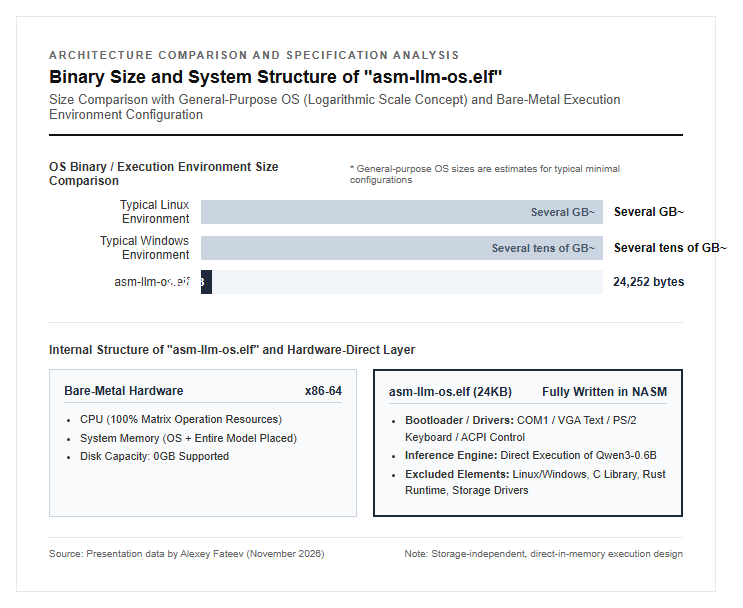
On November 26, 2026, independent developer Alexey Fateev announced “asm-llm-os.elf,” a bare-metal operating system designed to directly run the “Qwen3-0.6B” large language model. The OS’s standout feature is that it uses absolutely no existing general-purpose OSs like Linux or Windows, C libraries (libc), or Rust runtimes; all bootloaders, device drivers, and inference engines are written exclusively in x86-64 assembly language (NASM). With a binary size of just 24,252 bytes (approx. 24KB), it boasts an otherworldly smallness for a modern OS. Supported device drivers are also strictly limited to a serial port (COM1), an 80×25 character VGA text screen, a PS/2 keyboard, time measurement, and ACPI power control, with not even a storage driver included. Because it is designed to place both the OS and the model entirely in system memory for direct execution, it boots up quickly and without issue even under a virtual machine environment with 0GB of disk capacity. By eliminating the bloated code and unnecessary system call mediation inherent in conventional general-purpose OSs, a design philosophy is realized that allocates 100% of CPU resources to pure language model matrix operations. The figure below shows an overview of the lightweight architecture in a bare-metal environment.
Blazing-Fast Boot Times and a Simple Interactive Interface
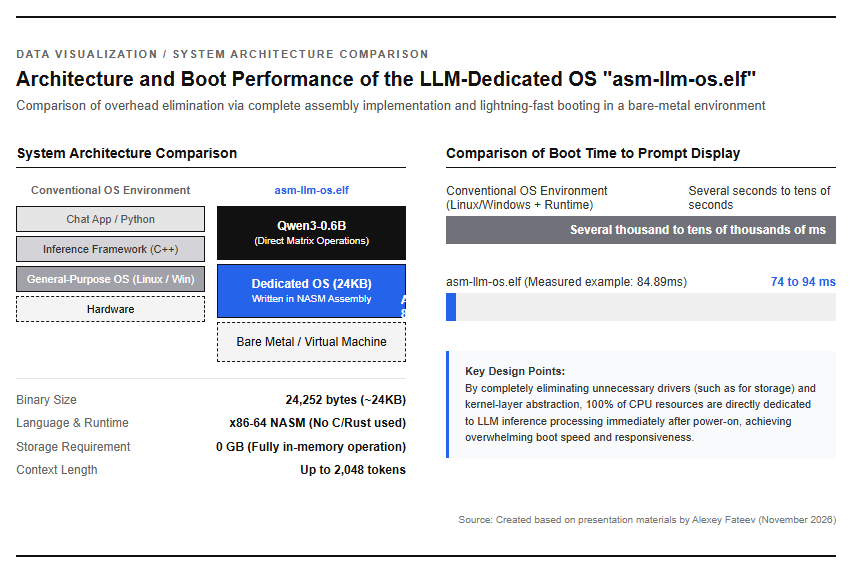
When launching an LLM in a conventional OS environment, it typically takes anywhere from several seconds to tens of seconds to boot because it has to go through numerous processes, such as OS kernel initialization, system service startup, inference framework loading, and Python or C++ runtime library loading. In contrast, with “asm-llm-os.elf,” the time from power-on or virtual machine boot to the display of the interactive prompt is a mere 74 to 94 milliseconds (with 84.89 milliseconds as a measured example). Launching a PC or a virtualization platform like Proxmox VE brings up a direct text chat screen, allowing users to immediately begin interacting with the LLM. The standard upper context length limit in this OS is set to 2,000 tokens, providing full support for multi-turn dialogues. When the conversation history approaches the token limit, the OS itself is equipped with a mechanism to automatically clear older history to manage the memory space and maintain stable operation. Despite being a completely in-memory operation with no storage, it is characterized by achieving a practical interactive environment with a minimal system configuration. The figure below shows the fast boot process and prompt response on a virtual machine.
Technical Mechanisms Enabling a 54% Speedup and Performance Comparison
Comparison Experiments with llama.cpp and Quantitative Performance
Developer Alexey Fateev conducted operation speed comparison experiments using an evaluation machine equipped with an AMD EPYC 7642 (16 cores) against “llama.cpp” (Q8_0 quantized model, CPU operation), a representative CPU inference framework running on Linux. The experimental results confirmed that “asm-llm-os.elf” recorded inference speeds significantly exceeding llama.cpp across all thread counts. The specific measurement results are as follows:
- 1-thread execution: 23.67 tokens/sec (approx. 42% faster than llama.cpp’s 16.63 tokens/sec)
- 4-thread execution: 78.89 tokens/sec (up to 54% faster than llama.cpp’s 51.08 tokens/sec)
- 8-thread execution: 118.08 tokens/sec (approx. 46% faster than llama.cpp’s 80.79 tokens/sec)
- 16-thread execution: 134.94 tokens/sec (approx. 31% faster than llama.cpp’s 103.03 tokens/sec)
It demonstrated consistently superior performance throughout multi-threaded environments as a whole, quantitatively proving that direct hardware control in a bare-metal environment has a profound effect on improving inference throughput.
Memory Access Optimization via the Utilization of 2MiB Huge Pages
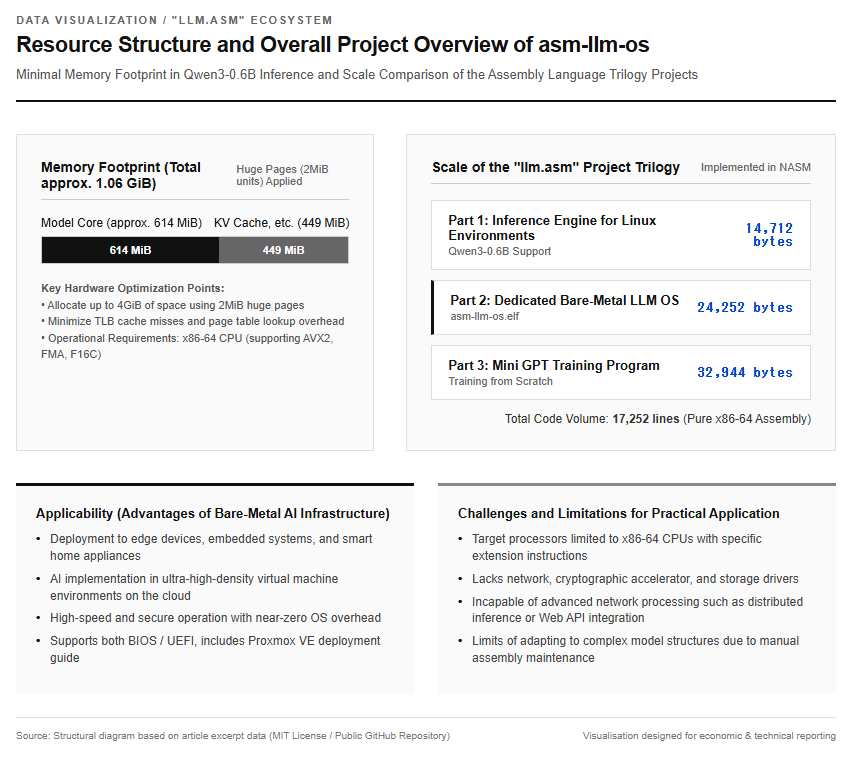
A key technical factor enabling this OS to achieve high inference performance is the comprehensive utilization of “2MiB huge pages” in memory management. Typically, general-purpose operating systems like Linux perform memory allocation using 4KiB page tables. However, when handling large-scale model data, frequent fine-grained page table lookups and TLB (Translation Lookaside Buffer) cache misses occur, creating significant overhead on the memory bus. By allocating memory spaces up to 4GiB as 2MiB huge pages, asm-llm-os minimizes the address translation processing required when loading the approximately 614MiB Qwen3-0.6B model data. As for the operating environment, an x86-64 CPU supporting the AVX2, FMA, and F16C instruction sets is required. Furthermore, in addition to the 614MiB model itself, memory usage is 449MiB for the KV cache and others, resulting in an extremely lightweight total footprint of about 1.06GiB. Optimizing memory control at the hardware level was the key to breaking through the memory access bottleneck during CPU inference.
Future Prospects and Challenges of the Assembly LLM Ecosystem
The Overall Picture and Open Sourcing of the “llm.asm” Trilogy Project
The newly introduced “asm-llm-os.elf” is not merely an isolated piece of experimental software; it is positioned as the second installment in a trilogy project called “llm.asm” developed by Fateev.
- Part 1: Qwen3-0.6B Inference Engine for Linux Environments (Size: 14,712 bytes)
- Part 2: Bare-Metal Bootable LLM-Dedicated OS “asm-llm-os.elf” (Size: 24,252 bytes)
- Part 3: Mini-GPT Training Program Built from Scratch (Size: 32,944 bytes)
Combined, the total amount of code across these three components is astoundingly compact at just 17,252 lines of pure x86-64 assembly language (NASM). The repository is freely available as open source under the MIT license on GitHub, and includes scripts for creating ISO images bootable on both BIOS and UEFI, as well as an installation guide for Proxmox VE. It has garnered significant attention from the open-source community as a minimalist implementation example completely devoid of external dependencies, serving as a model that demonstrates new possibilities for bare-metal AI infrastructure.
Applicability and Challenges Facing Bare-Metal AI Infrastructure
The emergence of an ultra-lightweight LLM-dedicated OS written in assembly opens up new paths for AI implementation in edge devices, embedded equipment, smart home appliances, and ultra-high-density virtual machine environments in the cloud. Because OS overhead is nearly zero, it becomes possible to run LLMs at high speed and securely even with limited hardware resources. However, challenges remain toward practical application. The biggest limitation is the lack of versatility and extensibility. In the current implementation, supported processors are limited to x86-64 CPUs with specific extension instructions, and since network drivers, cryptographic accelerators, and storage drivers are absent, advanced network processing such as distributed inference and Web API integration cannot be performed directly. In addition, manual maintenance of assembly code makes it difficult to keep up with changes in model structures, imposing limits on application to huge models with complex parameters. Moving forward, attention will focus on the addition of minimal necessary networking features and portability to heterogeneous architectures. The following figure summarizes the future direction of evolution for bare-metal AI infrastructure.
Reference Pages
- [llm.asm GitHub Repository] https://github.com/alesha-pro/llm.asm
[#LLM #Assembly #LocalLLM #OS #InferenceAcceleration #OpenSource]


コメント