Alconix Corporation, a specialized trading company specializing in non-ferrous metals, has decided to invest in PXP Inc., a company developing next-generation solar cells. Through this partnership, the establishment of domestic circular supply chains for critical minerals such as copper, which are essential for realizing a decarbonized society, is expected to accelerate.
- Full details of Alconix’s investment
- Use of PXP Series B Funding
- Advantages of Chalcopialite and Tandem Structures
- The value of flexibility regardless of installation location
- Long-term Management Plan 2030 and In-Depth Exploration of Winning Strategies
- The Discernment and Strength of Non-Ferrous Specialty Trading Companies in Raw Material Supply
- Domestic Circular Supply Chain Centered on Recycling Functions
- Promotion of Next-Generation Solar Cells as a National Policy
- Specific deregulation measures to accelerate adoption
- Operation and Mass Production Roadmap for Sagamihara Mother Factory
- Results of demonstration experiments expanding from EVs to infrastructure
Full details of Alconix’s investment
Alconix Ventures Inc., the corporate venture capital arm of Alconix Inc. (stock code 3036), announced on July 9, 2026, its investment in PXP Inc., a next-generation solar cell startup. PXP is a company headquartered in Sagamihara City, Kanagawa Prefecture, and is home to a world-class technical team led by President Satoru Kuriyagawa, who has world-class research and development achievements. This investment is part of Alconix’s long-term management plan 2030, which positions pioneering the next-generation energy sector as one of its top priorities.
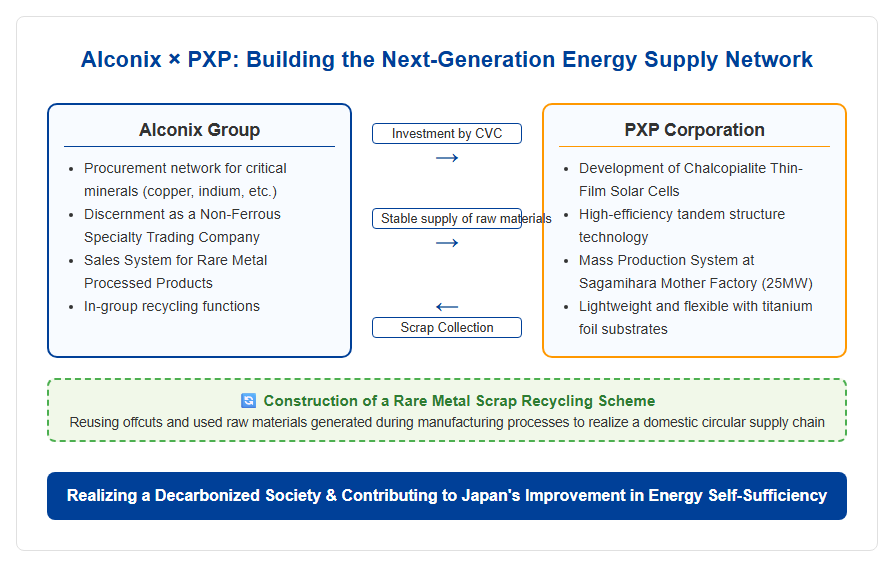
Alconix has developed a unique business model combining trading and distribution of non-ferrous metals with manufacturing and processing, establishing one of the leading domestic shares in the fields of rare metals and rare earths. On the other hand, PXP possesses thin-film solar cell technology that solves the weight and flexibility issues faced by conventional silicon-based solar cells. Through the partnership between the two companies, the fusion of Alconix’s raw material procurement capabilities and discernment with PXP’s innovative manufacturing technology is expected to create new added value that contributes to improving Japan’s energy self-sufficiency and decarbonization. Please refer to the diagram below.
Use of PXP Series B Funding
PXP announced on July 9, 2026, that it had raised a total of 1.56 billion yen in its Series B round. In this round, in addition to Alconix Ventures, leading companies representing infrastructure, finance, and industry, including its largest shareholder, SoftBank Corp., Tokyo Century Corp., and Mitsubishi UFJ Capital Corp., are among the top contenders. As a result, PXP’s cumulative equity fundraising reached approximately 3.11 billion yen.
The main purpose of the funds raised is capital investment for the company’s first mass-production factory, which is currently under construction in Sagamihara City, Kanagawa Prefecture. This mother plant is expected to have an annual production capacity of 25MW, and investments are being accelerated toward starting operations in fiscal year 2027. Additionally, PXP has secured approximately 900 million yen in long-term funds even in debt financing, and has been selected for about 2.6 billion yen in grants from government agencies and local governments, further strengthening its financial base. To ensure the market launch of next-generation solar cells, the company is preparing to rapidly advance everything from research and development to building a mass production system.
[Technological Innovation] PXP Takes on the Challenge of ‘Light, Bendable’ Solar Cells
Advantages of Chalcopialite and Tandem Structures
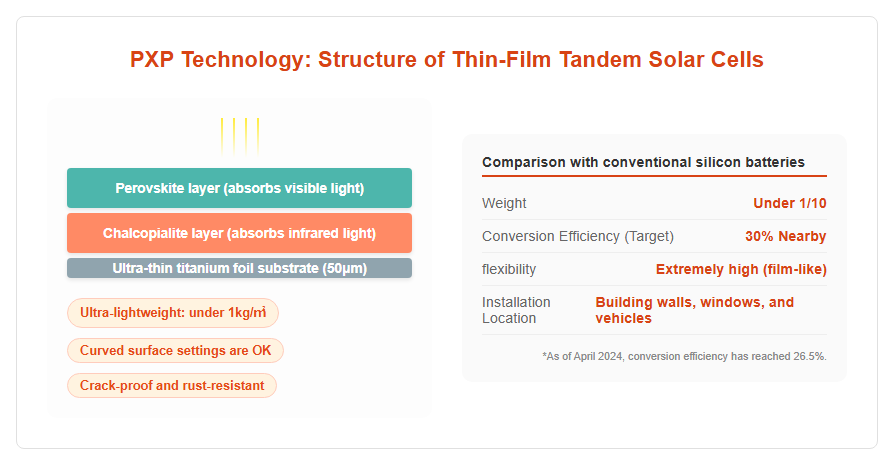
PXP’s main product is developing chalcopialite solar cells using compound semiconductors primarily made from copper (Cu), indium (In), and selenium (Se). These cells are formed on an ultra-thin titanium foil substrate just 50 microns thick, achieving an overwhelming lightweight weight of less than one-tenth (less than 1kg/square meter) compared to currently mainstream silicon-type solar cells. Additionally, titanium substrates are resistant to heat and water, resistant to rust, and resistant to tearing even when bent, eliminating the need for the “heavy cover glass” protection that was essential for conventional solar cells.
Furthermore, the company is a global leader in developing tandem solar cells that combine perovskite solar cells, which excel at visible light generation, with chalcopyrite solar cells, which excel at infrared light generation. By combining two cells with different properties, it becomes possible to efficiently convert sunlight across a wide wavelength range into electricity, aiming to achieve a conversion efficiency close to 30%, significantly surpassing conventional silicon-type conversion efficiency (about 18–22%). As of April 2024, it has already achieved a high efficiency of 26.5%, making it a rare product that combines world-class performance with lightweight design. The product image is as follows.
The value of flexibility regardless of installation location
The greatest value of PXP’s next-generation solar cells lies in their ability to transform locations that were difficult to install with conventional technologies into suitable power generation sites. Due to issues of weight and brittleness, silicon-type panels were difficult to install on vertical surfaces such as walls and windows when the load-bearing capacity of building roofs was insufficient. However, PXP’s ultra-lightweight and flexible film-type batteries can be installed on the roofs of old factories, on the rooftops of various curved facilities, or even on the exterior walls of buildings themselves.
This characteristic contributes to the expansion of renewable energy deployment, especially in urban and industrial zones. Until now, Japan’s solar power generation has relied on mountain development such as forest clearing due to the geographical constraint of limited flat land, but PXP’s technology enables the full utilization of existing building stock. Additionally, its high impact resistance and toughness to prevent breaking when stepped on make it suitable for long-term use in harsh outdoor environments. For consumers who had given up on solar power due to installation location constraints, this is expected to be an extremely feasible solution.
[Management & Strategy Background] Alconix’s Circular Supply Network
Long-term Management Plan 2030 and In-Depth Exploration of Winning Strategies
In May 2025, Alconix announced its six-year long-term management plan 2030, ending in the fiscal year ending March 2031. To achieve sustainable growth in the uncertain era known as VUCA, the company has moved away from its traditional three-year medium-term management plan and established a strategic axis from a long-term perspective. At the pinnacle of this plan lies the purpose of ‘for the future of someone out there,’ and a vision of connecting people, things, and technology.
The company’s business strategy defines three winning areas with high market growth potential: semiconductors, mobility, and next-generation energy. This investment in PXP is precisely a concrete action to enhance its presence in this next-generation energy sector. Alconix is not just offering trading functions; by integrating manufacturing capabilities and startup support through CVC, it aims to chart a new growth curve as a comprehensive solution provider for non-ferrous metals. For the fiscal year ending March 2031, we have set ambitious targets of over 15 billion yen in ordinary profit and ROIC of over 8%, and are strengthening investment in next-generation technologies as a growth engine to achieve these goals.
The Discernment and Strength of Non-Ferrous Specialty Trading Companies in Raw Material Supply
One of the key roles Alconix plays in its partnership with PXP is the stable supply of critical minerals essential for manufacturing. Mass production of chalcopyrite solar cells and perovskite solar cells requires special materials such as indium, copper, and iodine. Since spinning off from Nissho Iwai (now Sojitz), Alconix has built a global procurement network as an expert in rare metals and rare earths, possessing expertise in establishing a stable supply system that is not affected by changes in specific countries or market conditions.
Moreover, the company’s strength lies not only in its procurement capabilities but also in its ability to anticipate market trends. The global customer needs and technological trends obtained through trading company distribution functions function as the group’s strategic command center, encouraging optimization of resource allocation among manufacturing subsidiaries and investee companies. For development-oriented startups like PXP, the trading company’s extensive network and stable supply of raw materials provide a strong backing for dedicated research and development and early social implementation. By investing its own capital, Alconix demonstrates a deep commitment beyond just being a sales agent.
Domestic Circular Supply Chain Centered on Recycling Functions
In this round of investment, Alconix is particularly looking forward to building a circular economy through the recycling of scrap and end-of-life products generated during the manufacturing process. Through group companies such as Aluminum Copper Center Co., Ltd., the company is strengthening its non-ferrous metal recycling business as a key area, aiming to become Japan’s top scrap collector. In collaboration with PXP, they are considering building a recycling scheme to recover rare metal scrap generated during the manufacturing process of chalcopyrite solar cells and return them to raw materials.
Data shows that when producing materials through recycling, producing new bullion from natural resources results in about one-thirtieth of CO2 emissions for aluminum and about one-quarter of copper compared to producing new bullion. As demand for environmentally friendly green metals grows, Alconix’s recycling capabilities are becoming a source of extremely high economic value that goes beyond mere environmental contributions. By combining PXP’s next-generation solar cell clean energy technology with Alconix’s circular supply chain, the company aims to complete a sustainable business model that covers everything from raw material procurement to disposal and recycling in one go.
[Industry and Policy Tailwinds] The 7th Basic Energy Plan and Deregulation
Promotion of Next-Generation Solar Cells as a National Policy
The Japanese government is strongly promoting the social implementation of next-generation solar cells as a national policy, aiming to decarbonize and strengthen energy security. The 7th Basic Energy Plan, approved by the Cabinet in February 2025, set a goal to raise the share of solar power generation in domestic electricity generation to 23–29% by fiscal year 2040. Additionally, the introduction target for next-generation technologies, including perovskite solar cells (PSC), is set at about 20GW, making strengthening the domestic supply chain a key policy issue.
In particular, in October 2025, the then Prime Minister clearly stated in his policy speech that perovskite solar cells would be promoted as a domestically produced energy source alongside nuclear power. Against this backdrop, the Ministry of Economy, Trade and Industry is utilizing the Green Innovation Fund to provide subsidies totaling tens of billions of yen for technology development and demonstration testing. Japan is the inventor of perovskite solar cells and ranks second in the world for the production of iodine, the main raw material, and first in estimated reserves, raising expectations as one of the few cards enabling self-sufficiency in energy resources.
Specific deregulation measures to accelerate adoption
In addition to technological advancements, the review of regulations that had been barriers to adoption is also progressing rapidly. At the Regulatory Reform Promotion Conference in June 2026, the government announced a relaxation policy to support the practical use of next-generation solar cells. The main points of review are, first, the method for measuring the area of environmental facilities under the Factory Location Act. Previously, only the horizontal projected area viewed directly above was included, but for wall installations, the calculation of the vertical projected area from the front is now allowed, encouraging companies to utilize wall surfaces.
Additionally, installation standards for hazardous materials facilities such as gas stations will be relaxed. Until now, a structure that sandwiches the film with cover glass or similar materials was required as a fire countermeasure, but new safety standards are planned to be established that do not compromise the lightweight and flexible characteristics of film types. Furthermore, the design rules for BIPV have clarified the application relationship between the Building Standards Act and the Electricity Business Act, resolving confusion on site. These institutional improvements strongly support retrofitting into existing facilities targeted by PXP, as well as the introduction of power generation equipment while maintaining the building’s architectural design.
[Future Developments & Points of Interest] Path to mass production and social implementation in fiscal 2027
Operation and Mass Production Roadmap for Sagamihara Mother Factory
PXP’s most important immediate milestone is the start of operations at the mass production plant scheduled for fiscal year 2027. This mother factory, currently under construction in Sagamihara City, will have an annual production capacity of 25MW and will be responsible for the full-scale market supply of Chalcopialite solar cells. Founded in 2020, the company started with a mere 90-square-meter garage, but through joint research with Tokyo Institute of Technology, utilization of used equipment, and a small, elite autonomous development team (free-range approach), it has established mass production technology at an astonishing speed.
By 2024, the pilot line has already begun operations, and the operation of the mother plant marks a decisive step toward large-scale social implementation of these results. With mass production and further cost reduction, combined with the ability to install anywhere, the market could expand rapidly. Additionally, as a future step, mass production of tandem models combining perovskite and chalcopyrite is also being considered. The company’s development approach, which goes beyond lab-level results but aims solely to “bring practical products to market,” is expected to influence the international competitiveness of Japan’s next-generation solar cell industry.
Results of demonstration experiments expanding from EVs to infrastructure
PXP technology is already undergoing demonstration experiments in many fields and is beginning to show signs of social implementation. Particularly notable was the demonstration EV announced in January 2024. By attaching ultra-thin bendable solar cells to the roof of a kei car, it was demonstrated that it could travel about 16 km per day using only sunlight. This suggests the possibility of self-sufficiency for short-distance travel without relying on fossil fuel-derived electricity, and is expected to be a technology supporting the evolution of next-generation mobility. Here is what the demonstration EV looked like.
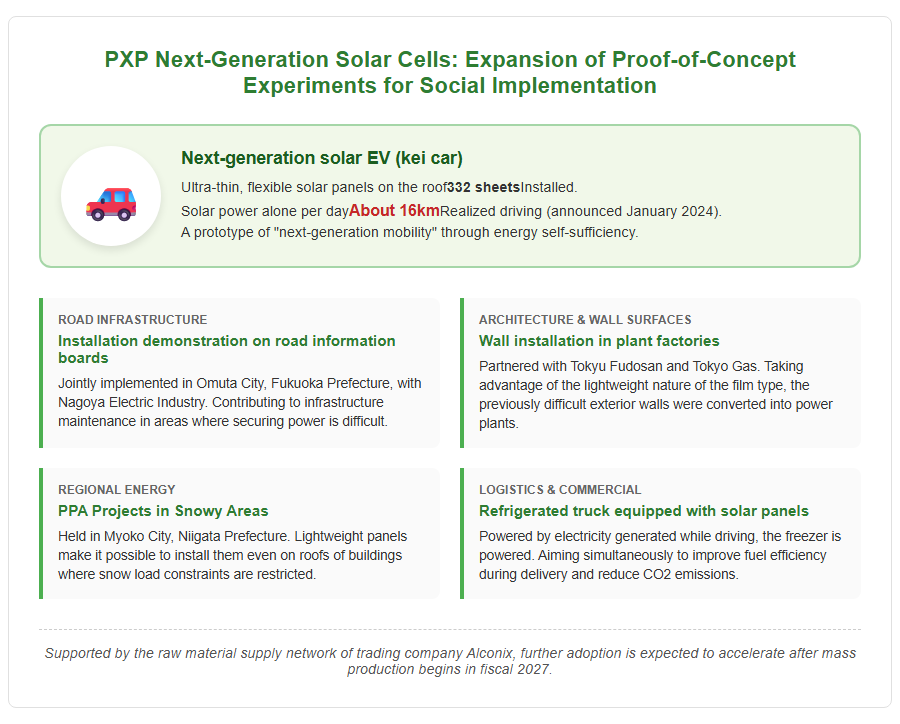
Beyond mobility, the momentum for demonstrations is accelerating as of 2026. In Omuta City, Fukuoka Prefecture, demonstration installations on road information boards have begun, and a wide range of projects are underway, including Nissan dealerships, Tokyu Fudosan’s plant factory walls, and a renewable energy power supply (PPA) project in Myoko City, Niigata Prefecture. The partnership with Alconix ensures a stable supply of raw materials for these diverse use cases and builds a solid business foundation that completes everything from manufacturing to recycling. The challenge of Alconix, which leverages the comprehensive strength of non-ferrous metals, and PXP, which shapes the next generation of light, is aiming to open new horizons for Japan’s energy industry.
[#アルコニックス #PXP #太陽電池 #ペロブスカイト #エネルギー基本計画 #脱炭素 #GX #経済]

コメント