On July 21, 2026, the State Duma of the Russian Federation passed the country’s first comprehensive bill regulating crypto assets. The underlying aim is to secure international settlement networks under prolonged economic sanctions and to keep the opaque gray market under government oversight.
- [News Focus] Russia’s first comprehensive regulatory law passes through the State Duma
- [Transformation of Market Structure] Introduction of Central Bank Supervision and Authorization
- [Impact on Consumers and Daily Life] Investment Limits and Knowledge Test for General Investors
- [Background of National Strategy] Legalization of international payments to circumvent economic sanctions
- [Future Developments & Key Points] Impact on September Implementation and Global Regulatory Trends
[News Focus] Russia’s first comprehensive regulatory law passes through the State Duma
On July 21, 2026, the Russian State Duma conducted the second and third readings of a comprehensive bill titled “On Digital Currency and Digital Rights (Bill No. 1194918-8),” which places crypto asset trading under government supervision, and passed them all at once. This law made it the first time in Russia that crypto assets were officially defined as ‘property’ under civil law.
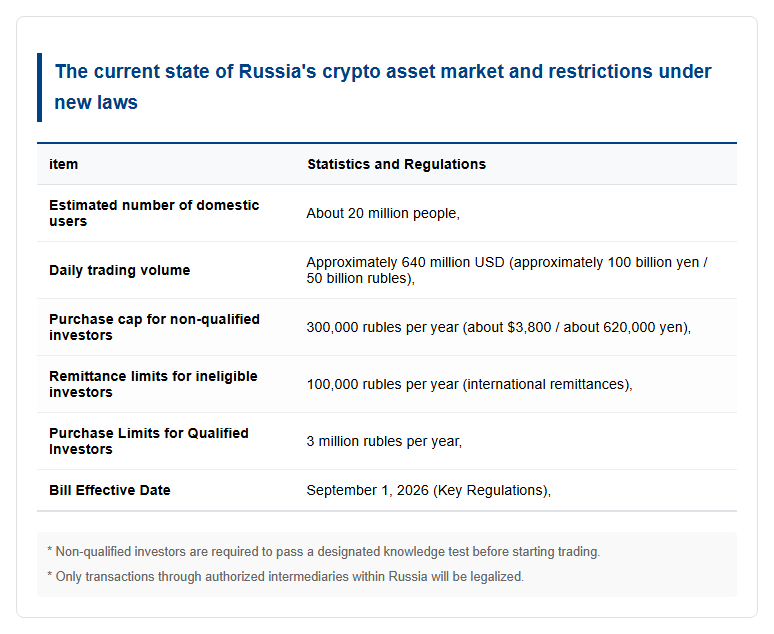
Establishing this legal status is extremely important, as holders of crypto assets will be able to obtain legal support for judicial protection in court, bankruptcy proceedings, or property division in the event of divorce. The main regulations are expected to take effect on September 1, 2026, with the Russian Central Bank acting as the primary regulator leading the authorization of market participants and the creation of whitelists for eligible tokens. The primary purpose of this law is to bring into the public framework the estimated 20 million domestic users, which had previously been in a legal gap, and the transaction activity amounting to about $640 million (about 100 billion yen) per day.
Please refer to the diagram below.
[Transformation of Market Structure] Introduction of Central Bank Supervision and Authorization
The new law requires entities involved in the crypto asset market to register in a special registry managed by the Central Bank of Russia. The regulation targets five categories: crypto asset exchanges, custodians, brokers, asset management companies, and clearing organizations. Until July 1, 2027, there is a grace period for continued operations without registration, after which transactions through licensed intermediaries within Russia will be legalized.
To strengthen oversight across the entire financial system, banks were subjected to strict obligations. Specifically, it is mandatory to refuse transfers suspected of being linked to unauthorized exchanges or foreign platforms. As a result, the Russian Central Bank intends to visualize the flow of funds and enforce thorough AML/CFT (Anti-Money Laundering and Counter-Terrorist Financing) measures. Additionally, payments for goods and services using crypto assets within the country remain prohibited, and advertising activities that encourage this remain prohibited.
Restrictions on Investors and Strategic Background
[Impact on Consumers and Daily Life] Investment Limits and Knowledge Test for General Investors
Strict restrictions have been imposed on general individual investors (non-qualified investors) to curb market overheating and reduce risks. Non-qualified investors can only purchase certain cryptocurrencies deemed highly liquid through licensed intermediaries. Specifically, Bitcoin (BTC) and Ethereum (ETH) are expected to be targeted, but the final whitelist will be decided after the law comes into effect.
The maximum amount that non-qualified investors can purchase is set at 300,000 rubles per intermediary per year (about $3,800, approximately 620,000 yen). Furthermore, before starting trading, it was mandatory to pass a special knowledge test on risk perception. On the other hand, “qualified investors” with certain assets or trading history are exempt from such annual purchase limits and are granted access to a broader range of digital assets. This two-tier system aims for authorities to balance consumer protection with market revitalization.
[Background of National Strategy] Legalization of international payments to circumvent economic sanctions
The greatest economic rationale of this bill lies in the formal recognition of crypto assets as a means of payment for foreign trade. As financial sanctions by Western countries intensify and foreign payment networks like SWIFT are being excluded, cryptocurrencies have served as an important “bypass” for Russian companies. In fact, a survey found that in 2025, trading volume of crypto assets aimed at avoiding state-led sanctions surged by 694% year-on-year, and ruble-pegged stablecoins like the A7A5 are being used for large-scale payments.
With this legislation, settlements based on trade contracts between Russian residents and non-residents, as well as the use of crypto assets obtained through mining, will be recognized as legal exceptions. The Deputy Prime Minister’s Office has also clearly stated that international cryptocurrency transactions through licensed intermediaries will be permitted. This clearly demonstrates Russia’s stance of protecting ruble sovereignty by banning everyday domestic payments, while prioritizing practical benefits in cross-border economic activities and integrating blockchain infrastructure as a strategic national payment layer.
Future Developments and Highlights
[Future Developments & Key Points] Impact on September Implementation and Global Regulatory Trends
This bill, which passed the Russian State Duma, is expected to be officially enacted within the next two weeks after approval by the Senate (Federation Council) and signed by President Vladimir Putin. The main provisions will take effect on September 1, 2026, and by July 1, 2027, the schedule is set to fully transition to a strict trading system exclusively through intermediaries. In the market, there is also a view that this bill will further enhance Bitcoin’s legitimacy and adoption, positively influencing future price forecasts.
In the international context, Russia’s move is not an isolated phenomenon. In Japan, a revised law designating crypto assets as financial products was enacted in July 2026, and in the United States, major countries are racing to establish laws, including the ‘CLARITY Bill’ being deliberated. The focus going forward will be how effectively Russia’s “controlled integration” model will function in the sanctioned economy, and how it will stimulate regulatory approaches from other countries. Furthermore, international scrutiny will inevitably intensify regarding the possibility of deepening on-chain cooperation with other sanctioned countries such as North Korea and Iran.
Reference Page
-
【TASS: Russia’s State Duma passes digital currency bill】https://tass.com/economy/2163053
-
【Chainalysis: 2025 Crypto Crime Report – Sanctions Evasion】https://www.chainalysis.com/blog/crypto-sanctions-2026/
[#ロシア #仮想通貨 #経済制裁 #国際決済 #ビットコイン #ブロックチェーン #金融規制 #経済ニュース]


コメント